• Skip to primary navigation
  • Skip to main content
  • Skip to primary navigation
  • Skip to main content
Choose which site to search.
University of Arkansas for Medical Sciences Logo University of Arkansas for Medical Sciences
Translational Research Institute
  • UAMS Health
  • Jobs
  • Giving
  • About TRI
    • What We Offer
    • Leadership & Governance
    • Staff
    • Citing Translational Research Institute CTSA Support
    • What is Translational Research?
    • Contact TRI
  • Funding Opportunities
    • Grants
      • Pilot Award Program
      • Consortium of Rural States (CORES) Multi-Institutional Pilot Award Program
      • Team Science Voucher Program
      • Winthrop P. Rockefeller Cancer Institute Rural Research Award Program
    • Scholarships
      • K12 Mentored Research Career Development Scholar Awards Program
      • Health Sciences Innovation and Entrepreneurship Postdoctoral Training Program
      • Implementation Science Scholar Program
      • (STARs) Program – Strategies for Training and Advancing Researchers
      • SMART Program [Master’s in Clinical and Translational Sciences (MS-CTS)]
    • Community
      • Community Based Participatory Research (CBPR) Scholars Program
      • Community Partners Educated as Arkansas Research Leaders (CPEARL) Program
    • Awardee Responsibilities
  • Services & Resources
    • Services
      • Biostatistics, Epidemiology and Research Design (BERD) Consultation
      • Clinical Data Repository (AR-CDR)
      • Comprehensive Informatics Resource Core
      • Mock Study Sections
      • Research Participant Recruitment
      • Research Support: Clinical Trials Innovation Unit (CTIU)
      • Implementation Science Program
      • Research Ethics Consultation
    • Resources
      • ARresearch Registry
      • Center for Health Literacy
      • Data Safety Monitoring
      • Grant Writing & Dissemination
      • UAMS Profiles
      • UAMS Rural Research Network
      • Other Resources
      • COVID-19 Research Guidelines
      • Community Partner Research Training
  • Career Development & Scholarships
    • Scholarship Opportunities
      • K12 Mentored Research Career Development Scholar Awards Program
      • Health Sciences Innovation and Entrepreneurship Postdoctoral Training Program
      • Data Science Scholars Program
      • Implementation Science Scholar Program
      • SMART Program
      • Translational Research Innovations and Partners (TRIP) Program
    • Training & Educational Opportunities
      • innOVATION Seminar Series
      • Path 2 K Program
      • Translational Workforce Development
      • Graduate Certificate in Implementation Science
      • SMART Program [Master’s in Clinical and Translational Sciences (MS-CTS)]
      • Good Clinical Practice Training
    • Didactic Training
  • Community
    • Community Engagement Leadership
    • Community Advisory Board
    • Community Engagement Partners
      • Community Partner Celebration
      • Faith-Academic Initiatives for Transforming Health (FAITH) Network
    • Community Engagement Services
      • Consultations and Technical Assistance
      • Community Review Boards
      • Community Partner Research Training
      • Equipment Library
    • Programs and Funding
      • Community Partners Educated as Arkansas Research Leaders (CPEARL) Program
      • Community Based Participatory Research (CBPR) Scholars Program
      • Community Scientist Academy
    • Toolkits
      • CSA Online Toolkit
      • CPEARL Toolkit
  • Events
    • Research Day
    • Clinical Trials Learning Collaborative
  • Newsroom
  1. University of Arkansas for Medical Sciences
  2. Translational Research Institute
  3. News
  4. Page 26

News

TRI Open House ‘Eye-Opening’ for Researchers

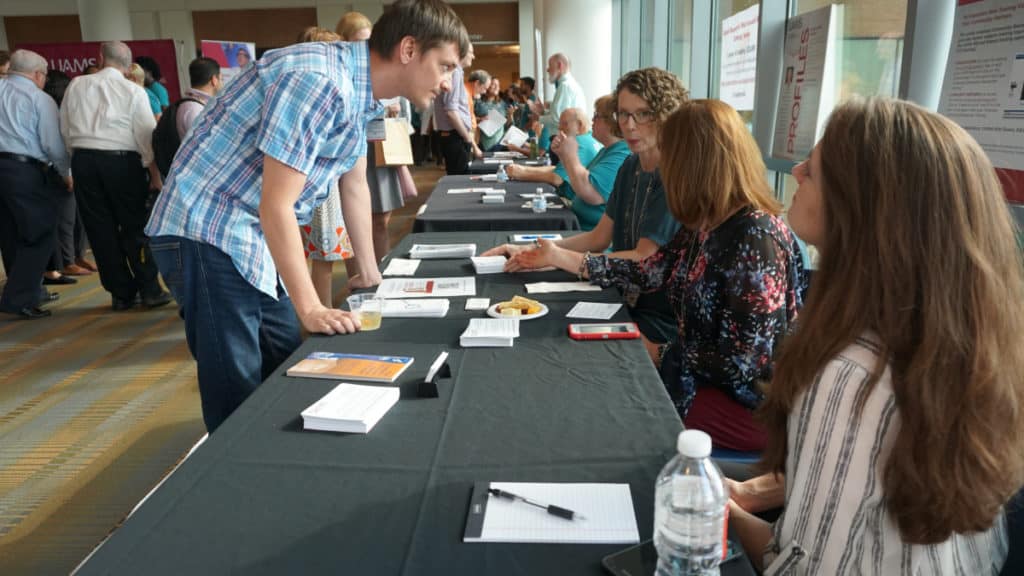
Oleg Karaduta, M.D., visits the information booths at TRI's Open House.
Oleg Karaduta, M.D., visits the Office of Research Compliance booth at TRI’s Open House.

Oleg Karaduta, M.D., made the rounds at TRI’s recent Open House, loading his bag with information cards, brochures and flyers from the 26 research services being promoted. While many are relevant to his work, the Mock Study Section/Grant Review program really caught his eye.

“I am planning to submit a grant application in a couple of months, so the Mock Study Section will be really useful for me,” said Karaduta, a post-doctoral fellow, referring to his NIH R00 Pathway to Independence application.

TRI’s Mock Study Section/Grant Review program assembles experienced NIH-funded researchers to review applications at no cost.

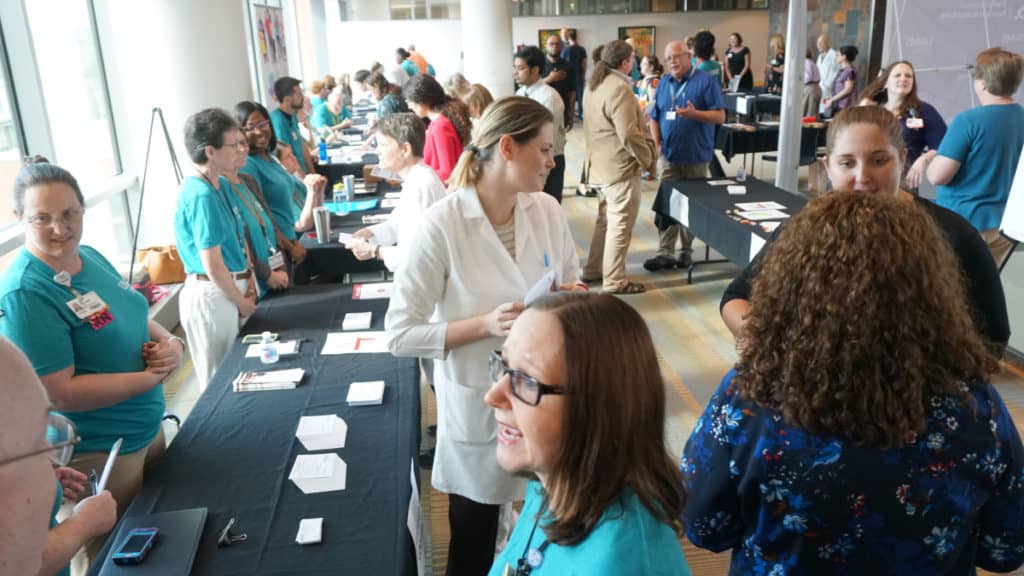
The Aug. 28 Open House, held for a second year, this time included representatives from the Central Arkansas Veterans Healthcare System, Arkansas Children’s Research Institute, UAMS IRB and Research Pharmacy.

Among the nearly 100 attendees was Jonathan Laryea, M.D., associate professor in the Department of Surgery.   “I know about some of the services, but having everything together in one place is very helpful,” Laryea said. “I think it’s eye opening.”

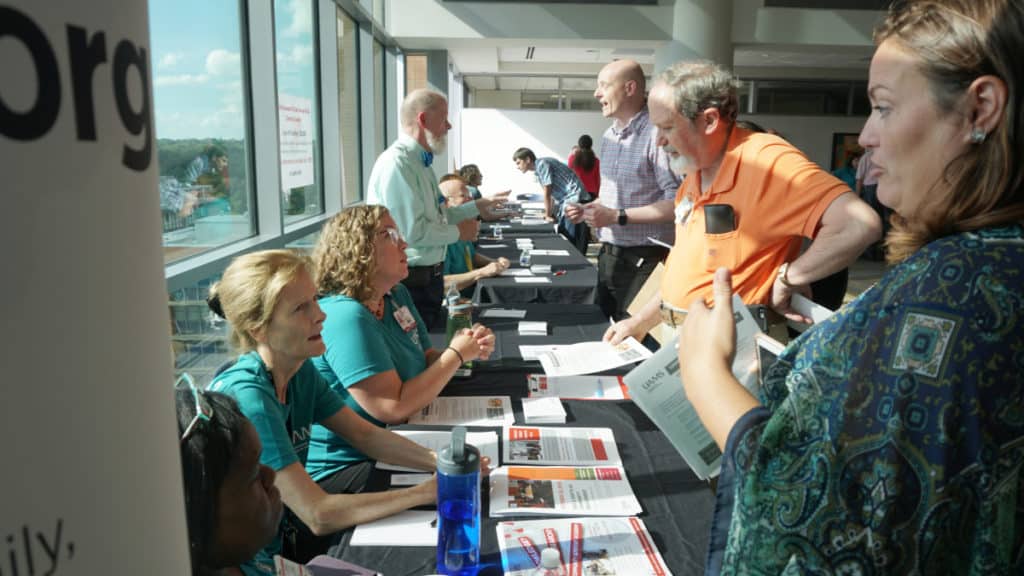
Kate Stewart, M.D., (left) and Rachel Hale, representing TRI's Community Engagement component, talk to visitors during the Open House.
Kate Stewart, M.D., (left) and Rachel Hale, representing TRI’s Community Engagement component, talk to visitors during the Open House.

Leah Dawson, Ph.D., said in an email she was familiar with TRI but didn’t fully appreciate its scope until the Open House.

“Visually it provided a picture of how far reaching TRI is on our campus by the sheer number of people and departments that were involved,” said Dawson, associate director of Clinical Trials at the Data Coordinating and Operations Center of the IDeA States Pediatric Network, UAMS College of Medicine. “I think TRI provides a common atmosphere for researchers to come together, which only betters the university and the research programs on campus.”

Dawson said she made it a point to talk to TRI’s Community Engagement Team to catch up on their activities. “I think they are a great asset to our university system and state,” she said.

Two breast cancer fellows, Sherry Johnson, D.O., and Michalina (Michelle) Kupsik, M.D., said the timing for the Open House couldn’t have been better. They were due to report on their research project plans the day after the Open House but still needed key information.

Helpful guidance came from the Arkansas Clinical Data Repository table with information about accessing de-identified UAMS clinical data. “We knew our clinical question but we didn’t know how we were going to get the data,” Kupsik said.

Michalina (Michelle) Kupsik, M.D., (center, white coat), and Sherry Johnson, D.O., (right) found the Open House to be helpful and timely.

“Now we know!” Johnson said.

Filed Under: News, Newsroom Tagged With: Jonathan Laryea, Oleg Karaduta, Translational Research Institute, TRI, UAMS, University of Arkansas for Medical Sciences

TRI Implementation Science Visiting Lecturer

Anne Sales, Ph.D., R.N., from the University of Michigan, will present “Frameworks to Strategies: Designing Implementation Interventions” on Thursday, Sept. 27, 12:30 – 1:30 p.m., Rahn Building, 8/240.

She will discuss current issues in implementation science, including types and uses of implementation research frameworks, strategies, and interventions. She will discuss how these can be used in conducting implementation research studies.

The lecture at UAMS will be available via interactive video network at the UAMS Northwest Campus, second floor conference room, H07, and Arkansas Children’s Research Institute, Room R3026-1.


View flyer.

Filed Under: Front, News, Newsroom Tagged With: Anne Sales, Implementation Science, Translational Research Institute, UAMS

September TRIbune

In this issue of The TRIbune, we highlight the work of Dr. Prasad Padala, M.D., whose TRI pilot award helped him acquire a $1.1 million VA grant. Padala is conducting an exciting study using magnetic stimulation of the brain (rTMS) to help delay the onset of dementia.

TRI Director Laura James, M.D., reminds researchers of the newest pilot opportunity for opioid addiction and pain management research. The call for applications was issued Monday (see announcement below).

We had a great turnout for our second Open House and have included the comments of a few attendees. We also highlight a study by Erika Petersen, M.D., of a spinal cord stimulation device to treat neuropathic pain. And as always, we include the publication citations of studies that have utilized TRI services or support.

Read The TRIbune.

Filed Under: Front, News, Newsroom Tagged With: Padala, Translational Research Institute, TRIbune, UAMS

Call for Pilot Awards to Address Opioid Addiction and Pain Management

Researchers are encouraged to apply for pilot study awards being offered for opioid addiction and pain management research. Funded by UAMS, one-year awards of $25,000 will be available for studies that can produce data to support applications for larger extramural awards. Letters of intent (LOI) are due Oct. 8, 2018, by noon. View the Letter of Intent cover page.

Multidisciplinary teams will be given priority.  Any UAMS faculty, including at Arkansas Children’s Hospital and Research Institute, and the Central Arkansas Veterans Healthcare System, are invited to apply. View the Request for Applications (RFA) LOI document.  

Frequently Asked Questions

Contact: Nia Indelicato, NLIndelicato@uams.edu, or 501-526-0363.

Key Dates:

  • RFA released: Sept 10
  • Letter of Intent due: Oct. 8, by noon
  • Full applications invited: Oct. 12
  • TRI/Biostatistics consultations: Oct. 15 – 26
  • Proof of IRB submission due: Oct. 29, by noon (include in application)
  • Application due: Oct. 29, by noon
  • Videos due: Nov. 5 
  • Awardees announcement: Dec. 10 
  • Start date: Jan. 1, 2019

Filed Under: Front, News, Newsroom Tagged With: Arkansas Children's, Central Arkansas Veterans Healthcare System, opioids, pilot awards, research, RFA, Translational Research Institute, UAMS, VA

UAMS Employees, It’s Time to Nominate Your Community Partners!

UAMS faculty and staff, here’s your chance to have UAMS recognize the work of your community partners! The Translational Research Institute (TRI) will host its sixth annual UAMS Community Partner Celebration on Nov. 16, 2018. This celebration recognizes the outstanding community partners that have helped make our various endeavors possible, whether it involves research, education and training, or services. The deadline for nominations is Friday, Oct. 5, 2018. 

Please click the corresponding link(s) below to nominate your community partner!

The categories are:

  • Community Partnership Student Award: Recognizes an undergraduate student, graduate/medical student, resident, or fellow who demonstrate initiative, commitment, and passion in an academic-community partnership project aimed at improving the health of children, adults and/or communities.
  • Institutional Health Partner Award: Recognizes an institutional partner (non-community based organization) that has provided invaluable expertise, guidance, and/or support to you on various projects.
  • Community-Based Organization of the Year Award: Recognizes a community-based organization that has provided invaluable expertise, guidance, and/or support to you on a project.
  • Community Advisory Board of the Year Award: Recognizes a community advisory board that has provided invaluable expertise, guidance, and/or support to you on a project.
  • Chancellor’s Community Research Partner Award: Recognizes an outstanding community-based organization that has participated in health research.

Click the corresponding link(s) above to nominate your community partner.

Eligibility Criteria:

  • Submit outstanding community based organizations (CBOs), community advisory boards (CABs), students and institutional partners that have provided invaluable expertise, guidance, and/or support to you on various projects. Patient advisory boards and councils will also be accepted.
  • Nonprofit CBOs that work with “groups of people affiliated by geographic proximity, special interest, or similar situations to address the well-being of those communities” will be recognized at this event.
  • CABs consist of community representatives who advise institutional representatives on issues that affect the public.
  • Institutional partners are defined as non-community based organizations such as state agencies, foundations, and other private organizations.

Only individuals from UAMS, ACH/ACHRI, and the VA are eligible to submit organizations for recognition.

How this works:

  • Submit you nomination by the submission deadline via the REDCap link above. Please contact the TRI CE team with any questions or if you need technical assistance.
  • Award nominees will be reviewed by impartial 3rd party reviewers.
  • Award winner will be recognized and announced at the Community Partner Celebration on November 16, 2018.
  • Additionally, the CE team will contact all nominees to invite them to the celebration and solicit pictures for of their organization that will be featured at the celebration.
  • Individuals may submit multiple nominees and for multiple categories.

Submissions are due October 5, 2018.

For more information contact Rachel Hale at rbhale@uams.edu, 501-526-6628.

Filed Under: Front, News, Newsroom Tagged With: Celebration, community partners, Translational Research Institute, UAMS

Seeking Five Years of Funding, TRI Submits Application to NCATS

One year of bridge funding was great news last year for the Translational Research Institute (TRI), but it set the stage for a big challenge.

While the September 2017 Clinical and Translational Science Award (CTSA) allowed TRI time to strengthen its next application for five years of funding, it meant producing a fourth CTSA application in four years, a mammoth undertaking for TRI Director Laura James, M.D., and numerous faculty and TRI staff.

Work on the application began almost immediately after the bridge award was announced, said James, also UAMS associate vice chancellor for clinical and translational science.

“We dedicated ourselves to the application, but we also remained committed to our ongoing initiatives and innovative plans in collaboration with research leaders across our hub [UAMS, Arkansas Children’s Hospital (ACH), Arkansas Children’s Research Institute (ACRI), and Central Arkansas Veterans Healthcare System (CAVHS)],” she said.

1,864 Pages

“Until you’ve been in the middle of this type of grant application, it’s hard to understand the amount of work involved in weaving together a consistent and compelling story that clearly explains the incredible progress achieved at UAMS since our first CTSA grant in 2009, as well as the exciting vision we have for the future,” James said.

The latest journey concluded on May 24, 2018, when James and 32 other UAMS faculty submitted the 1,864-page document to the NIH National Center for Advancing Translational Sciences (NCATS). TRI is seeking five years of funding – $26.1 million – in an application with three funding components: the main component, an Institutional Career Development Core (KL2 Program) and National Research Service Award Training Core (the Health Sciences Innovation and Entrepreneurship Training Program).

The application describes numerous core strengths at UAMS and how various research champions at UAMS, ACH, and CAVHS will work as a team to enhance the health of Arkansans through transformative research.

Challenges and Opportunities

TRI’s strategy for the application was to craft a story that reflected the unique challenges and opportunities in Arkansas.

“Our clinical and education footprint around the state is very strong, as reflected by the numerous outreach clinics and expansive telemedicine program,” she said.

The application emphasizes plans for not just strengthening UAMS’ research footprint, but also for addressing the needs of Arkansas’ underrepresented communities.

“For our research to be relevant for Arkansans, it really needs to engage those who traditionally have not been in the center of clinical and translational research,” James said. “It needs to align with the health care needs of special populations, including children and older adults, as well as underrepresented minorities, and individuals with low health literacy.”

The quality partnerships that TRI has developed with other CTSA sites over the last four years strengthens the application. “We have partnerships that are centered on research itself, as well as partnerships that address research processes, such as grant reviews, or that are building off our successes in engaging community members to help us with decision-making,” James said.

Washington Delegation

UAMS and TRI leaders were buoyed by the May 7 visit from a delegation that included NCATS Director Christopher Austin, M.D., staff from U.S. Sen. John Boozman’s office and the Senate Health and Human Services (HHS) Appropriations Subcommittee.

The day began with welcomes from James and Donald R. Bobbitt, Ph.D., president of the University of Arkansas System, followed by 17 faculty and a community representative giving brief presentations highlighting individual scientific programs and/or TRI programs. Faculty from informatics, pharmacy, public health, pediatrics, psychiatry, family and preventive medicine, pharmacology and toxicology, biochemistry, and internal medicine gave presentations, as did research leaders from ACRI and CAVHS. The day concluded with a small-group discussion that included new UAMS Chancellor Cam Patterson, M.D., MBA, and Lawrence Cornett, Ph.D., UAMS vice chancellor for research.

Congressional staff attending were:

  • Laura Friedel, staff director/clerk, HHS Appropriations Subcommittee, U.S. Senate Committee on Appropriations
  • Mackensie Burt, Legislative Director, Office of U.S. Senator John Boozman

NCATS representatives attending with Austin were:

  • Adrienne Hallett, associate director, Office of Legislative Policy and Analysis, NIH
  • Pamela McInnes, D.D.S., M.Sc., deputy director, NCATS, NIH
  • Michael Kurilla, M.D., Ph.D., director, Clinical Innovation, NCATS, NIH
  • Mary Purucker, M.D., Ph.D., director, CTSA Program Hubs, Clinical Innovation Division, NCATS, NIH
  • Samantha Jonson, MPS, special assistant to the director, NCATS, NIH

“We were encouraged with the nature of the questions from NCATS as well as their comments about our programs,” James said. “It was clear that we are on the right path.”

While “third time’s a charm” is the best known maxim, James said she would be happy to make it “four’s a charm” for this CTSA application.

“I feel confident that we’ve delivered a competitive application,” she said.

Filed Under: News Tagged With: CTSA, Laura James, NCATS, TRI, UAMS, University of Arkansas for Medical Sciences

May-June TRIbune

This issue of The TRIbune features the Translational Research Institute’s (TRI) recent submission of its 1,864-page Clinical and Translational Science Award (CTSA) application. After receiving a one-year bridge award last year, TRI submitted its application to the NIH National Center for Advancing Translational Sciences (NCATS) on May 24 for five years of funding.

As TRI Director Laura James, M.D., notes, while there are no guarantees, she believes TRI has submitted a competitive application. A May 7 visit from NCATS leaders and congressional staff affirmed that TRI is headed in the right direction. We also highlight some key numbers related to the application, and our TRI & Me features TRI Associate Director John Arthur, M.D., Ph.D. We also include the latest publication citations by researchers whose work has benefited from TRI resources or funding.

Filed Under: Front, News, Newsroom Tagged With: NCATS, newsletter, NIH, Translational Research Institute, TRI, TRIbune, UAMS

New Pilot Awards Available for CTSA Inter-institutional Studies

The Western States Consortium, which includes the UAMS Translational Research Institute (TRI) and four other Clinical and Translational Science Award (CTSA) institutions, has issued the call to all faculty for pilot award applications.

The purpose of the pilot awards is to promote inter-institutional collaboration by funding innovative, translational research projects that involve two or more of the four Western States Consortium members. Awards of up to $25,000 will be provided by each participating institution.

In addition to TRI, the Western States Consortium members are the University of Kentucky, University of New Mexico, University of Kansas Medical Center, and University of Utah, all part of the national CTSA consortium supported by the National Center for Advancing Translational Sciences (NCATS) at the National Institutes of Health (NIH).

Applications are due August 10, 2018, at 5 p.m. (CT). Each proposal’s lead principal investigator will submit one combined proposal via an online application system.

For additional details, view the Request for Applications (RFA) document.

If you have any questions, please contact Nia Indelicato at NLIndelicato@uams.edu or 501-614-2287.

Key Dates:

  • Application Release Date: June 15, 2018
  • IRB Submission Deadline: July 13, 2018
  • Application Deadline: Aug. 10, 2018, 5 p.m. Central Time
  • Notice of intent to fund at each CTSA: Aug. 24, 2018
  • Just-In-Time Period: Aug. 24, 2018 – Aug. 31, 2018
  • Submission to NIH for Prior Approval of Human Subjects: Sept. 21, 2018
  • Funding Cycle: Nov. 1, 2018, through Oct. 31, 2019

Filed Under: Front, News, Newsroom Tagged With: pilot, request for applications, RFA, Translational Research Institute, TRI, UAMS, University of Arkansas for Medical Sciences, Western States Consortium

New Course for Research Community Partners Replaces CITI Training

A new human subjects training video is now available for community members working in partnership with UAMS faculty researchers.

The online Arkansas Community Researcher Training (ArCRT) is a community-friendly course that was produced as an alternative to CITI training. Human subjects training is required by the UAMS IRB and federal research funding agencies.

The UAMS Translational Research Institute and Office of Research Compliance worked with a community focus group to create the course.

“We took an existing face-to-face community partner training program and modified it for this online learning tool that can be used throughout the state,” said TRI Executive Director Amy Jo Jenkins. “We also added some local flavor with eight research staff from TRI, the Compliance Office and the Myeloma Institute conducting the training. It was a lot of fun!”

UAMS Communications and Marketing produced the videos, while the final product, including the instructors’ narrations and avatars were produced by the UAMS Office of Educational Development.

Researchers can view the training via UAMS Blackboard. Sign in with your UAMS login and click on “My Communities.” In the search field, type “Arkansas Community Researcher Training.”

Community partners can access the training at uams.gosignmeup.com.

Click on “Create Account” and fill out the form. In the search field, type “Arkansas Community Researcher Training.”

[button text=”View Illustrated Instructions” url=”https://tri.uams.edu/wp-content/uploads/sites/80/2018/06/ArCRT_Registration_Instructions.pdf” target=”_blank” type=”btn-play” /]

For questions or assistance, contact Kim Givens, KGivens@uams.edu, 501-686-6879.

ArCRT was funded in part by TRI and its Clinical and Translational Science Award from the NIH National Center for Advancing Translational Sciences.

Filed Under: Front, News, Newsroom

UAMS Clinical Trials Day Punctuated by Success Stories

In May 2006, Harold “Hap” Peterson was advised to get his affairs in order by UAMS cancer specialist Laura Hutchins, M.D. He had late-stage melanoma, a type of skin cancer, with tumors spreading throughout his body.

He was shocked to hear he had only three to six months to live. “I said, ‘I don’t feel sick at all,’” he recalled while attending the May 21 UAMS Clinical Trials Day celebration.

Patients and other visitors to the Cancer Institute were treated to snacks and punch as part of the UAMS Clinical Trials Day celebration.

In addition to radiation treatments, Hutchins, a hematologist oncologist and associate director of clinical research at the UAMS Winthrop P. Rockefeller Cancer Institute, prescribed Dacarbazine, a chemotherapy medication. It worked, but for just two years. There were no other approved medications available to help him. Hutchins suggested a compassionate use clinical trial that was testing an experimental melanoma drug called Ipilimumab.

He jumped at the chance, and it saved his life.

After about five years on the drug, he was cured.

“If I could speak to people who are questioning whether to go on a clinical trial, I would just be thrilled to tell them about my experience,” said Peterson, of Hot Springs Village.

Ipilimumab was approved by the U.S. Food and Drug Administration in 2011.

“There was no cure for this, and I’m sitting here 12 years later,” the retired airline pilot said. “I play golf four times a week, I travel, I do anything I want to do – I feel like a 21-year-old.”

A clinical trial is medical research that requires the participation of people. Clinical trials study such things as new medications, medical devices (such as a knee replacement), and even diets, to find out if they are safe and effective. Many clinical trials test new treatments to learn if they are more effective and/or have less harmful side effects than the standard treatment.

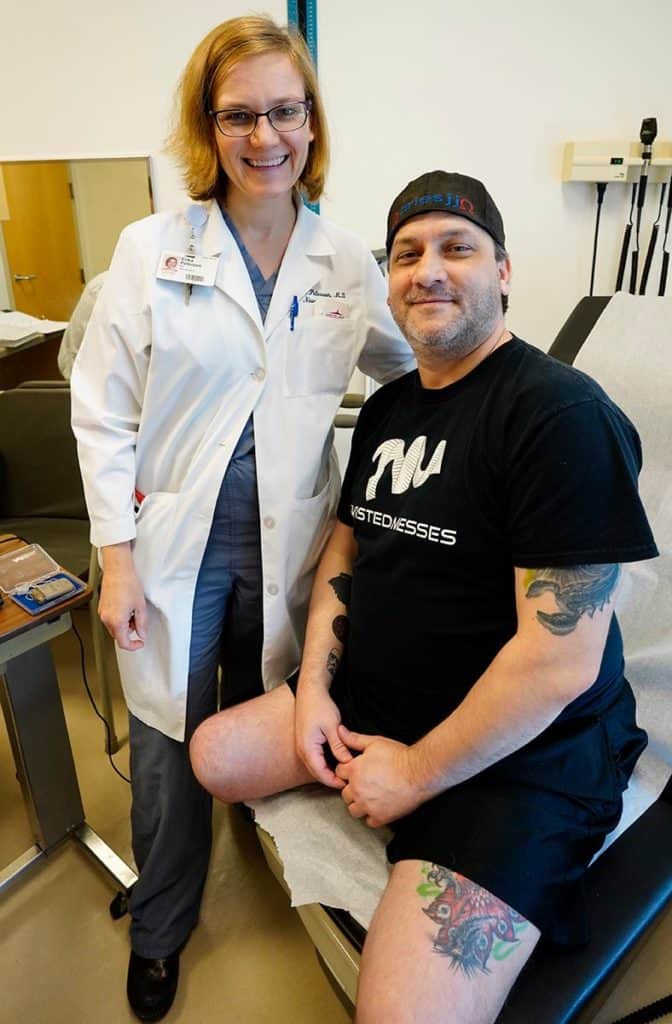
Homer Paul recently completed participation in a Parkinson’s disease clinical trial at the Translational Research Institute.

Another clinical trial participant at UAMS Clinical Trials Day, Homer Paul of Conway, recently helped test an experimental Parkinson’s disease drug. Existing drugs have helped Paul manage his disease, and agreed to volunteer to participate in the study testing an extended-release drug. The trial required him to spend 12 hours at a time for multiple blood draws and neurological tests at the UAMS Translational Research Institute.

During one visit, a fire alarm required evacuation of the building. Only two hours into his regimen, the study team walked Paul outside and found a secluded spot nearby to continue his neurological and blood tests until they were allowed back inside.

“They were pretty adamant about getting blood samples exactly on time,” he said. “It was kind of funny because I thought, ‘these nurses are relentless.’ I started calling them the A-Team.”

While Paul has managed his condition with existing drugs over the last 10 years, he said the extended release drug could help even out the highs and lows of today’s medications.

“I’m glad to be a part of it,” he said. “It’s my way to contribute to the cause and to the cure. At the end of the day, you want the quality of life for people to improve.”

Clinical Trials Day is celebrated around the world on or near May 20 each year in memory of the first randomized clinical trial, May 20, 1747, which discovered that citrus fruit could prevent scurvy in sailors.

“Clinical trials not only look at new drugs but also help pave the way toward examining new sensitive methods for determining patients’ response to treatment,” said Faith Davies, M.D., deputy director of the UAMS Myeloma Institute and director of the Phase I Clinical Trials Program for the Cancer Institute and Myeloma Institute. “Bringing new drugs which attack the cancer cells in different ways to our patients is really important and will hopefully improve response and survival rates and decrease side effects.”

“Clinical trials are an important foundation of biomedical research, advancing medicine and saving untold lives with the development of treatments that so many of us take for granted,” said Laura James, M.D., director of the UAMS Translational Research Institute and associate vice chancellor for clinical and translational research. “Clinical Trials Day honors the work of the professionals who develop and conduct clinical trials and all individuals who have previously participated in clinical trials. Their past participation made it possible for current patients to benefit from new innovations to advance health outcomes.”

The Clinical Trials Day celebration was sponsored by UAMS’ Translational Research Institute, Winthrop P. Rockefeller Cancer Institute, Myeloma Institute and Research Compliance Office.

Filed Under: Front, News, Newsroom

  • «Previous Page
  • Page 1
  • Interim pages omitted …
  • Page 24
  • Page 25
  • Page 26
  • Page 27
  • Page 28
  • Interim pages omitted …
  • Page 48
  • Next Page»
Translational Research Institute LogoTranslational Research InstituteTranslational Research Institute
Mailing Address: 4301 West Markham Street, Little Rock, AR 72205
Phone: (501) 686-7000
  • Facebook
  • X
  • Instagram
  • YouTube
  • LinkedIn
  • Pinterest
  • Disclaimer
  • Terms of Use
  • Privacy Statement
  • Legal Notices

© 2026 University of Arkansas for Medical Sciences