• Skip to primary navigation
  • Skip to main content
  • Skip to primary navigation
  • Skip to main content
Choose which site to search.
University of Arkansas for Medical Sciences Logo University of Arkansas for Medical Sciences
Translational Research Institute
  • UAMS Health
  • Jobs
  • Giving
  • About TRI
    • What We Offer
    • Leadership & Governance
    • Staff
    • Cite TRI
    • What is Translational Research?
    • Contact TRI
  • Funding Opportunities
    • Grants
      • Pilot Award Program
      • Consortium of Rural States (CORES) Multi-Institutional Pilot Award Program
      • Team Science Voucher Program
      • Winthrop P. Rockefeller Cancer Institute Rural Research Award Program
    • Scholarships
      • K12 Mentored Research Career Development Scholar Awards Program
      • HSIE (T32) Training Program
      • Implementation Science Scholar Program
      • (STARs) Program – Strategies for Training and Advancing Researchers
      • SMART Program [Master’s in Clinical and Translational Sciences (MS-CTS)]
    • Community
      • Community Based Participatory Research (CBPR) Scholars Program
      • Community Partners Educated as Arkansas Research Leaders (CPEARL) Program
    • Awardee Responsibilities
  • Services & Resources
    • Services
      • Biostatistics, Epidemiology and Research Design (BERD) Consultation
      • Clinical Data Repository (AR-CDR)
      • Comprehensive Informatics Resource Core (CIRC)
      • Mock Study Sections
      • Research Participant Recruitment
      • Research Support: Clinical Trials Innovation Unit (CTIU)
      • Implementation Science Program
      • Research Ethics Consultation
    • Resources
      • ARresearch Registry
      • Center for Health Literacy
      • Data Safety Monitoring
      • Grant Writing & Dissemination
      • UAMS Profiles
      • UAMS Rural Research Network
      • Other Resources
      • COVID-19 Research Guidelines
      • Community Partner Research Training
  • Career Development & Scholarships
    • Scholarship Opportunities
      • K12 Mentored Research Career Development Scholar Awards Program
      • HSIE (T32) Training Program
      • Data Science Scholars Program
      • Implementation Science Scholar Program
      • SMART Program
      • Translational Research Innovations and Partners (TRIP) Program
    • Training & Educational Opportunities
      • innOVATION Seminar Series
      • Path 2 K Program
      • Translational Workforce Development
      • Graduate Certificate in Implementation Science
      • SMART Program [Master’s in Clinical and Translational Sciences (MS-CTS)]
      • Good Clinical Practice Training
    • Didactic Training
  • Community
    • Community Engagement Leadership
    • Community Advisory Board
    • Community Engagement Partners
      • Community Partner Celebration
      • Faith-Academic Initiatives for Transforming Health (FAITH) Network
    • Community Engagement Services
      • Consultations and Technical Assistance
      • Community Review Boards
      • Community Partner Research Training
      • Equipment Library
    • Programs and Funding
      • Community Partners Educated as Arkansas Research Leaders (CPEARL) Program
      • Community Based Participatory Research (CBPR) Scholars Program
      • Community Scientist Academy
    • Toolkits
      • CSA Online Toolkit
      • CPEARL Toolkit
  • Events
    • Research Day
    • Clinical Trials Learning Collaborative
  • Newsroom
  1. University of Arkansas for Medical Sciences
  2. Translational Research Institute
  3. digital health

digital health

First UAMS Digital Health Conference a Hit for Researchers, Providers

Nearly everyone in the audience raised their hand when Curtis Lowery, M.D., asked if they used their smartphones for banking or making purchases. In welcoming UAMS’ first Digital Health

Carolyn Greene, Ph.D., asks a question during the conference

Conference on Nov. 30, he told the 80-plus attendees the health care industry has been frustratingly slower to follow the banking industry’s embrace of digital technology.

“It is unacceptable for me in women’s health to have maternal deaths that are preventable,” said Lowery, a nationally recognized pioneer and innovator in the use of telemedicine who chairs the Department of Obstetrics and Gynecology in the UAMS College of Medicine. “We can do something about it.”

The conference gave researchers and health care providers an overview of the fast evolving digital health technologies and a chance to learn more specifically about the current lag in policies and regulations, and the endless opportunities this technology brings to providers and patients.

Digital health includes interactive video (telemedicine, telehealth), wearable devices, implantable devices, smartphone applications, robotics, augmented intelligence and machine learning.

UAMS digital health researcher Carolyn Greene, Ph.D., associate professor in the College of Medicine Department of Psychiatry, said the

Anita Walden, M.S., speaks with a patient who uses digital health.

day-long conference was a valuable use of her time.

“I loved that there was an opportunity to think about research and the promise of digital health in the future, but also we got a chance to hear about all the incredible digital health work that’s happening right now across the UAMS campuses and across the state,” she said. “As a clinician, you want to know about the shiny objects – you know, the exciting stuff – but sometimes your ability to really use it depends on being able to get reimbursed for it. I thought the conference did a good job of discussing some of those practical aspects also.”

The conference’s keynote speakers were Penny Mohr from the Patient-Centered Outcomes Research Institute (PCORI), where she is senior advisor for Emerging Technology and Delivery System Innovation Research Initiatives; and Mei Wa Kwong, J.D., executive director of the Center for Connected Health Policy, the federally designated National Telehealth Policy Resource Center.

“I really enjoyed hearing Mei Wa Kwong talk,” said Sarah Rhoads, Ph.D., D.N.P., a former UAMS faculty researcher and now a professor at the University of Tennessee Health Science Center at Memphis. “She did a great job simplifying and explaining the payment for mobile health and telehealth and telemedicine and the issues surrounding remote patient monitoring. It’s very important to know what the payers are willing to pay for when it comes to implementing technology.”
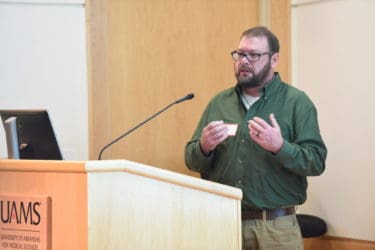
John Paul Nolan, a research community advisory board member, urged UAMS to take the lead on digital health.

Rhoads also said she enjoyed Mohr’s perspective on what PCORI can and cannot fund. “It just provided a lot of clarity for me,” she said.

Health systems are behind other industries in adopting digital technologies in part because government policies haven’t kept pace with the advances, said Anita Walden, M.S., a conference organizer and instructor in the Department of Biomedical Informatics in the UAMS College of Medicine.

“Patients are looking forward to using digital technologies, and the industry companies and the payers are moving forward with trying to implement it,” Walden said. “They need the providers to catch up.”

Despite the challenges, Lowery said that UAMS, with the strong support of Chancellor Cam Patterson, M.D., MBA, will lead the state in adoption of digital health technologies.

“I think over the next few years we’re going to build the most modern, connected health care delivery system in the nation because we’re the only teaching hospital in the state and we have a lot of really rural and poor hospital systems everywhere,” he said. “I think all of us are committed to changing that.”
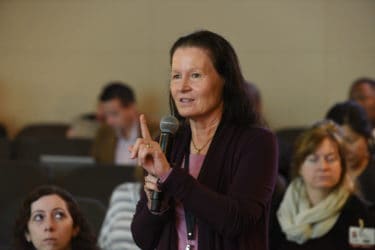
Linda Larson-Prior, Ph.D., asks a question during the conference.

In the next five years, he predicted, the same percentage who are banking on their phones today will be receiving health care through their mobile devices.

John Paul Nolan, a research participant and Community Advisory Board member for a UAMS research study, urged Lowery and other UAMS leaders to take the lead in digital health care. Holmes, a veteran, said an expansion of telemedicine is desperately needed in rural communities. In small towns, residents notice whose vehicle is parked at a mental health clinic. Because of the stigma, people who need help often don’t get it. If mental health services could be provided via interactive video to a veteran with post-traumatic stress disorder, for example, that scenario could be avoided.

“UAMS is poised to provide care,” Nolan said. With smartphones and other mobile devices, “In that moment of crisis, they don’t have to get out of the house. Those are the things we need to be looking at. UAMS brings a very powerful chip to the table because of its infrastructure, its national and international partners and the way that it is set up to study and to disseminate the information to make the public more aware of what’s going on.”

The Digital Health Conference was sponsored by the UAMS Office of Interprofessional Education, with support from the UAMS Center for Distance Health, the Department of Biomedical Informatics, South Central Telehealth Resource Center, and the UAMS Translational Research Institute.

Filed Under: Front, News, Newsroom Tagged With: Carolyn Greene, Curtis Lowery, digital health, digital health conference, Telehealth, Telemedicine, Translational Research Institute, UAMS, University of Arkansas for Medical Sciences

Digital Health Conference Nov. 30

UAMS’ first Digital Health Conference will be Friday, Nov. 30, 9 a.m. – 3:30 p.m., at Reynolds Institute on Aging. View the agenda. There is no charge for attendance but you must register. Space is limited, so Register Now.

Hear from leaders in the field how emerging digital technologies, such as mobile apps, wearable biomonitors, predictive analytics and artificial intelligence, are transforming health care.

Question? Contact: Anita Walden, acwalden@uams.edu, or Aaron Kemp, ASKemp@uams.edu.

The conference is sponsored by the Office of Interprofessional Education, with support from the South Central Telehealth Resource Center and the Translational Research Institute (TRI).

Filed Under: Front, News, Newsroom Tagged With: conference, digital health, mobile health, research, UAMS

ARresearch ‘Kick-Starts’ Digital Health Study Enrollment

A UAMS NIH-funded digital health study needed 128 participants with mild to moderate depression. Within 10 weeks, it had 103, well ahead of schedule, said Carolyn Greene, Ph.D., who is leading the study. TRI’s ARresearch registry of volunteers, she said, has provided about 20 participants.

“That was a good way for us to kick-start this study,” said Greene, associate professor in the Department of Psychiatry, Division of Health Services Research.

Greene’s study is targeting UAMS primary care patients with untreated depression. She said finding such patients for her study is difficult because they may not be coming in for regular doctor visits, or may not feel comfortable discussing their mental health with their doctors.

“That’s where the ARresearch database was extremely helpful to us,” she said.

Greene, who is also the national manager of Mental Health Web Services at the Department of Veterans Affairs, said the study is conducted online or over the phone, from screening to receipt of a gift card for participants.

For eight weeks, a coach will help patients with downloading and using a portfolio of mobile apps, and provide encouragement.

The apps use evidence-based cognitive behavioral tools and have shown that they can help significantly reduce depression. Greene’s study will address how the apps, combined with a coach, could fit into UAMS’ system of care.

“The goal isn’t for the coach to replace a therapist, but to help them use the apps to learn skills and tools to become their own therapist,” Greene said.

The study includes gathering input from clinicians and administrators.

“Our goal is to solve a problem for the primary care clinics, which have many patients with mild to moderate depression but not a lot of resources to provide interventions,” she said.

Filed Under: Front, News, Newsroom Tagged With: ARresearch, Carolyn Greene, depression, digital health, TRI

The October TRIbune Is Out!

In this month’s TRIbune we’re highlighting digital health research successes. For Tamara Perry, M.D., years of dedication developing an asthma application to help teens got a big shot in the arm with a $3.1 million NIH grant. Her app will be tested with 400 asthma patients over the next five years. Perry used data and a prototype app developed with a TRI pilot award and a follow-up pilot from Arkansas Children’s Research Institute to help secure the NIH funding. Carolyn Greene, Ph.D., said TRI’s ARresearch registry of volunteers was a great way to kick-start enrollment for her digital health study seeking participants with depression. This issue also announces UAMS’ first Digital Health Conference on Nov. 30. Our Research on the Horizon features Rohit Dhall, M.D., who is the local principal investigator on an industry-sponsored Parkinson’s disease study. As always, we feature the latest TRI-cited publications.
Read the October TRIbune.

Filed Under: Front, News, Newsroom Tagged With: 2018, digital health, Greene, October, Perry, TRIbune

Translational Research Institute LogoTranslational Research InstituteTranslational Research Institute
Mailing Address: 4301 West Markham Street, Little Rock, AR 72205
Phone: (501) 686-7000
  • Facebook
  • X
  • Instagram
  • YouTube
  • LinkedIn
  • Pinterest
  • Disclaimer
  • Terms of Use
  • Privacy Statement
  • Legal Notices

© 2025 University of Arkansas for Medical Sciences