• Skip to primary navigation
  • Skip to main content
  • Skip to primary navigation
  • Skip to main content
Choose which site to search.
University of Arkansas for Medical Sciences Logo University of Arkansas for Medical Sciences
Translational Research Institute
  • UAMS Health
  • Jobs
  • Giving
  • About TRI
    • What We Offer
    • Leadership & Governance
    • Staff
    • Cite TRI
    • What is Translational Research?
    • Contact TRI
  • Funding Opportunities
    • Grants
      • Pilot Award Program
      • Consortium of Rural States (CORES) Multi-Institutional Pilot Award Program
      • Team Science Voucher Program
      • Winthrop P. Rockefeller Cancer Institute Rural Research Award Program
    • Scholarships
      • K12 Mentored Research Career Development Scholar Awards Program
      • Health Sciences Innovation and Entrepreneurship Postdoctoral Training Program
      • Implementation Science Scholar Program
      • (STARs) Program – Strategies for Training and Advancing Researchers
      • SMART Program [Master’s in Clinical and Translational Sciences (MS-CTS)]
    • Community
      • Community Based Participatory Research (CBPR) Scholars Program
      • Community Partners Educated as Arkansas Research Leaders (CPEARL) Program
    • Awardee Responsibilities
  • Services & Resources
    • Services
      • Biostatistics, Epidemiology and Research Design (BERD) Consultation
      • Clinical Data Repository (AR-CDR)
      • Comprehensive Informatics Resource Core
      • Mock Study Sections
      • Research Participant Recruitment
      • Research Support: Clinical Trials Innovation Unit (CTIU)
      • Implementation Science Program
      • Research Ethics Consultation
    • Resources
      • ARresearch Registry
      • Center for Health Literacy
      • Data Safety Monitoring
      • Grant Writing & Dissemination
      • UAMS Profiles
      • UAMS Rural Research Network
      • Other Resources
      • COVID-19 Research Guidelines
      • Community Partner Research Training
  • Career Development & Scholarships
    • Scholarship Opportunities
      • K12 Mentored Research Career Development Scholar Awards Program
      • Health Sciences Innovation and Entrepreneurship Postdoctoral Training Program
      • Data Science Scholars Program
      • Implementation Science Scholar Program
      • SMART Program
      • Translational Research Innovations and Partners (TRIP) Program
    • Training & Educational Opportunities
      • innOVATION Seminar Series
      • Path 2 K Program
      • Translational Workforce Development
      • Graduate Certificate in Implementation Science
      • SMART Program [Master’s in Clinical and Translational Sciences (MS-CTS)]
      • Good Clinical Practice Training
    • Didactic Training
  • Community
    • Community Engagement Leadership
    • Community Advisory Board
    • Community Engagement Partners
      • Community Partner Celebration
      • Faith-Academic Initiatives for Transforming Health (FAITH) Network
    • Community Engagement Services
      • Consultations and Technical Assistance
      • Community Review Boards
      • Community Partner Research Training
      • Equipment Library
    • Programs and Funding
      • Community Partners Educated as Arkansas Research Leaders (CPEARL) Program
      • Community Based Participatory Research (CBPR) Scholars Program
      • Community Scientist Academy
    • Toolkits
      • CSA Online Toolkit
      • CPEARL Toolkit
  • Events
    • Research Day
    • Clinical Trials Learning Collaborative
  • Newsroom
  1. University of Arkansas for Medical Sciences
  2. Translational Research Institute
  3. NCATS

NCATS

NIH Awards Five-Year, $24.2 Million Grant to UAMS Translational Research Institute

The University of Arkansas for Medical Sciences (UAMS) Translational Research Institute announced July 3 it will receive five years of federal funding totaling $24.2 million to accelerate research that addresses Arkansas’ biggest health challenges.
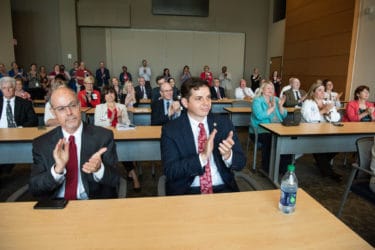
University of Arkansas System President Donald R. Bobbitt, Ph.D., front left, and Jimmy Harris, front right, Little Rock field representative for U.S., Sen. John Boozman, applaud the announcement.

The Translational Research Institute helps researchers turn their ideas and findings into new medical treatments and other health interventions. Its focus is on rural Arkansas populations, where health and health care disparities persist. A major emphasis of the award is research partnerships with Arkansas communities to ensure that research supported by the institute aligns with the priorities and needs of Arkansans.

“This funding recognizes the outstanding research occurring right here in Arkansas,” said U.S. Senator John Boozman. “It will help UAMS researchers build on their successes and develop new therapies and medical procedures that will improve lives in Arkansas and beyond. I was pleased to support the efforts of UAMS to secure this funding, but this award truly is a testament to the body of work produced by UAMS. Arkansans can be proud of all UAMS has accomplished and its bright future that lies ahead.”

The new funding, called a Clinical and Translational Science Award (CTSA), comes from the National Center for Advancing Translational Sciences (NCATS), part of the National Institutes of Health (NIH). UAMS is one of more than 50 CTSA Program sites in the United States. The institute first received CTSA funding in 2009.

“Competition for these awards is fierce, so having a CTSA means we’ve shown UAMS to be among the country’s leading research innovators,” said UAMS Chancellor Cam Patterson, M.D., MBA. “For Arkansans, this award is significant because it will translate to improved health and health care. The university also thanks Sen. Boozman for his important help in achieving this result.”
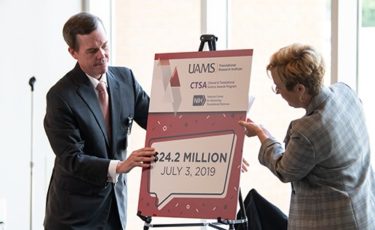
Patterson, left, and James finish unveiling a poster announcing the grant award.

The CTSA award includes a main grant and two training grants. Laura James, M.D., is the principal investigator on the primary Translational Research Institute grant, which totals $20.6 million, and provides research infrastructure and oversite for the entire CTSA program.

“A CTSA is among the most significant NIH awards an institution can receive,” said James, also institute director and UAMS associate vice chancellor for clinical and translational research.  “We are thrilled over this award because it represents the collective effort of numerous faculty members working across diverse research programs. This award demonstrates the synergy and strengths of research talents at UAMS. In addition, the CTSA will harmonize our efforts as health care providers and researchers to improve the health outcomes of Arkansans through research innovations.”

“We are also very proud that this opportunity allows us to work closer with our partner institutions, Arkansas Children’s Hospital (ACH), Arkansas Children’s Research Institute (ACRI) and Central Arkansas Veterans Healthcare System (CAVHS), as well as the UAMS Northwest Regional Campus, to expand the impact of research throughout the state,” James said.

The institute is supporting novel research that addresses significant health issues in Arkansas, such as opioids and pain management, diabetes and obesity, mental health and rare diseases. It is also expanding opportunities for UAMS researchers to participate in multisite clinical trials, including cross-CTSA research opportunities.

“The Translational Research Institute has created a collaborative cross-campus and cross-CTSA environment that enables our researchers to thrive,” said Shuk-Mei Ho, Ph.D., UAMS vice chancellor for research. “The funding is important, and the prestige of being part of the CTSA Program helps us recruit the best researchers nationally.”

The two other grants that are part of the award include the Institutional Career Development Core grant totaling $2.3 million, led by Mary Aitken, M.D., and Brooks Gentry, M.D.; and the National Research Service Award Training Core, $1.3 million, led by Nancy Rusch, Ph.D., and Curtis Lowery, M.D.

“Supporting the development of our early stage translational researchers is critical to ensuring that UAMS and Arkansas have the capacity to meet health challenges of the future,” Aitken said. “The KL2 program has been an central part of the TRI’s efforts to identify and cultivate our research pool and launch the careers of our faculty, and plans for the next phase of TRI to further refine the program make it likely to have continued success.”

The new funding will enable important new and existing efforts to continue, including:

  • Providing the public with easier access to cutting-edge clinical trials.
  • Increasing the number of clinical trials offered at UAMS, ACH, and CAVHS.
  • Pilot grants for the best translational research ideas for improving health and health care.
  • Education and translational science training for early career researchers.
  • Entrepreneurship training to help researchers commercialize their ideas.
  • Implementation science training to identify and adopt the most successful approaches and the latest medical advances.
  • Supporting team-based collaborations at the local and national level.
  • Increasing partnerships with communities to ensure the most meaningful clinical and translational research is conducted with rural populations.
  • Streamlining translational research processes and enhancing research quality with state-of-the-art informatics approaches and methods.
  • Adopting “plain language” communications to ensure research opportunities and findings are disseminated broadly to the public.

In preparation for the award, UAMS developed a number of new research approaches that will help expand research opportunities in the future, including:

  • ARresearch.org, a volunteer research participant registry and website, providing researchers a pool of nearly 6,000 potential research volunteers.
  • Expanding researcher access to de-identified patient data that can be used to understand disease patterns and that provide a framework to guide studies testing new research treatments or approaches.
  • Expansion of cross-institutional collaborations with multiple other CTSA programs across the U.S.
  • Expansion of study management tools and resources, to ensure that research is conducted according to the highest standards of quality and reproducibility.
  • Creation of a Community Scientist Academy, to provide in-depth training for the public on clinical research and to provide service and decision-making opportunities for the public.
  • Expansion of its Community Advisory Board, ensuring that its grassroots stakeholders have a voice in the institute’s efforts.
  • An efficient, cost-saving electronic service request system for researchers, which allows them to select from a menu of over 30 unique services and receive customized help with research-related tasks.

In addition to partnerships with ACH/ACRI and the CAVHS, the institute fosters research collaborations across all UAMS colleges – Medicine, Nursing, Pharmacy, Health Professions and Public Health, as well as the UAMS Graduate School. The National Research Service Award Training Core, led by Rusch, involves a training partnership with the Sam M. Walton College of Business at the University of Arkansas at Fayetteville.

The NCATS/NIH award is under Award Number U54TR001629.

UAMS is the state’s only health sciences university, with colleges of Medicine, Nursing, Pharmacy, Health Professions and Public Health; a graduate school; hospital; a main campus in Little Rock; a Northwest Arkansas regional campus in Fayetteville; a statewide network of regional campuses; and seven institutes: the Winthrop P. Rockefeller Cancer Institute, Jackson T. Stephens Spine & Neurosciences Institute, Harvey & Bernice Jones Eye Institute, Psychiatric Research Institute, Donald W. Reynolds Institute on Aging, Translational Research Institute and Institute for Digital Health & Innovation. It is the only adult Level 1 trauma center in the state. UAMS has 2,727 students, 870 medical residents and five dental residents. It is the state’s largest public employer with more than 10,000 employees, including 1,200 physicians who provide care to patients at UAMS, its regional campuses, Arkansas Children’s Hospital, the VA Medical Center and Baptist Health. Visit www.uams.edu or www.uamshealth.com. Find us on Facebook, Twitter, YouTube or Instagram.

Filed Under: Front, News, Newsroom Tagged With: Cam Patterson, Clinical and Translational Science Award, CTSA, Laura James, NCATS, Senator John Boozman, Translational Research Institute, TRI, UAMS, University of Arkansas for Medical Sciences

Seeking Five Years of Funding, TRI Submits Application to NCATS

One year of bridge funding was great news last year for the Translational Research Institute (TRI), but it set the stage for a big challenge.

While the September 2017 Clinical and Translational Science Award (CTSA) allowed TRI time to strengthen its next application for five years of funding, it meant producing a fourth CTSA application in four years, a mammoth undertaking for TRI Director Laura James, M.D., and numerous faculty and TRI staff.

Work on the application began almost immediately after the bridge award was announced, said James, also UAMS associate vice chancellor for clinical and translational science.

“We dedicated ourselves to the application, but we also remained committed to our ongoing initiatives and innovative plans in collaboration with research leaders across our hub [UAMS, Arkansas Children’s Hospital (ACH), Arkansas Children’s Research Institute (ACRI), and Central Arkansas Veterans Healthcare System (CAVHS)],” she said.

1,864 Pages

“Until you’ve been in the middle of this type of grant application, it’s hard to understand the amount of work involved in weaving together a consistent and compelling story that clearly explains the incredible progress achieved at UAMS since our first CTSA grant in 2009, as well as the exciting vision we have for the future,” James said.

The latest journey concluded on May 24, 2018, when James and 32 other UAMS faculty submitted the 1,864-page document to the NIH National Center for Advancing Translational Sciences (NCATS). TRI is seeking five years of funding – $26.1 million – in an application with three funding components: the main component, an Institutional Career Development Core (KL2 Program) and National Research Service Award Training Core (the Health Sciences Innovation and Entrepreneurship Training Program).

The application describes numerous core strengths at UAMS and how various research champions at UAMS, ACH, and CAVHS will work as a team to enhance the health of Arkansans through transformative research.

Challenges and Opportunities

TRI’s strategy for the application was to craft a story that reflected the unique challenges and opportunities in Arkansas.

“Our clinical and education footprint around the state is very strong, as reflected by the numerous outreach clinics and expansive telemedicine program,” she said.

The application emphasizes plans for not just strengthening UAMS’ research footprint, but also for addressing the needs of Arkansas’ underrepresented communities.

“For our research to be relevant for Arkansans, it really needs to engage those who traditionally have not been in the center of clinical and translational research,” James said. “It needs to align with the health care needs of special populations, including children and older adults, as well as underrepresented minorities, and individuals with low health literacy.”

The quality partnerships that TRI has developed with other CTSA sites over the last four years strengthens the application. “We have partnerships that are centered on research itself, as well as partnerships that address research processes, such as grant reviews, or that are building off our successes in engaging community members to help us with decision-making,” James said.

Washington Delegation

UAMS and TRI leaders were buoyed by the May 7 visit from a delegation that included NCATS Director Christopher Austin, M.D., staff from U.S. Sen. John Boozman’s office and the Senate Health and Human Services (HHS) Appropriations Subcommittee.

The day began with welcomes from James and Donald R. Bobbitt, Ph.D., president of the University of Arkansas System, followed by 17 faculty and a community representative giving brief presentations highlighting individual scientific programs and/or TRI programs. Faculty from informatics, pharmacy, public health, pediatrics, psychiatry, family and preventive medicine, pharmacology and toxicology, biochemistry, and internal medicine gave presentations, as did research leaders from ACRI and CAVHS. The day concluded with a small-group discussion that included new UAMS Chancellor Cam Patterson, M.D., MBA, and Lawrence Cornett, Ph.D., UAMS vice chancellor for research.

Congressional staff attending were:

  • Laura Friedel, staff director/clerk, HHS Appropriations Subcommittee, U.S. Senate Committee on Appropriations
  • Mackensie Burt, Legislative Director, Office of U.S. Senator John Boozman

NCATS representatives attending with Austin were:

  • Adrienne Hallett, associate director, Office of Legislative Policy and Analysis, NIH
  • Pamela McInnes, D.D.S., M.Sc., deputy director, NCATS, NIH
  • Michael Kurilla, M.D., Ph.D., director, Clinical Innovation, NCATS, NIH
  • Mary Purucker, M.D., Ph.D., director, CTSA Program Hubs, Clinical Innovation Division, NCATS, NIH
  • Samantha Jonson, MPS, special assistant to the director, NCATS, NIH

“We were encouraged with the nature of the questions from NCATS as well as their comments about our programs,” James said. “It was clear that we are on the right path.”

While “third time’s a charm” is the best known maxim, James said she would be happy to make it “four’s a charm” for this CTSA application.

“I feel confident that we’ve delivered a competitive application,” she said.

Filed Under: News Tagged With: CTSA, Laura James, NCATS, TRI, UAMS, University of Arkansas for Medical Sciences

May-June TRIbune

This issue of The TRIbune features the Translational Research Institute’s (TRI) recent submission of its 1,864-page Clinical and Translational Science Award (CTSA) application. After receiving a one-year bridge award last year, TRI submitted its application to the NIH National Center for Advancing Translational Sciences (NCATS) on May 24 for five years of funding.

As TRI Director Laura James, M.D., notes, while there are no guarantees, she believes TRI has submitted a competitive application. A May 7 visit from NCATS leaders and congressional staff affirmed that TRI is headed in the right direction. We also highlight some key numbers related to the application, and our TRI & Me features TRI Associate Director John Arthur, M.D., Ph.D. We also include the latest publication citations by researchers whose work has benefited from TRI resources or funding.

Filed Under: Front, News, Newsroom Tagged With: NCATS, newsletter, NIH, Translational Research Institute, TRI, TRIbune, UAMS

TRI Part of NIH Milestone to Accelerate Multisite Clinical Studies

CTSA Program paves way for nationwide single IRB model.

Developing new treatments for diseases often requires large numbers of clinical research participants enrolled in the same study at numerous geographical sites. These multisite clinical trials are well-positioned to discover whether a promising therapeutic is safe and effective, and may provide medical professionals with the information needed for treating their patients. However, the initiation of such studies may be delayed because each site typically relies on its own Institutional Review Boards (IRBs) to provide ethics reviews of the risks and benefits of the proposed research.

Christopher P. Austin, M.D.

The National Institutes of Health (NIH) is leading policy and programmatic initiatives to streamline this overly cumbersome process. NIH’s National Center for Advancing Translational Sciences (NCATS) announced today that all Clinical and Translational Science Awards (CTSA) Program sites (including the UAMS Translational Research Institute) have signed on to the NCATS Streamlined, Multisite, Accelerated Resources for Trials (SMART) IRB authorization agreement. This agreement — which now includes a total of more than 150 top medical research institutions — will enable all participating study sites to rely on the ethics review of one IRB for each study, making it possible to initiate multisite studies within weeks instead of months. For patients waiting to enroll in a study, this could make a life-saving difference.

The SMART IRB authorization agreement serves as a model to help investigators adhere to the NIH’s policy on single IRB use for multisite studies. This policy was designed to improve IRB efficiencies while ensuring the protection of research participants so that research can proceed expeditiously.

The authorization agreement effort was led by Harvard Catalyst, University of Wisconsin-Madison Institute for Clinical and Translational Research, and Dartmouth Synergy. Through these institutions, a team of NCATS-supported SMART IRB ambassadors facilitated and provided critical guidance and support to assist institutions in joining and implementing the SMART IRB authorization agreement.

“This milestone is a giant step toward a nationwide model for greater efficiency in IRB review, which is critical to getting more treatments to more patients more quickly,” said NCATS Director Christopher P. Austin, M.D. “It was made possible by the teamwork of hundreds of experts across the country who worked together to achieve what was thought to be impossible even a few years ago.”

In addition, the SMART IRB authorization agreement will provide the foundation for NCATS’ Trial Innovation Network central IRBs. The Trial Innovation Network is a collaborative CTSA Program initiative designed to address critical roadblocks in clinical research, and to optimize and streamline the clinical trial and studies process.

Next steps for the NCATS SMART IRB Platform include the development of education, training and harmonization of best practices for a single IRB review. Learn more at https://ncats.nih.gov/expertise/clinical/smartirb and https://smartirb.org (link is external).

About the National Center for Advancing Translational Sciences (NCATS): To get more treatments to more patients more quickly, NCATS incorporates the power of data, new technologies and strategic collaborations to develop, demonstrate and disseminate innovations in translational science. Rather than targeting a particular disease or fundamental science, NCATS focuses on what is common across all diseases and the translational process. Learn more at https://ncats.nih.gov.

About the National Institutes of Health (NIH): NIH, the nation’s medical research agency, includes 27 Institutes and Centers and is a component of the U.S. Department of Health and Human Services. NIH is the primary federal agency conducting and supporting basic, clinical, and translational medical research, and is investigating the causes, treatments, and cures for both common and rare diseases. For more information about NIH and its programs, visit www.nih.gov.

Filed Under: Front, News, Newsroom Tagged With: Christopher P. Austin, CTSA, IRB, NCATS, NIH, SMART IRB, Translational Research Institute, UAMS

Translational Research Institute LogoTranslational Research InstituteTranslational Research Institute
Mailing Address: 4301 West Markham Street, Little Rock, AR 72205
Phone: (501) 686-7000
  • Facebook
  • X
  • Instagram
  • YouTube
  • LinkedIn
  • Pinterest
  • Disclaimer
  • Terms of Use
  • Privacy Statement
  • Legal Notices

© 2026 University of Arkansas for Medical Sciences