• Skip to primary navigation
  • Skip to main content
  • Skip to primary navigation
  • Skip to main content
Choose which site to search.
University of Arkansas for Medical Sciences Logo University of Arkansas for Medical Sciences
Translational Research Institute
  • UAMS Health
  • Jobs
  • Giving
  • About TRI
    • What We Offer
    • Leadership & Governance
    • Staff
    • Citing Translational Research Institute CTSA Support
    • What is Translational Research?
    • Contact TRI
  • Funding Opportunities
    • Grants
      • Pilot Award Program
      • Consortium of Rural States (CORES) Multi-Institutional Pilot Award Program
      • Team Science Voucher Program
      • Winthrop P. Rockefeller Cancer Institute Rural Research Award Program
    • Scholarships
      • K12 Mentored Research Career Development Scholar Awards Program
      • Health Sciences Innovation and Entrepreneurship Postdoctoral Training Program
      • Implementation Science Scholar Program
      • (STARs) Program – Strategies for Training and Advancing Researchers
      • SMART Program [Master’s in Clinical and Translational Sciences (MS-CTS)]
    • Community
      • Community Based Participatory Research (CBPR) Scholars Program
      • Community Partners Educated as Arkansas Research Leaders (CPEARL) Program
    • Awardee Responsibilities
  • Services & Resources
    • Services
      • Biostatistics, Epidemiology and Research Design (BERD) Consultation
      • Clinical Data Repository (AR-CDR)
      • Comprehensive Informatics Resource Core
      • Mock Study Sections
      • Research Participant Recruitment
      • Research Support: Clinical Trials Innovation Unit (CTIU)
      • Implementation Science Program
      • Research Ethics Consultation
    • Resources
      • ARresearch Registry
      • Center for Health Literacy
      • Data Safety Monitoring
      • Grant Writing & Dissemination
      • UAMS Profiles
      • UAMS Rural Research Network
      • Other Resources
      • COVID-19 Research Guidelines
      • Community Partner Research Training
  • Career Development & Scholarships
    • Scholarship Opportunities
      • K12 Mentored Research Career Development Scholar Awards Program
      • Health Sciences Innovation and Entrepreneurship Postdoctoral Training Program
      • Data Science Scholars Program
      • Implementation Science Scholar Program
      • SMART Program
      • Translational Research Innovations and Partners (TRIP) Program
    • Training & Educational Opportunities
      • innOVATION Seminar Series
      • Path 2 K Program
      • Translational Workforce Development
      • Graduate Certificate in Implementation Science
      • SMART Program [Master’s in Clinical and Translational Sciences (MS-CTS)]
      • Good Clinical Practice Training
    • Didactic Training
  • Community
    • Community Engagement Leadership
    • Community Advisory Board
    • Community Engagement Partners
      • Community Partner Celebration
      • Faith-Academic Initiatives for Transforming Health (FAITH) Network
    • Community Engagement Services
      • Consultations and Technical Assistance
      • Community Review Boards
      • Community Partner Research Training
      • Equipment Library
    • Programs and Funding
      • Community Partners Educated as Arkansas Research Leaders (CPEARL) Program
      • Community Based Participatory Research (CBPR) Scholars Program
      • Community Scientist Academy
    • Toolkits
      • CSA Online Toolkit
      • CPEARL Toolkit
  • Events
    • Research Day
    • Clinical Trials Learning Collaborative
  • Newsroom
  1. University of Arkansas for Medical Sciences
  2. Translational Research Institute
  3. University of Arkansas for Medical Sciences
  4. Page 2

University of Arkansas for Medical Sciences

ARresearch.org Registry Hits 5,000 Volunteer Milestone

A registry that matches people’s health interests with research studies at the University of Arkansas for Medical Sciences (UAMS) now has more than 5,000 Arkansans signed up.
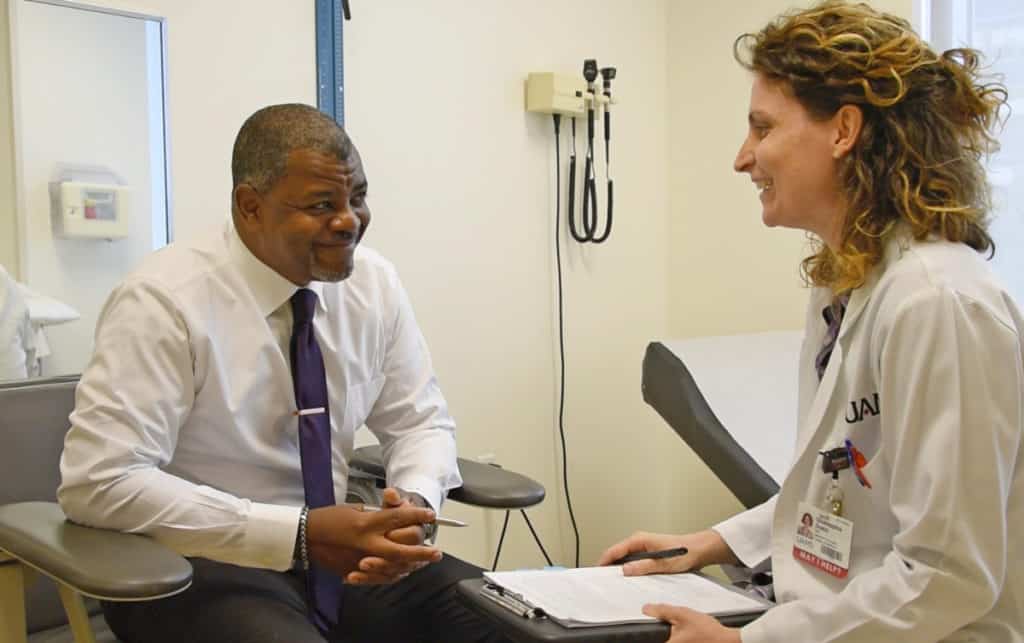
Nathaniel Noble of Little Rock joined the ARresearch.org registry and participated in a UAMS research study coordinated by Research Associate Dusio Giuseppina, Ph.D. (right).

The milestone was reached just two years after the registry was created to help address the critical need for research study volunteers.

“Five thousand is significant because now we are reaching a critical mass of volunteers needed to help our researchers meet their study enrollment targets and produce high-quality findings,” said Laura James, M.D., director of the UAMS Translational Research Institute, which established the registry. “We appreciate the tremendous support of our fellow Arkansans. They tell us wherever we recruit that they love UAMS and enthusiastically support our research mission.”

The registry is at ARresearch.org, a UAMS website created by the Translational Research Institute with input from its Community Advisory Board and UAMS patient advisory groups. Registrants select from a list of 29 health interest areas (allergy, heart disease, skin disorders, etc.) so that researchers know who to contact when they have studies in those health areas. Registrants can select as many of the categories as they want.

Studies at UAMS range from clinical trials (investigational drugs and devices) to health-related surveys and tests of health interventions.

One researcher who has found the registry invaluable is John Arthur, M.D., Ph.D., professor and chief of nephrology in the UAMS College of Medicine. Arthur was able to find 31 participants for his research studying bacteria in the gut of chronic kidney disease patients.
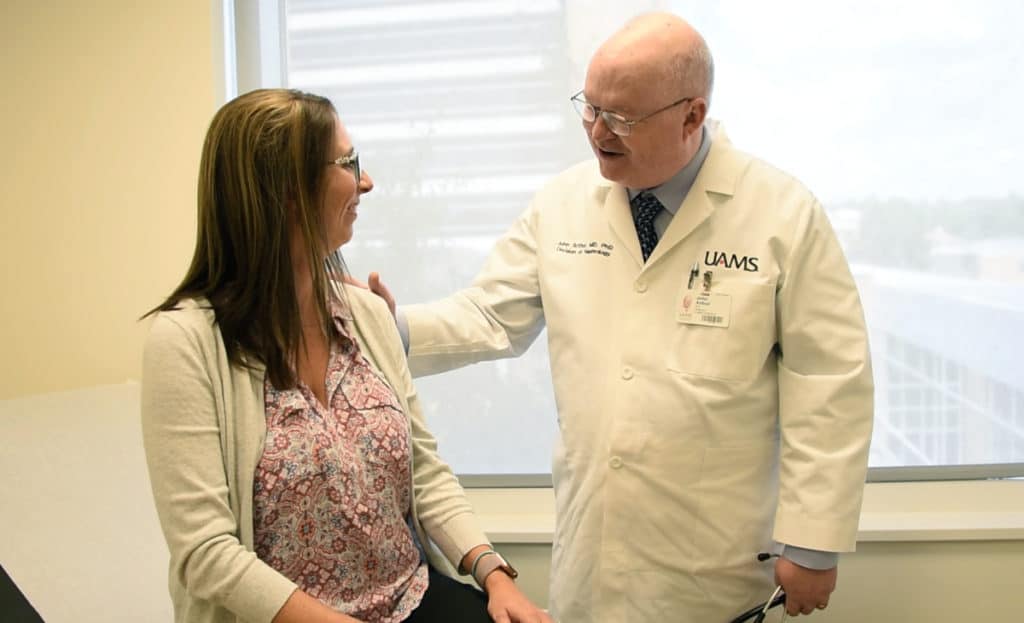
Using the ARresearch.org registry, John Arthur, M.D., Ph.D., found 31 Arkansans to participate in his kidney disease study.

“We really couldn’t have conducted this research without the ability to find fairly large numbers of healthy volunteers, and ARresearch has been fabulous for that,” said Arthur, also associate director of the Translational Research Institute. In addition to helping UAMS researchers, the registry is also popular with Arkansans.

Nathaniel Noble, of Little Rock, joined the ARresearch.org registry last year after hearing about it at a Rotary Club luncheon. He checked the “Healthy Volunteer” option on the form and soon received an email from UAMS asking if he would be interested in participating in Arthur’s kidney research study.

“It hit home because my dad was on dialysis the last years of his life,” Noble said. “I felt that I needed to do my part so maybe someone else’s dad won’t have to go through the same experience.”

Noble said his participation was a good experience. “They were very personable and walked me through the tests they were running. Mine was in three parts and they did whatever it took to work around my schedule.”

Anita Rose, of North Little Rock, helped put the registry over the 5,000 mark when she joined during the Back to School Bash at North Little Rock Academy on Aug. 11. She said the word “research” immediately got her attention when she saw the
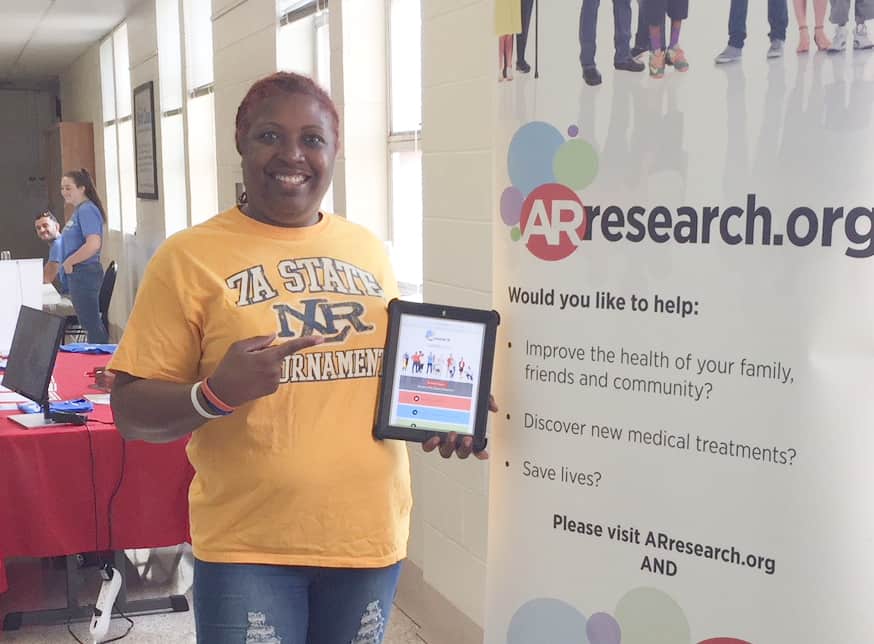
Anita Rose, of North Little Rock, said her mother's breast cancer inspired her to join the ARresearch.org volunteer registry.
Anita Rose, of North Little Rock, said her mother’s breast cancer inspired her to join the ARresearch.org volunteer registry.

ARresearch.org booth.

“My mom had breast cancer and we need that researched more,” Rose said.

Jean McSweeney, Ph.D., R.N., who led development of ARresearch.org, noted that the registry compares well to the demographics in Arkansas’ census data.

“We’ve worked hard to ensure that we are recruiting a broad pool of registrants, and we are proud to have registrants from all 75 Arkansas counties,” said McSweeney, professor and associate dean for research in the College of Nursing. “I think our success can be attributed in part to the early involvement of community representatives when we were developing ARresearch.”

Nationally, up to 48 percent of research studies fail to meet their enrollment goals and most require twice the amount of time to meet their recruitment goals than originally planned, according to a 2013 Tufts University study. As a result, increasing public participation in research has become a priority for the National Institutes of Health (NIH). The Translational Research Institute represents UAMS as part of a national consortium of Clinical and Translational Science Award (CTSA) Program institutions supported by the National Center for Advancing Translational Sciences (NCATS) of the NIH.

UAMS is the state’s only health sciences university, with colleges of Medicine, Nursing, Pharmacy, Health Professions and Public Health; a graduate school; hospital; northwest Arkansas regional campus; statewide network of regional centers; and six institutes: the Winthrop P. Rockefeller Cancer Institute, Jackson T. Stephens Spine & Neurosciences Institute, Harvey & Bernice Jones Eye Institute, Psychiatric Research Institute, Donald W. Reynolds Institute on Aging and Translational Research Institute. It is the only adult Level 1 trauma center in the state. UAMS has 2,834 students, 822 medical residents and six dental residents. It is the state’s largest public employer with more than 10,000 employees, including 1,200 physicians who provide care to patients at UAMS, its regional campuses throughout the state, Arkansas Children’s Hospital, the VA Medical Center and Baptist Health. Visit www.uams.edu or www.uamshealth.com. Find us on Facebook, Twitter, YouTube or Instagram.
Filed Under: Front, Newsroom Tagged With: ARresearch, ARresearch.org, clinical trial, Jean McSweeney, John Arthur, Laura James, participant, recruitment, research, Translational Research Institute, UAMS, University of Arkansas for Medical Sciences, volunteer

The TRIbune – New Look and Now Monthly!

This month TRI is unveiling its redesigned TRIbune newsletter.

We’ve made a couple of other changes, too. While we will continue to inform you about TRI activities that benefit UAMS’ research enterprise, more emphasis will be on your work as researchers.

In this issue, we highlight the experience of Marie Burdine, Ph.D., in the TRI-supported fastPace entrepreneurship training program. Burdine, whose lab is spearheading promising work for the Division of Surgical Research, is also the subject of the newsletter’s new Q&A Researcher Profile.

Also new: Research on the Horizon, a brief study overview with a UAMS principal investigator utilizing TRI services – this month featuring Kevin Sexton, M.D. This issue has exciting news about a big milestone for ARresearch.org, and we have your and your colleagues’ publications that cite TRI support. Check it out!

Filed Under: Front, Newsroom Tagged With: newsletter, Translational Research Institute, TRI, TRIbune, UAMS, University of Arkansas for Medical Sciences

TRI Graduates 17 in Latest Community Scientist Academy

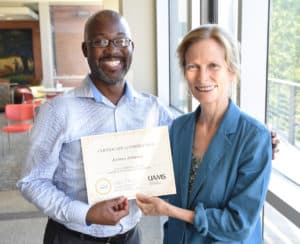
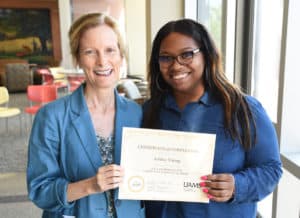
Kate Stewart, M.D., MPH, (left) who leads the Community Scientist Academy, presents a graduation certificate to Ashley Young.

Ashley Young, one of 17 graduates of the UAMS Translational Research Institute’s spring 2018 Community Scientist Academy, said graduation night was bittersweet.

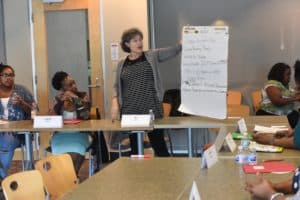
“I loved it. I’m sad that it wasn’t longer,” the Little Rock resident said of the six-week program. “I loved the interactive activities, and I loved how we had a different speaker each week. I also loved the people I met so it’s been a great experience all around.”

The Translational Research Institute established the Community Scientist Academy in 2016 on the recommendation of its Community Advisory Board. Its purpose is to increase community understanding about the research process and offer research decision-making opportunities to communities, patients and other stakeholders. These opportunities include reviewing grants; advising on research projects; serving on community review boards, community advisory boards, and patient and family advisory councils; and assisting with ARresearch, the Translational Research Institute’s research participant registry.

Through four academies it has graduated 44 Arkansans from diverse communities and a variety of socioeconomic backgrounds.  The academies are free and open to the public. The next academy is Sept. 25 through Oct. 30. Classes will be each Tuesday, 5:30 – 7:30 p.m. Contact Nicki Spencer, 501-526-6629 or ndspencer@uams.edu, to

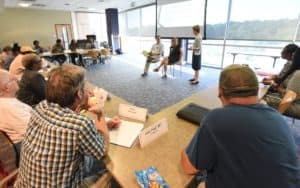
Attendees heard from UAMS researchers during each weekly class.

register.

Academy graduate JaJuan Johnson of Little Rock thanked the Translational Research Institute in an email for “an insightful six weeks of engaging with medical research experts.”

“I cannot begin to list the areas that most resonated with me, but I can definitely say I am more enlightened and trustworthy of medical research,” Johnson said.

He said the academy deepened his understanding on the importance of community collaboration in medical research.

“I Iook forward to continued work with the Translational Research Institute and will encourage others to get involved,” he said.

Angela Aikens said she was inspired to attend the Community Scientist Academy after being diagnosed last year with empty sella syndrome, a condition involving the pituitary gland that caused her chronic migraine headaches.

Jajuan Johnson said the academy was enlightening and made him more trustworthy of research.

“I just really thank God for research,” said Aikens, of Little Rock. “This opportunity to attend and to take part in the discussion and to listen to the physicians and the researchers over the past few weeks really gave me a birds-eye view of what all goes into the research process.”

Victoria Akins, M.D., who was a geriatrician at UAMS until she was diagnosed with multiple myeloma three years ago, attended the Community Scientist Academy as way to stay connected with UAMS.

“I realized that as a physician and as a patient at UAMS, I’m in a unique position to educate the community,” said Akins, of Jacksonville. “The academy enables me to better explain research to community people and to explain to physicians how the community is involved.”

Janet Bowen, a retired UAMS registered nurse, said the academy has provided insight and new perspective.

“Instead of one Institutional Review Board, there are now four,” she said, noting that she was a member of UAMS’ single board in the 1980s. The Institutional Review Board must approve all research that involves human participation.

She was also interested to hear how important grant funding has become. “I was just astounded to hear about the importance of grant funding, and in fact if they don’t have it they may not have a job.”

The graduation keynote address was given by Anna Huff Davis, community representative for the Translational Research Institute Leadership Council and liaison with the UAMS Fay W. Boozman

Ti Davis participates in a class exercise.

College of Public Health.

Davis, a past academy graduate, asked the graduates to encourage their family, friends and community to participate in research, either as a study participant or as a community co-investigator.

“Just imagine what would happen if we aren’t involved?” said Davis, also director of the Mid Delta Community Consortium. “I’m hypertensive, and if the medication that I take had not been tested on someone, I don’t know where I’d be today. I don’t even know if that medication would be available. I might not even be here because that medication might not be available for me.”

Filed Under: Front, Newsroom Tagged With: Community Scientist Academy, Translational Research Institute, UAMS, University of Arkansas for Medical Sciences

Seeking Five Years of Funding, TRI Submits Application to NCATS

One year of bridge funding was great news last year for the Translational Research Institute (TRI), but it set the stage for a big challenge.

While the September 2017 Clinical and Translational Science Award (CTSA) allowed TRI time to strengthen its next application for five years of funding, it meant producing a fourth CTSA application in four years, a mammoth undertaking for TRI Director Laura James, M.D., and numerous faculty and TRI staff.

Work on the application began almost immediately after the bridge award was announced, said James, also UAMS associate vice chancellor for clinical and translational science.

“We dedicated ourselves to the application, but we also remained committed to our ongoing initiatives and innovative plans in collaboration with research leaders across our hub [UAMS, Arkansas Children’s Hospital (ACH), Arkansas Children’s Research Institute (ACRI), and Central Arkansas Veterans Healthcare System (CAVHS)],” she said.

1,864 Pages

“Until you’ve been in the middle of this type of grant application, it’s hard to understand the amount of work involved in weaving together a consistent and compelling story that clearly explains the incredible progress achieved at UAMS since our first CTSA grant in 2009, as well as the exciting vision we have for the future,” James said.

The latest journey concluded on May 24, 2018, when James and 32 other UAMS faculty submitted the 1,864-page document to the NIH National Center for Advancing Translational Sciences (NCATS). TRI is seeking five years of funding – $26.1 million – in an application with three funding components: the main component, an Institutional Career Development Core (KL2 Program) and National Research Service Award Training Core (the Health Sciences Innovation and Entrepreneurship Training Program).

The application describes numerous core strengths at UAMS and how various research champions at UAMS, ACH, and CAVHS will work as a team to enhance the health of Arkansans through transformative research.

Challenges and Opportunities

TRI’s strategy for the application was to craft a story that reflected the unique challenges and opportunities in Arkansas.

“Our clinical and education footprint around the state is very strong, as reflected by the numerous outreach clinics and expansive telemedicine program,” she said.

The application emphasizes plans for not just strengthening UAMS’ research footprint, but also for addressing the needs of Arkansas’ underrepresented communities.

“For our research to be relevant for Arkansans, it really needs to engage those who traditionally have not been in the center of clinical and translational research,” James said. “It needs to align with the health care needs of special populations, including children and older adults, as well as underrepresented minorities, and individuals with low health literacy.”

The quality partnerships that TRI has developed with other CTSA sites over the last four years strengthens the application. “We have partnerships that are centered on research itself, as well as partnerships that address research processes, such as grant reviews, or that are building off our successes in engaging community members to help us with decision-making,” James said.

Washington Delegation

UAMS and TRI leaders were buoyed by the May 7 visit from a delegation that included NCATS Director Christopher Austin, M.D., staff from U.S. Sen. John Boozman’s office and the Senate Health and Human Services (HHS) Appropriations Subcommittee.

The day began with welcomes from James and Donald R. Bobbitt, Ph.D., president of the University of Arkansas System, followed by 17 faculty and a community representative giving brief presentations highlighting individual scientific programs and/or TRI programs. Faculty from informatics, pharmacy, public health, pediatrics, psychiatry, family and preventive medicine, pharmacology and toxicology, biochemistry, and internal medicine gave presentations, as did research leaders from ACRI and CAVHS. The day concluded with a small-group discussion that included new UAMS Chancellor Cam Patterson, M.D., MBA, and Lawrence Cornett, Ph.D., UAMS vice chancellor for research.

Congressional staff attending were:

  • Laura Friedel, staff director/clerk, HHS Appropriations Subcommittee, U.S. Senate Committee on Appropriations
  • Mackensie Burt, Legislative Director, Office of U.S. Senator John Boozman

NCATS representatives attending with Austin were:

  • Adrienne Hallett, associate director, Office of Legislative Policy and Analysis, NIH
  • Pamela McInnes, D.D.S., M.Sc., deputy director, NCATS, NIH
  • Michael Kurilla, M.D., Ph.D., director, Clinical Innovation, NCATS, NIH
  • Mary Purucker, M.D., Ph.D., director, CTSA Program Hubs, Clinical Innovation Division, NCATS, NIH
  • Samantha Jonson, MPS, special assistant to the director, NCATS, NIH

“We were encouraged with the nature of the questions from NCATS as well as their comments about our programs,” James said. “It was clear that we are on the right path.”

While “third time’s a charm” is the best known maxim, James said she would be happy to make it “four’s a charm” for this CTSA application.

“I feel confident that we’ve delivered a competitive application,” she said.

Filed Under: News Tagged With: CTSA, Laura James, NCATS, TRI, UAMS, University of Arkansas for Medical Sciences

New Pilot Awards Available for CTSA Inter-institutional Studies

The Western States Consortium, which includes the UAMS Translational Research Institute (TRI) and four other Clinical and Translational Science Award (CTSA) institutions, has issued the call to all faculty for pilot award applications.

The purpose of the pilot awards is to promote inter-institutional collaboration by funding innovative, translational research projects that involve two or more of the four Western States Consortium members. Awards of up to $25,000 will be provided by each participating institution.

In addition to TRI, the Western States Consortium members are the University of Kentucky, University of New Mexico, University of Kansas Medical Center, and University of Utah, all part of the national CTSA consortium supported by the National Center for Advancing Translational Sciences (NCATS) at the National Institutes of Health (NIH).

Applications are due August 10, 2018, at 5 p.m. (CT). Each proposal’s lead principal investigator will submit one combined proposal via an online application system.

For additional details, view the Request for Applications (RFA) document.

If you have any questions, please contact Nia Indelicato at NLIndelicato@uams.edu or 501-614-2287.

Key Dates:

  • Application Release Date: June 15, 2018
  • IRB Submission Deadline: July 13, 2018
  • Application Deadline: Aug. 10, 2018, 5 p.m. Central Time
  • Notice of intent to fund at each CTSA: Aug. 24, 2018
  • Just-In-Time Period: Aug. 24, 2018 – Aug. 31, 2018
  • Submission to NIH for Prior Approval of Human Subjects: Sept. 21, 2018
  • Funding Cycle: Nov. 1, 2018, through Oct. 31, 2019

Filed Under: Front, News, Newsroom Tagged With: pilot, request for applications, RFA, Translational Research Institute, TRI, UAMS, University of Arkansas for Medical Sciences, Western States Consortium

Public Invited to Attend UAMS Community Scientist Academy

Arkansans interested in having a voice in research programs at the University of Arkansas for Medical Sciences (UAMS) or simply learning how research is done are invited to participate in UAMS’ Summer 2018 Community Scientist Academy.

Sponsored by the UAMS Translational Research Institute, the Community Scientist Academy will be on Tuesdays each week May 22 through June 26, from 5:30 – 7:30 p.m. on the UAMS campus in Little Rock.

For questions and to register, contact Nicki Spencer, ndspencer@uams.edu, or (501) 526-6629. The training is being offered at no cost to participants.

Participants in the Community Scientist Academy will interact with UAMS researchers and community members involved in research in small roundtable discussions and other interactive sessions. They will learn:

  • How researchers decide what health issues to study
  • The research process
  • The benefits of individual and community organizations’ involvement in research

Graduates of the Community Scientist Academy will become more knowledgeable volunteers with additional opportunities to help influence UAMS research decisions on behalf of their communities. Examples include serving on:

  • Standing community advisory boards
  • One-time community boards created to advise researchers on specific studies
  • Panels that decide what research grants get funded

For graduates who are leading community organizations, there may also be opportunities to partner with UAMS on community-based research projects.

“The Community Scientist Academy will provide the basic knowledge to strengthen the public’s voice on research steering committees, mentoring committees, review committees, research projects, and in other leadership capacities,” said Kate Stewart, M.D., M.P.H., who leads the Translational Research Institute’s Community Engagement program. “We want our fellow Arkansans to understand what we do because their input makes a big difference in our efforts to improve health.”

UAMS researchers conduct clinical studies and community-based studies. Its clinical studies are conducted in UAMS’ hospital and clinics across the state, including at its main campus in Little Rock, its eight regional campuses, Arkansas Children’s Research Institute, and the Central Arkansas Veterans Healthcare System.

Filed Under: Front, News, Newsroom Tagged With: Community Scientist Academy, Kate Stewart, Nicki Spencer, Translational Research Institute, UAMS, University of Arkansas for Medical Sciences

‘Dos & Don’ts of Community Engagement’ Workshop for Researchers

A new workshop on the Dos and Don’ts of Community Engagement is being offered to researchers, students and staff, Oct. 18, 1 – 5 p.m., College of Public Health, G232.

The workshop was developed by the Translational Research Institute, College of Public Health and UAMS’ community partners. The workshop will include simulation and role reversal, video testimonials, and group reflection and debriefing.  The objective is to increase researchers’ knowledge of the dos and don’ts of community engaged research in the research domains of entering the community; the realities and constraints of community-based organizations; and dissemination.

The workshop is supported by the Arkansas Prevention Research Center and the Arkansas Center for Health Disparities.

For more information, contact jcoffey@uams.edu.

Filed Under: Front, News, Newsroom Tagged With: Community Engagement, Dos and Don'ts, research, Translational Research Institute, TRI, UAMS, University of Arkansas for Medical Sciences

  • «Previous Page
  • Page 1
  • Page 2
Translational Research Institute LogoTranslational Research InstituteTranslational Research Institute
Mailing Address: 4301 West Markham Street, Little Rock, AR 72205
Phone: (501) 686-7000
  • Facebook
  • X
  • Instagram
  • YouTube
  • LinkedIn
  • Pinterest
  • Disclaimer
  • Terms of Use
  • Privacy Statement
  • Legal Notices

© 2026 University of Arkansas for Medical Sciences