• Skip to primary navigation
  • Skip to main content
  • Skip to primary navigation
  • Skip to main content
Choose which site to search.
University of Arkansas for Medical Sciences Logo University of Arkansas for Medical Sciences
Translational Research Institute
  • UAMS Health
  • Jobs
  • Giving
  • About TRI
    • What We Offer
    • Leadership & Governance
    • Staff
    • Cite TRI
    • What is Translational Research?
    • Contact TRI
  • Funding Opportunities
    • Grants
      • Pilot Award Program
      • Consortium of Rural States (CORES) Multi-Institutional Pilot Award Program
      • Team Science Voucher Program
      • Winthrop P. Rockefeller Cancer Institute Rural Research Award Program
    • Scholarships
      • K12 Mentored Research Career Development Scholar Awards Program
      • HSIE (T32) Training Program
      • Implementation Science Scholar Program
      • (STARs) Program – Strategies for Training and Advancing Researchers
      • SMART Program [Master’s in Clinical and Translational Sciences (MS-CTS)]
    • Community
      • Community Based Participatory Research (CBPR) Scholars Program
      • Community Partners Educated as Arkansas Research Leaders (CPEARL) Program
    • Awardee Responsibilities
  • Services & Resources
    • Services
      • Biostatistics, Epidemiology and Research Design (BERD) Consultation
      • Clinical Data Repository (AR-CDR)
      • Comprehensive Informatics Resource Core (CIRC)
      • Mock Study Sections
      • Research Participant Recruitment
      • Research Support: Clinical Trials Innovation Unit (CTIU)
      • Implementation Science Program
      • Research Ethics Consultation
    • Resources
      • ARresearch Registry
      • Center for Health Literacy
      • Data Safety Monitoring
      • Grant Writing & Dissemination
      • UAMS Profiles
      • UAMS Rural Research Network
      • Other Resources
      • COVID-19 Research Guidelines
      • Community Partner Research Training
  • Career Development & Scholarships
    • Scholarship Opportunities
      • K12 Mentored Research Career Development Scholar Awards Program
      • HSIE (T32) Training Program
      • Data Science Scholars Program
      • Implementation Science Scholar Program
      • SMART Program
      • Translational Research Innovations and Partners (TRIP) Program
    • Training & Educational Opportunities
      • innOVATION Seminar Series
      • Path 2 K Program
      • Translational Workforce Development
      • Graduate Certificate in Implementation Science
      • SMART Program [Master’s in Clinical and Translational Sciences (MS-CTS)]
      • Good Clinical Practice Training
    • Didactic Training
  • Community
    • Community Engagement Leadership
    • Community Advisory Board
    • Community Engagement Partners
      • Community Partner Celebration
      • Faith-Academic Initiatives for Transforming Health (FAITH) Network
    • Community Engagement Services
      • Consultations and Technical Assistance
      • Community Review Boards
      • Community Partner Research Training
      • Equipment Library
    • Programs and Funding
      • Community Partners Educated as Arkansas Research Leaders (CPEARL) Program
      • Community Based Participatory Research (CBPR) Scholars Program
      • Community Scientist Academy
    • Toolkits
      • CSA Online Toolkit
      • CPEARL Toolkit
  • Events
    • Research Day
    • Clinical Trials Learning Collaborative
  • Newsroom
  1. University of Arkansas for Medical Sciences
  2. Translational Research Institute
  3. pain

pain

UAMS Opioid/Pain Pilot Awardees Named

Six UAMS faculty have received pilot awards in opioid addiction and pain research. The one-year awards of up to $25,000 each were made possible through the UAMS Office of Vice Chancellor for Research and are being administered by the UAMS Translational Research Institute. The pilot projects will provide important preliminary data for these research teams to submit future federal grants to expand opioid addiction and pain research at UAMS.

Below are the awardees, their research titles and their video summaries of their projects:

Johnathan Goree, M.D., Video-based, Patient-Focused Opioid Education in the Perioperative Period: A Feasibility Study; https://youtu.be/QB9f_E9AOG0

Corey Hayes, Pharm.D., MPH, Linking the Arkansas Prescription Drug Monitoring Program Data with the Arkansas All-Payer Claims Database; https://youtu.be/ScgtR2OLZWE

Linda Larson-Prior, Ph.D., Impact of Buprenorphine-Assisted Treatment on Sleep, Mood and Cognition among Opioid Use Disorder Patients; https://youtu.be/sRWujnCwnOQ

 Issam Makhoul, M.D., The Development and Implementation of a Standardized Pain Management Protocol for Adult Sickle Cell Patients; https://youtu.be/rpkW7TqqUVU

Clare Nesmith, M.D., Quantitation of Opioids in Neonates with Neonatal Opioid Withdrawal; https://youtu.be/WA8nL6fucoM

Alison Oliveto, Ph.D., Gamified Intervention to Prevent Adolescent Opioid Misuse; https://youtu.be/uCdG2L3fNN8

The awardees were selected from a diverse and competitive pool of applicants. Seventeen Letters of Intent were submitted, and 12 were invited to submit a full application. Ten full applications were reviewed and scored by a study section of 29 faculty and community reviewers.

The project start date is Jan. 1, 2019.
Filed Under: Front, News, Newsroom Tagged With: Alison Oliveto, Clare Nesmith, Corey Hayes, Issam Makhoul, Johnathan Goree, Laura James, Linda Larson-Prior, opioid, pain, pilot awards, research, translational research, TRI, UAMS, University of Arkansas for Medical Sciences

Amputation Pain Study at UAMS Enrolling Participants

People with frequent and recurring pain from an amputated leg are being enrolled in a University of Arkansas for Medical Sciences (UAMS) research study of a device designed to reduce

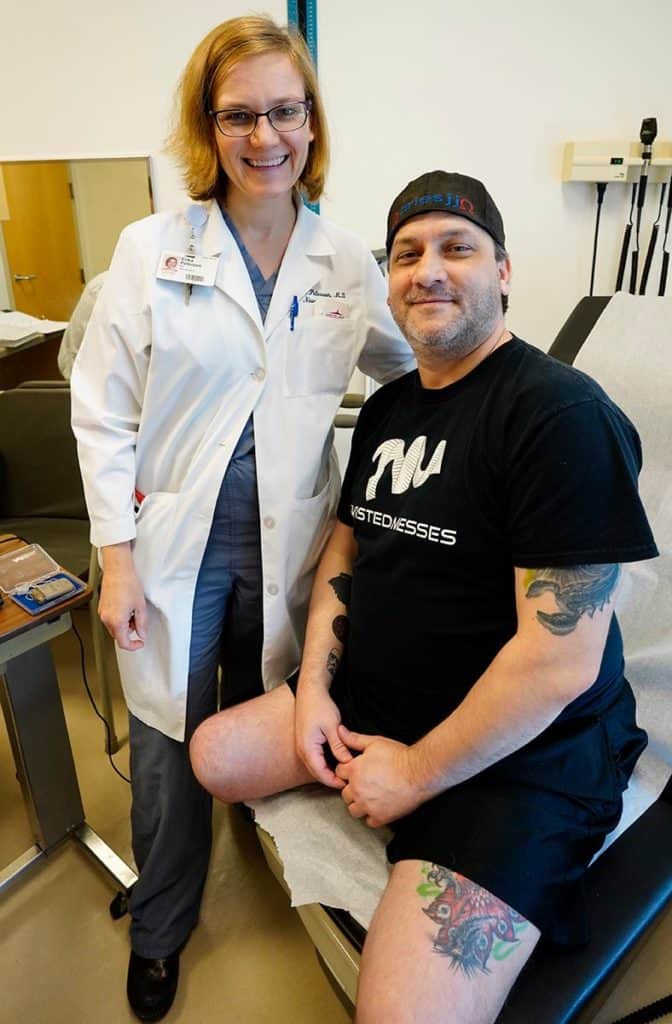
Erika Peterson, M.D., implanted the device in the thigh of Jared Jackson's amputated leg.
Erika Peterson, M.D., implanted the device in the thigh of Jared Jackson’s amputated leg.

amputation pain.

Led at UAMS by Erika Petersen, M.D., a neurosurgeon and researcher, the study is part of a clinical trial being conducted at sites across the United States.

The study is testing the safety and effectiveness of an implanted device, Altius® High Frequency Nerve Block, that is designed to block nerve signals and reduce pain in an amputated limb. The investigational device sends a high-frequency electrical signal to targeted nerves to block the nerve transmission. It was developed by Neuros Medical Inc., in Cleveland, Ohio.

Called the QUEST study (High-FreQUEncy Nerve Block for PoST-Amputation Pain, ClinicalTrials.gov Identifier: NCT02221934), it is a randomized, controlled clinical study of up to 180 patients, at up to 25 clinical study sites in the U.S.

Study participants will undergo surgery to be implanted with the device. It includes a cuff electrode, which is coiled around the nerve, and a pulse generator, which is similar to a pacemaker. Together they deliver an electrical signal to the nerve when activated. Once implanted, study participants can activate a 30-minute treatment session on demand, as needed for their pain. Participants will be followed for a year and seen in clinic once a month. They will also receive modest compensation for their time and travel.

Eligibility requirements for participating in the study include:

  • Having one amputated leg
  • Frequent and recurring amputation pain
  • 21 years of age or older

Those interested in learning if they are eligible may contact the UAMS Translational Research Institute study coordinator, 501-398-8622.

An earlier pilot study involving 10 participants demonstrated that the implant device may be safe and effective for post-amputation pain. (Soin A., Syed Shah N., Fang Z-P. 2015. High-Frequency Electrical Nerve Block for Postamputation Pain: A Pilot Study. Neuromodulation 2015; 18:197-206). DCO# 18-0030 / LB-0042 Rev. A / Effective May 23, 2018 Page 4 of 11.

The project described is supported by the Translational Research Institute (TRI), grant 1U54TR001629-01A1 through the National Center for Advancing Translational Sciences of the National Institutes of Health (NIH). The content is solely the responsibility of the authors and does not necessarily represent the official views of the NIH.

UAMS is the state’s only health sciences university, with colleges of Medicine, Nursing, Pharmacy, Health Professions and Public Health; a graduate school; hospital; northwest Arkansas regional campus; statewide network of regional centers; and six institutes: the Winthrop P. Rockefeller Cancer Institute, Jackson T. Stephens Spine & Neurosciences Institute, Harvey & Bernice Jones Eye Institute, Psychiatric Research Institute, Donald W. Reynolds Institute on Aging and Translational Research Institute. It is the only adult Level 1 trauma center in the state. UAMS has 2,834 students, 822 medical residents and six dental residents. It is the state’s largest public employer with more than 10,000 employees, including 1,200 physicians who provide care to patients at UAMS, its regional campuses throughout the state, Arkansas Children’s Hospital, the VA Medical Center and Baptist Health. Visit www.uams.edu or www.uamshealth.com. Find us on Facebook, Twitter, YouTube or Instagram.

Filed Under: Front, News, Newsroom Tagged With: amputation, clinical trial, implant, pain, Petersen, research, Translational Research Institute, TRI, UAMS, University of Arkansas for Medical Sciences

Translational Research Institute LogoTranslational Research InstituteTranslational Research Institute
Mailing Address: 4301 West Markham Street, Little Rock, AR 72205
Phone: (501) 686-7000
  • Facebook
  • X
  • Instagram
  • YouTube
  • LinkedIn
  • Pinterest
  • Disclaimer
  • Terms of Use
  • Privacy Statement
  • Legal Notices

© 2025 University of Arkansas for Medical Sciences