• Skip to primary navigation
  • Skip to main content
  • Skip to primary navigation
  • Skip to main content
Choose which site to search.
University of Arkansas for Medical Sciences Logo University of Arkansas for Medical Sciences
Translational Research Institute
  • UAMS Health
  • Jobs
  • Giving
  • About TRI
    • What We Offer
    • Leadership & Governance
    • Staff
    • Citing Translational Research Institute CTSA Support
    • What is Translational Research?
    • Contact TRI
  • Funding Opportunities
    • Grants
      • Pilot Award Program
      • ARLife Small Grants Program
      • Team Science Voucher Program
      • Consortium of Rural States (CORES) Multi-Institutional Pilot Award Program
      • Winthrop P. Rockefeller Cancer Institute Rural Research Award Program
    • Scholarships
      • K12 Mentored Research Career Development Scholar Awards Program
      • Health Sciences Innovation and Entrepreneurship Postdoctoral Training Program
      • Implementation Science Scholar Program
      • Strategies for Training and Advancing Researchers (STARs) Program
      • Scholars in Mentored Applied Research & Translational Science (SMART) Program
    • Community
      • Community Based Participatory Research (CBPR) Scholars Program
      • Community Partners Educated as Arkansas Research Leaders (CPEARL) Program
    • Awardee Responsibilities
  • Services & Resources
    • Services
      • Biostatistics, Epidemiology and Research Design (BERD) Consultation
      • Clinical Data Repository (AR-CDR)
      • Comprehensive Informatics Resource Core
      • Mock Study Sections
      • Research Participant Recruitment
      • Research Support: Clinical Trials Innovation Unit (CTIU)
      • Implementation Science Program
      • Research Ethics Consultation
    • Resources
      • ARresearch Registry
      • Center for Health Literacy
      • Data Safety Monitoring
      • Grant Writing & Dissemination
      • UAMS Profiles
      • UAMS Rural Research Network
      • Other Resources
      • COVID-19 Research Guidelines
      • Community Partner Research Training
  • Career Development & Scholarships
    • Scholarship Opportunities
      • K12 Mentored Research Career Development Scholar Awards Program
      • Health Sciences Innovation and Entrepreneurship Postdoctoral Training Program
      • Data Science Scholars Program
      • Implementation Science Scholar Program
      • SMART Program
      • Translational Research Innovations and Partners (TRIP) Program
    • Training & Educational Opportunities
      • innOVATION Seminar Series
      • Path 2 K Program
      • Translational Workforce Development
      • Graduate Certificate in Implementation Science
      • SMART Program [Master’s in Clinical and Translational Sciences (MS-CTS)]
      • Good Clinical Practice Training
    • Didactic Training
  • Community
    • Community Engagement Leadership
    • Community Advisory Board
    • Community Engagement Partners
      • Community Partner Celebration
      • Faith-Academic Initiatives for Transforming Health (FAITH) Network
    • Community Engagement Services
      • Consultations and Technical Assistance
      • Community Review Boards
      • Community Partner Research Training
      • Equipment Library
    • Programs and Funding
      • Community Partners Educated as Arkansas Research Leaders (CPEARL) Program
      • Community Based Participatory Research (CBPR) Scholars Program
      • Community Scientist Academy
    • Toolkits
      • CSA Online Toolkit
  • Events
    • Research Day
    • Clinical Trials Learning Collaborative
  • Newsroom
  1. University of Arkansas for Medical Sciences
  2. Translational Research Institute
  3. News
  4. Page 29

News

UAMS TRI Receives $3.5 Million To Help Speed Discovery

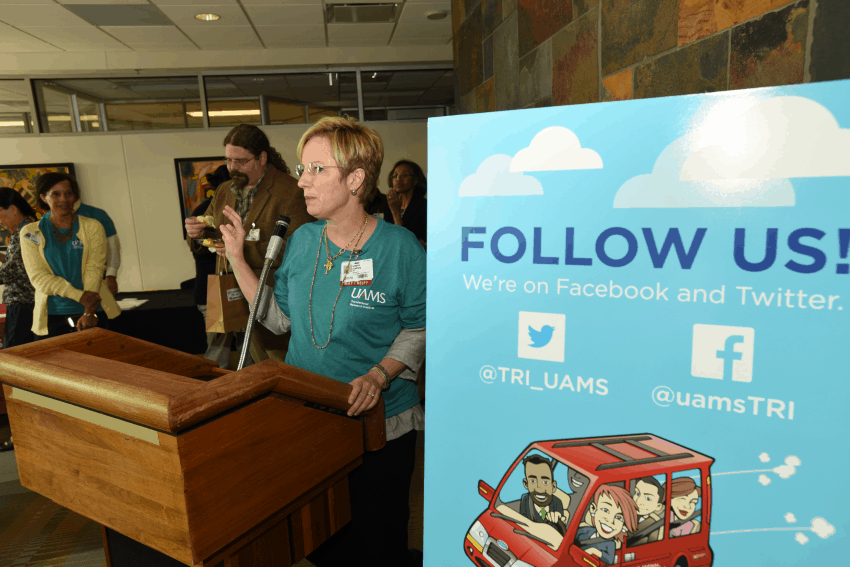
TRI Director Laura James, M.D., speaks to researchers at the recent TRI Open House.

The UAMS Translational Research Institute has received funding for a Clinical and Translational Science Award (CTSA) totaling $3,497,558 through Aug. 31, 2018.

The 11 months of funding comes from the National Center for Advancing Translational Sciences (NCATS) of the National Institutes of Health (NIH). It will enable UAMS to continue its mission of accelerating scientific discovery with innovative programs that help researchers translate their findings into new knowledge and treatments, said Translational Research Institute Director Laura James, M.D., UAMS associate vice chancellor for clinical and translational research.

“This is a significant federal research award for Arkansas,” said James, also principal investigator for the award. “We are very excited and proud to receive this award so that we can expand translational research at UAMS and improve the health of Arkansans through collaboration with our partner institutions – the Arkansas Children’s Research Institute and the Central Arkansas Veterans Healthcare System.”

The Translational Research Institute will apply for five years of CTSA funding in May 2018. If the May application is fully funded, the award would likely total more than $25 million. The first CTSA grant was awarded to UAMS in 2009.

Receipt of the $3.5 million award ensures that UAMS remains a member of the national CTSA consortium, made up of 62 academic research institutions across the country.

“In essence, the CTSA is the most important NIH grant an institution can receive,” James said. “Consortium members work very closely with each other to develop transferable solutions that address many of today’s greatest human health challenges.”

As a CTSA-funded site, UAMS directly helps researchers overcome long-standing obstacles to their work and provides patients tremendous opportunities to participate in cutting-edge clinical trials, in which they receive new medications and/or benefit from new treatments that are not available commercially. In addition, UAMS will continue to harness extremely large data sets, in concert with other institutions, to develop state-of-the-art solutions to health challenges. For example, these types of studies allow UAMS to use available data to understand if one treatment is better than another treatment for complex health care problems, such as mental illness, diabetes and other diseases that are common in Arkansas.

“The UAMS Translational Research Institute has been a significant contributor to the CTSA consortium in helping it meet its goals,” said Lawrence Cornett, Ph.D., UAMS vice chancellor for research. “This award ensures that UAMS clinical and translational investigators have ready access to diverse resources and approaches that the Translational Research Institute provides. Moreover, our researchers will benefit from resources available at over 60 other institutions within the consortium.”

In the last three years, the Translational Research Institute has launched or improved several research resources that are now being used by the UAMS research community:

  • ARresearch.org, a volunteer research participant registry and website, was established in collaboration with lay members of the community so that researchers have access to a pool of over 3,600 individuals who have indicated an interest in hearing more about research volunteer opportunities.
  • Arkansas Clinical Data Repository, a research data warehouse with de-identified patient data that researchers can use to understand patterns in data that will provide a framework to guide future studies testing new research treatments or approaches.
  • UAMS Profiles, an online researcher-to-researcher networking/collaboration tool, which gives researchers a user-friendly way to locate potential research partners locally and nationally.
  • TRI Portal, a cost-saving electronic request system for researchers, which allows the researcher to select from a menu of over 30 unique services and receive customized help with a research-related task in an efficient manner.

The Translational Research Institute (TRI) partners with the UAMS Fay W. Boozman College of Public Health to provide a robust community engagement program to increase public involvement and participation in research at UAMS. Representative components of the program include:

  • TRI’s Community Advisory Board, a board whose members represent multiple grassroots segments of the state’s population. The board provides critical viewpoints, including perspectives that researchers need to make their studies operational.
  • TRI’s Community Scientist Academy, which teaches the public how research is conducted and provides readiness training so that community members can serve as consultants to researchers and help plan the design and tools used in the research.

Additional components of the new CTSA award include funds to start a new informatics research consultation service, a new research subject recruitment program, and statistical services to ensure studies are properly designed to answer research questions. Other new programs that will be provided by the grant are dissemination services, so that the findings of research studies are communicated to numerous audiences, including research participants, the local community, other researchers, treating physicians and national audiences.

“The new grant allows us to get services to researchers, but more importantly, it allows UAMS, and our research partners, to tackle the health challenges we face here in Arkansas,” James said. “Our mission goes beyond research and really helps us as an academic community take better care of patients. The secondary effects of this grant will have a very important impact on Arkansas that includes benefits to our local workforce, economy and productivity as Arkansans.”

The NCATS/NIH award is under Award Number U54TR001629.

UAMS is the state’s only health sciences university, with colleges of Medicine, Nursing, Pharmacy, Health Professions and Public Health; a graduate school; hospital; northwest Arkansas regional campus; statewide network of regional centers; and seven institutes: the Winthrop P. Rockefeller Cancer Institute, Jackson T. Stephens Spine & Neurosciences Institute, Myeloma Institute, Harvey & Bernice Jones Eye Institute, Psychiatric Research Institute, Donald W. Reynolds Institute on Aging and Translational Research Institute. It is the only adult Level 1 trauma center in the state. UAMS has 2,834 students, 822 medical residents and six dental residents. It is the state’s largest public employer with more than 10,000 employees, including 1,200 physicians who provide care to patients at UAMS, its regional campuses throughout the state, Arkansas Children’s Hospital, the VA Medical Center and Baptist Health. Visit www.uams.edu or www.uamshealth.com. Find us on Facebook, Twitter, YouTube or Instagram.

Filed Under: Front, News, Newsroom

Speed Collaborating Event Creates New Research Opportunities

UAMS’ first Speed Collaborating event was so productive for at least one researcher that she joked she now has too many collaboration options.

The two-hour gathering Oct. 5 drew 34 UAMS faculty. Researchers were paired based on their top five research interests and were given 5-10 minutes to discuss potential collaborations. After each brief session, they were paired with another researcher.

Participants who filled out an evaluation form following the event all rated it as either excellent or good. A sampling of their comments include:

  • “This was so good now I have too many collaboration options lol”
  • “The best thing about the event was meeting folks from across campus and hearing about different lines of research going on all over UAMS.”
  • “Thank you very much for the organization. This was something new and exciting I’ve never seen done before. I enjoyed meeting new people!”
  • “What a wonderful networking opportunity, thank you!”

The event was led by the Women’s Faculty Development Caucus Research Committee with support from the UAMS Faculty Center, the Translational Research Institute (TRI) and Office of Interprofessional Education.

Filed Under: Front, News Tagged With: Collaboration, Lisa Brents, research, Robert Reis, Translational Research Institute, UAMS

TRI Calls for Community Partner Award Nominees

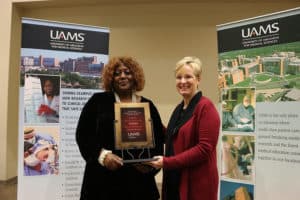
Naomi Cottoms and the Tri County Rural Health Network won the Chancellor's Award in 2016.
Naomi Cottoms and the Tri County Rural Health Network won the Chancellor’s Award in 2016.

Do you know a UAMS community or institutional partner that should be recognized for their collaboration with UAMS? The Translational Research Institute (TRI) is seeking nominations from faculty and staff for its fifth annual UAMS Community Partner Celebration on Nov. 17. This celebration recognizes the outstanding community partners that have helped make our various endeavors possible, whether it involves research, education and training, or services.

This year, we are happy to announce four new awards:

  • Community Partnership Student Award
  • Institutional Health Partner Award
  • Community-Based Organization of the Year Award
  • Community Advisory Board of the Year Award

We’re also seeking nominees for the Chancellor’s Community Research Partner Award.

Learn more and submit your community partner nominees!

The deadline for submissions to recognize community partners and submissions for the Chancellor’s Community Research Partner Award is Oct. 12. For more information, contact Rachel Hale, rbhale@uams.edu or 501-526-6628.

Filed Under: Front, News, Newsroom

TRI Research and Career Development Seminar Series Begins Sept. 22

The TRI Research and Career Development Seminar Series resumes Friday, Sept. 22, 8:30 – 10 a.m., in the ED II Building, G112 A/B.

Jean McSweeney, Ph.D., R.N., will present, “ARresearch – UAMS’ Research Volunteer Registry.” Learn about the ARresearch Registry, how TRI recruits, and how you can use it for your research.

McSweeney is associate dean for research and professor and co-director of the Ph.D. program in the UAMS College of Nursing. She is the TRI liaison to Recruitment Innovation Centers and faculty leader for the TRI Recruitment Unit Team.
The seminar series is sponsored by the TRI KL2 Mentored Research Career Development Program.

Download PDF

Filed Under: Front, News, Newsroom

First TRI Open House Draws More than 100

Sarah Rhoads, Ph.D., D.N.P., visits with TRI’s Nia Indelicato and Amy Jo Jenkins.

The first Open House for the UAMS Translational Research Institute (TRI) drew more than 100 attendees from UAMS’ research community interested in learning about the resources and services offered by TRI.

TRI held the open house as a fun way to introduce itself to new researchers and for others to learn more about what all TRI has to offer. In addition to the 19 featured research services, the event included food and wine, as well as door prizes.

Both new and veteran UAMS researchers echoed their approval.

Hari Eswaran, Ph.D., a long-time professor in the College of Medicine Department of Obstetrics and Gynecology, said he was familiar with many of TRI’s offerings, but he discovered more during the open house.

TRI-supported services and resources on display included those of its Clinical Trials Innovation Unit, community engagement, participant recruitment, pilot awards, KL2 scholar awards, biostatistics, biomedical informatics, implementation science and entrepreneurship initiatives.

“Everybody knows TRI but probably not the whole gamut of what they do,” Eswaran said. “For example, I didn’t know about their implementation science function.”

Carolyn Greene, Ph.D., an associate professor in the Department of Psychiatry who is new to UAMS, said she was pleasantly surprised by the event.

“I’m really impressed by all the resources in one place,” she said. “Everything I need is right here.”

Sarah Rhoads, Ph.D., D.N.P., was also happy with the event. “I like how I can see everything that TRI offers, from A to Z, in one place.”

TRI’s Kate Stewart, M.D., M.P.H., and Anna Huff, (seated) speak with attendees about TRI’s Community Engagement Program.

TRI Director Laura James, M.D., said she plans to hold the Open House annually.

Filed Under: Front, News Tagged With: Laura James, Open House, research, Resources, Sarah Rhoads, Services, Translational Research Institute, TRI

July/August TRIbune

Our latest TRIbune newsletter highlights data from the ARresearch.org database of nearly 3,500 registrants that is sure to be of interest to UAMS researchers. This issue’s TRIbutary reflects on our Research Mentoring Workshop held this summer, and our TRI & Me features Jonathan Young, a leader in our Clinical Trials Innovation Unit (CTIU). You’ll also want to check out all the new publications by UAMS researchers who cited TRI for its support.

Download PDF

Filed Under: Front, News, Newsroom

TRI Open House Aug. 29!

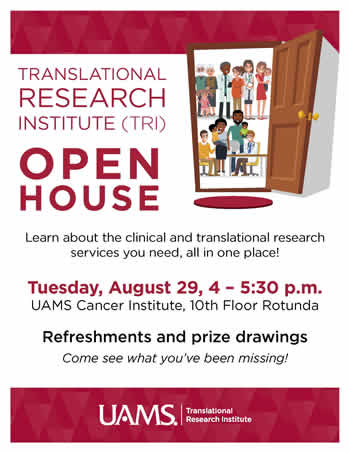
The UAMS Translational Research Institute (TRI) will host an open house to showcase its many clinical and translational research services, Tuesday, Aug. 29, 4-5:30 p.m., in the Cancer Institute, 10th floor rotunda. We’ll have wine (starting at 4:30) and hors d’oeuvres as well as prize drawings. Best of all, you’ll get to meet the dedicated TRI employees who are providing these important services.

We’ll help you navigate the research process and arm you with the information needed to execute your study as efficiently as possible. Come see what you’ve been missing!

View Flyer

Filed Under: Front, News, Newsroom

TRI Issues Call for KL2 Scholar Applications

The UAMS Translational Research Institute (TRI) is pleased to invite full applications for 2017 TRI KL2 Mentored Research Career Development Scholar Award Program. The KL2 Scholar Awards provide support for early career UAMS faculty with a professional degree (M.D., Ph.D., Pharm.D., D.N.P., Dr.PH., D.O., etc.) who are committed to an academic career in multidisciplinary clinical or translational research.

The KL2 Scholar Award is a two-year program of intensive training in clinical and/or translational science research, combining an innovative educational program with mentored clinical/translational science research.

KL2 Scholars will receive:

  • Salary support/stipend of up to $95,000 (including fringe) per year.
  • Up to $25,000 of support per year for research, tuition, travel and educational materials.

Important Dates

  • August 23, 2017: KL2 Informational Session (4:00 p.m. – 5:00 p.m. Stephens Spine Institute Building 11th floor conference room, or join session via Blackboard Collaborate)
  • August 28, 2017 at 5:00 p.m.: Letter of Intent (LOI) due
  • September 15, 2017 at 12 p.m. (noon): Full applications due
  • September 29, 2017:  Awardees announced
  • October 1, 2017:  Scholar start date and earliest possible project start date

Read the Request for Applications

Read our Frequently Asked Questions

Filed Under: Front, News, Newsroom

NCATS Day

First NCATS Day Demonstrates Commitment to Patients Through Smarter Science

 Translational Research Institute
The Translational Research Institute’s Camille Hart, program manager for community engagement, attended NCATS Day with an eye for information that would be of interest to community partners — both organizations and individuals — back in Arkansas. Daniel Soñé Photography.

To gain more insight about patients’ needs and discuss opportunities to integrate the patient perspective into translational research, NCATS convened the first NCATS Day on June 30, 2017, on the NIH campus in Bethesda, Maryland. More than 150 people attended, including patients, their families and other caregivers, and representatives of more than 75 patient and disease advocacy groups.

With a theme of “Partnering with Patients for Smarter Science,” the all-day event enabled participants to learn more about NCATS and research supported by the Center. It also served as a forum for NCATS staff and researchers to hear directly from patients about their needs, establish new communication channels or strengthen existing ones and identify ways to enhance patient participation in research.

Read the full story…

Filed Under: Front, News, Newsroom

Strong Mentorship Helps Researcher Discover Success

UAMS’ Craig Forrest, Ph.D., (left), credits his former mentors, Usha Ponnappan, Ph.D., and Xuming Zhang, Ph.D., D.V.M., with his early success.

Craig Forrest, Ph.D., recalled the day four years ago when one of his Department of Microbiology and Immunology mentors, Xuming  Zhang, Ph.D., D.V.M., came looking for him.

Forrest had sought input from Zhang and mentor Usha Ponnappan, Ph.D., on his first NIH National Cancer Institute grant application. Zhang found him in a fifth-floor lab of the Biomedical One building. There, standing at the freezer, the two had one of the more consequential mentoring sessions of Forrest’s early career.

“This is all wrong,” Zhang said, presenting his marked-up copy with an outline and arrows showing Forrest how to more effectively make his case.

“He knew exactly what he was doing,” Forrest said.

Ponnappan, who joined UAMS 25 years ago, and Zhang, who joined UAMS 20 years ago, said their approaches to mentoring are grounded in their own experiences as junior faculty.

Zhang, as an early career researcher, recalled his own need for the kind of detailed review he gave Forrest’s application. He loved getting thorough critiques from his mentors and colleagues because it gave him a better chance of being funded. Today, Zhang can bring to bear his expertise in the field and experience as an NIH reviewer to help mentees.

“Based on my own experience, for basic science faculty you have to have an NIH grant to be successful,” he said. “Without a grant, you can’t get promoted.”

Leading up to his grant submission, Forrest would pop into the offices of Ponnappan and Zhang to ask questions. “I bothered them constantly.”

Their advice was incorporated into his application, which achieved a rare perfect grant score and a five-year NCI grant totaling $1.83 million. The grant is helping further work on his discovery of a protein with a significant role in controlling herpes infections. Forrest’s early data gathering and a surprise discovery that were cornerstones of his grant application were supported by a UAMS Translational Research Institute pilot award and a COBRE grant.

The NIH application reviewers said they anticipate that his research “may reveal novel therapeutic targets,” and concluded, “In sum, there is considerable enthusiasm for the talented new investigator (Forrest) and the proposed work ….”

Forrest and his team have published three papers so far, and have three more in the works. He’s also filed a patent application through BioVentures.

Mentoring traditionally has been an informal practice, although some departments, such as Microbiology and Immunology in the UAMS College of Medicine, have a prescribed process. Department Chair Richard P. Morrison, Ph.D., started an official mentoring program eight years ago.  He describes it as “simple, straightforward and non-overbearing.”

Each junior faculty member has a three-person mentoring committee. The committees meet with the mentees once a semester to discuss progress and goals, followed by a written report.

Over the program’s eight years, the department’s five most senior junior faculty have produced five R01’s, three R21’s and three K22 awards – and all have received promotion and tenure, Morrison said.

Ponnappan and Zhang also helped Forrest become an associate professor, marking the official end of a six-year mentor-mentee relationship.

“Once they got me through the tenure process, it was kind of over,” Forrest said. “I’m on my own now, although I haven’t completely been away from them.”

Ponnappan said Forrest was a like a sponge and a pleasure to mentor. “He lives science,” she said. “His success is his own success. We just pointed him in right direction, that’s all.”

Forrest is now breaking new ground as a mentor himself, sitting on mentoring committees where he can learn from senior faculty.

He already has a key piece of advice for junior faculty, telling them, “Make sure you use your mentors.”

Seats Still Available for TRI-Sponsored Mentoring Workshop

UAMS researchers are invited to a free, day-long workshop on June 22 to help improve their mentoring skills.

The workshop will be 8:30 a.m. – 3:30 p.m. at the Reynolds Institute on Aging, Room 1190.

Lunch will be provided.

Sponsored by TRI, the mentor training workshop is modeled after the nationally recognized University of Wisconsin-Madison Center for the Improvement of Mentored Experiences in Research (CIMER) curriculum. Facilitators Mary Aitken, M.D., M.P.H., and Beatrice Boateng, Ph.D., have received CIMER certification to offer mentor training at UAMS.

Contact: Donna Mattingly, dmattingly@uams.edu, or (501) 614-2287.

View flyer

Filed Under: Front, News

  • «Previous Page
  • Page 1
  • Interim pages omitted …
  • Page 27
  • Page 28
  • Page 29
  • Page 30
  • Page 31
  • Interim pages omitted …
  • Page 48
  • Next Page»
Translational Research Institute LogoTranslational Research InstituteTranslational Research Institute
Mailing Address: 4301 West Markham Street, Little Rock, AR 72205
Phone: (501) 686-7000
  • Facebook
  • X
  • Instagram
  • YouTube
  • LinkedIn
  • Pinterest
  • Disclaimer
  • Terms of Use
  • Privacy Statement
  • Legal Notices

© 2026 University of Arkansas for Medical Sciences