• Skip to primary navigation
  • Skip to main content
  • Skip to primary navigation
  • Skip to main content
Choose which site to search.
University of Arkansas for Medical Sciences Logo University of Arkansas for Medical Sciences
Translational Research Institute
  • UAMS Health
  • Jobs
  • Giving
  • About TRI
    • What We Offer
    • Leadership & Governance
    • Staff
    • Cite TRI
    • What is Translational Research?
    • Contact TRI
  • Funding Opportunities
    • Grants
      • Pilot Award Program
      • Consortium of Rural States (CORES) Multi-Institutional Pilot Award Program
      • Team Science Voucher Program
      • Winthrop P. Rockefeller Cancer Institute Rural Research Award Program
    • Scholarships
      • K12 Mentored Research Career Development Scholar Awards Program
      • Health Sciences Innovation and Entrepreneurship Postdoctoral Training Program
      • Implementation Science Scholar Program
      • (STARs) Program – Strategies for Training and Advancing Researchers
      • SMART Program [Master’s in Clinical and Translational Sciences (MS-CTS)]
    • Community
      • Community Based Participatory Research (CBPR) Scholars Program
      • Community Partners Educated as Arkansas Research Leaders (CPEARL) Program
    • Awardee Responsibilities
  • Services & Resources
    • Services
      • Biostatistics, Epidemiology and Research Design (BERD) Consultation
      • Clinical Data Repository (AR-CDR)
      • Comprehensive Informatics Resource Core
      • Mock Study Sections
      • Research Participant Recruitment
      • Research Support: Clinical Trials Innovation Unit (CTIU)
      • Implementation Science Program
      • Research Ethics Consultation
    • Resources
      • ARresearch Registry
      • Center for Health Literacy
      • Data Safety Monitoring
      • Grant Writing & Dissemination
      • UAMS Profiles
      • UAMS Rural Research Network
      • Other Resources
      • COVID-19 Research Guidelines
      • Community Partner Research Training
  • Career Development & Scholarships
    • Scholarship Opportunities
      • K12 Mentored Research Career Development Scholar Awards Program
      • Health Sciences Innovation and Entrepreneurship Postdoctoral Training Program
      • Data Science Scholars Program
      • Implementation Science Scholar Program
      • SMART Program
      • Translational Research Innovations and Partners (TRIP) Program
    • Training & Educational Opportunities
      • innOVATION Seminar Series
      • Path 2 K Program
      • Translational Workforce Development
      • Graduate Certificate in Implementation Science
      • SMART Program [Master’s in Clinical and Translational Sciences (MS-CTS)]
      • Good Clinical Practice Training
    • Didactic Training
  • Community
    • Community Engagement Leadership
    • Community Advisory Board
    • Community Engagement Partners
      • Community Partner Celebration
      • Faith-Academic Initiatives for Transforming Health (FAITH) Network
    • Community Engagement Services
      • Consultations and Technical Assistance
      • Community Review Boards
      • Community Partner Research Training
      • Equipment Library
    • Programs and Funding
      • Community Partners Educated as Arkansas Research Leaders (CPEARL) Program
      • Community Based Participatory Research (CBPR) Scholars Program
      • Community Scientist Academy
    • Toolkits
      • CSA Online Toolkit
      • CPEARL Toolkit
  • Events
    • Research Day
    • Clinical Trials Learning Collaborative
  • Newsroom
  1. University of Arkansas for Medical Sciences
  2. Translational Research Institute
  3. Strong Mentorship Helps Researcher Discover Success

Strong Mentorship Helps Researcher Discover Success

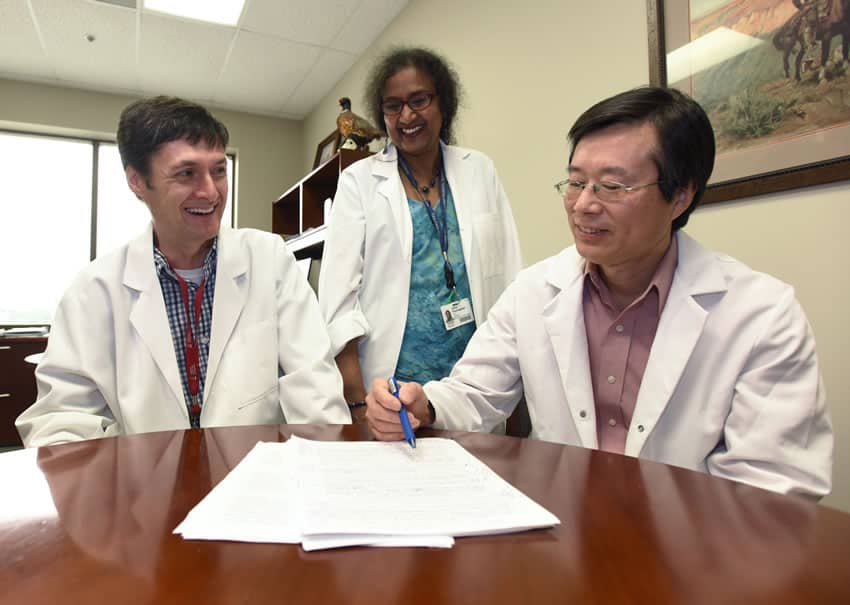
UAMS’ Craig Forrest, Ph.D., (left), credits his former mentors, Usha Ponnappan, Ph.D., and Xuming Zhang, Ph.D., D.V.M., with his early success.

Craig Forrest, Ph.D., recalled the day four years ago when one of his Department of Microbiology and Immunology mentors, Xuming  Zhang, Ph.D., D.V.M., came looking for him.

Forrest had sought input from Zhang and mentor Usha Ponnappan, Ph.D., on his first NIH National Cancer Institute grant application. Zhang found him in a fifth-floor lab of the Biomedical One building. There, standing at the freezer, the two had one of the more consequential mentoring sessions of Forrest’s early career.

“This is all wrong,” Zhang said, presenting his marked-up copy with an outline and arrows showing Forrest how to more effectively make his case.

“He knew exactly what he was doing,” Forrest said.

Ponnappan, who joined UAMS 25 years ago, and Zhang, who joined UAMS 20 years ago, said their approaches to mentoring are grounded in their own experiences as junior faculty.

Zhang, as an early career researcher, recalled his own need for the kind of detailed review he gave Forrest’s application. He loved getting thorough critiques from his mentors and colleagues because it gave him a better chance of being funded. Today, Zhang can bring to bear his expertise in the field and experience as an NIH reviewer to help mentees.

“Based on my own experience, for basic science faculty you have to have an NIH grant to be successful,” he said. “Without a grant, you can’t get promoted.”

Leading up to his grant submission, Forrest would pop into the offices of Ponnappan and Zhang to ask questions. “I bothered them constantly.”

Their advice was incorporated into his application, which achieved a rare perfect grant score and a five-year NCI grant totaling $1.83 million. The grant is helping further work on his discovery of a protein with a significant role in controlling herpes infections. Forrest’s early data gathering and a surprise discovery that were cornerstones of his grant application were supported by a UAMS Translational Research Institute pilot award and a COBRE grant.

The NIH application reviewers said they anticipate that his research “may reveal novel therapeutic targets,” and concluded, “In sum, there is considerable enthusiasm for the talented new investigator (Forrest) and the proposed work ….”

Forrest and his team have published three papers so far, and have three more in the works. He’s also filed a patent application through BioVentures.

Mentoring traditionally has been an informal practice, although some departments, such as Microbiology and Immunology in the UAMS College of Medicine, have a prescribed process. Department Chair Richard P. Morrison, Ph.D., started an official mentoring program eight years ago.  He describes it as “simple, straightforward and non-overbearing.”

Each junior faculty member has a three-person mentoring committee. The committees meet with the mentees once a semester to discuss progress and goals, followed by a written report.

Over the program’s eight years, the department’s five most senior junior faculty have produced five R01’s, three R21’s and three K22 awards – and all have received promotion and tenure, Morrison said.

Ponnappan and Zhang also helped Forrest become an associate professor, marking the official end of a six-year mentor-mentee relationship.

“Once they got me through the tenure process, it was kind of over,” Forrest said. “I’m on my own now, although I haven’t completely been away from them.”

Ponnappan said Forrest was a like a sponge and a pleasure to mentor. “He lives science,” she said. “His success is his own success. We just pointed him in right direction, that’s all.”

Forrest is now breaking new ground as a mentor himself, sitting on mentoring committees where he can learn from senior faculty.

He already has a key piece of advice for junior faculty, telling them, “Make sure you use your mentors.”

Seats Still Available for TRI-Sponsored Mentoring Workshop

UAMS researchers are invited to a free, day-long workshop on June 22 to help improve their mentoring skills.

The workshop will be 8:30 a.m. – 3:30 p.m. at the Reynolds Institute on Aging, Room 1190.

Lunch will be provided.

Sponsored by TRI, the mentor training workshop is modeled after the nationally recognized University of Wisconsin-Madison Center for the Improvement of Mentored Experiences in Research (CIMER) curriculum. Facilitators Mary Aitken, M.D., M.P.H., and Beatrice Boateng, Ph.D., have received CIMER certification to offer mentor training at UAMS.

Contact: Donna Mattingly, dmattingly@uams.edu, or (501) 614-2287.

View flyer

Posted by uamsonline on June 6, 2017

Filed Under: Front, News

Translational Research Institute LogoTranslational Research InstituteTranslational Research Institute
Mailing Address: 4301 West Markham Street, Little Rock, AR 72205
Phone: (501) 686-7000
  • Facebook
  • X
  • Instagram
  • YouTube
  • LinkedIn
  • Pinterest
  • Disclaimer
  • Terms of Use
  • Privacy Statement
  • Legal Notices

© 2026 University of Arkansas for Medical Sciences