• Skip to primary navigation
  • Skip to main content
  • Skip to primary navigation
  • Skip to main content
Choose which site to search.
University of Arkansas for Medical Sciences Logo University of Arkansas for Medical Sciences
Translational Research Institute
  • UAMS Health
  • Jobs
  • Giving
  • About TRI
    • What We Offer
    • Leadership & Governance
    • Staff
    • Citing Translational Research Institute CTSA Support
    • What is Translational Research?
    • Contact TRI
  • Funding Opportunities
    • Grants
      • Pilot Award Program
      • Consortium of Rural States (CORES) Multi-Institutional Pilot Award Program
      • Team Science Voucher Program
      • Winthrop P. Rockefeller Cancer Institute Rural Research Award Program
    • Scholarships
      • K12 Mentored Research Career Development Scholar Awards Program
      • Health Sciences Innovation and Entrepreneurship Postdoctoral Training Program
      • Implementation Science Scholar Program
      • (STARs) Program – Strategies for Training and Advancing Researchers
      • SMART Program [Master’s in Clinical and Translational Sciences (MS-CTS)]
    • Community
      • Community Based Participatory Research (CBPR) Scholars Program
      • Community Partners Educated as Arkansas Research Leaders (CPEARL) Program
    • Awardee Responsibilities
  • Services & Resources
    • Services
      • Biostatistics, Epidemiology and Research Design (BERD) Consultation
      • Clinical Data Repository (AR-CDR)
      • Comprehensive Informatics Resource Core
      • Mock Study Sections
      • Research Participant Recruitment
      • Research Support: Clinical Trials Innovation Unit (CTIU)
      • Implementation Science Program
      • Research Ethics Consultation
    • Resources
      • ARresearch Registry
      • Center for Health Literacy
      • Data Safety Monitoring
      • Grant Writing & Dissemination
      • UAMS Profiles
      • UAMS Rural Research Network
      • Other Resources
      • COVID-19 Research Guidelines
      • Community Partner Research Training
  • Career Development & Scholarships
    • Scholarship Opportunities
      • K12 Mentored Research Career Development Scholar Awards Program
      • Health Sciences Innovation and Entrepreneurship Postdoctoral Training Program
      • Data Science Scholars Program
      • Implementation Science Scholar Program
      • SMART Program
      • Translational Research Innovations and Partners (TRIP) Program
    • Training & Educational Opportunities
      • innOVATION Seminar Series
      • Path 2 K Program
      • Translational Workforce Development
      • Graduate Certificate in Implementation Science
      • SMART Program [Master’s in Clinical and Translational Sciences (MS-CTS)]
      • Good Clinical Practice Training
    • Didactic Training
  • Community
    • Community Engagement Leadership
    • Community Advisory Board
    • Community Engagement Partners
      • Community Partner Celebration
      • Faith-Academic Initiatives for Transforming Health (FAITH) Network
    • Community Engagement Services
      • Consultations and Technical Assistance
      • Community Review Boards
      • Community Partner Research Training
      • Equipment Library
    • Programs and Funding
      • Community Partners Educated as Arkansas Research Leaders (CPEARL) Program
      • Community Based Participatory Research (CBPR) Scholars Program
      • Community Scientist Academy
    • Toolkits
      • CSA Online Toolkit
      • CPEARL Toolkit
  • Events
    • Research Day
    • Clinical Trials Learning Collaborative
  • Newsroom
  1. University of Arkansas for Medical Sciences
  2. Translational Research Institute
  3. Author: uamsonline
  4. Page 14

uamsonline

GCP Training Required by Jan. 1, 2017

Amy Jo Jenkins, with Lawrence Cornett, Ph.D., presented about the GCP training requirement during the monthly RESIN meeting.

On Sept. 16, 2016, the National Institutes of Health (NIH) released its Policy on Good Clinical Practice (GCP) Training for NIH Awardees Involved in NIH-Funded Clinical Trials.  This policy applies to NIH-funded investigators and site staff who are responsible for the conduct, management and oversight of NIH-funded clinical trials. 

An NIH Clinical Trial is defined as research studies in which one or more human subjects are prospectively assigned to one or more interventions to evaluate the effects of those interventions on health-related biomedical or behavioral outcomes.  An intervention is defined as a manipulation of the subject or subject’s environment for the purpose of modifying one or more health-related biomedical or behavioral processes and/or endpoints.

Faculty who participate in industry-sponsored trials have already completed this training through industry-led GCP training conducted at site initiative visits. This information should be documented in study binders maintained by study staff.  

The Policy on GCP Training is effective Jan. 1, 2017.  

If you are currently conducting an NIH-funded clinical trial, you will need to complete your training prior to the first of the year.  There are two ways to do this:

  1. Complete GCP training using the CITI program.
  2. Send record/certificate of current GCP training (i.e., from industry-sponsored trial participation) to Catrice Banks-Johnson. 

NOTE: GCP training expires after 3 years.

If you have ambitions of conducting an NIH-funded clinical trial, you are highly encouraged to complete the training now! 

If you are a researcher and have determined this does not apply to you, you are highly encouraged to complete the training now! GCP training is likely to be mandated within the next 6-12 months, as many institutions, journals and other funding sources are trending toward this requirement.

If you have any questions, please contact one of the following institutional offices:

Amy Jo Jenkins
Translational Research Institute
686-5939
AJJenkins@uams.edu

Jennifer Holland
IRB
526-7559
JRHolland@uams.edu

Darri Scalzo
Office of Research Compliance
686-8062
DLScalzo@uams.edu

Larry Cornett, PhD
Office of the Vice Chancellor for Research
686-5347
CornettLawrenceE@uams.edu
Download Powerpoint

Or View on Slideshare

Filed Under: Front, News, Newsroom

Get Plugged in with Profiles Plug-In!

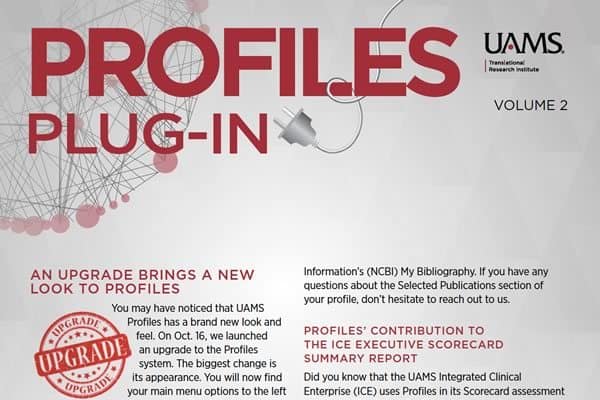
The UAMS Profiles newsletter, Profiles Plug-In, Volume 2, introduces users to the updated version of the Profiles website. TRI has dramatically improved the look and feel of the site. You’ll also learn how faculty information in Profiles is being used by the UAMS Integrated Clinical Enterprise (ICE) to help create its quarterly scorecard report.  

VIEW ARCHIVE

Profiles

Filed Under: Front, News, Newsroom

TRI Seeks Early-Career Researchers Interested in Becoming Grant Reviewers

TRI is looking for early-career investigators at UAMS/ACRI/CAVHS who are interested in participating in mentored grant reviews.

This learning opportunity will include mentored reviews of TRI-sponsored pilot awards and KL2 Scholar awards along with independent training utilizing NIH resources.

If you are interested, please submit this brief form. After collecting names through the end of the year, TRI will contact registrants about next steps.  

Filed Under: Front, News, Newsroom Tagged With: early career, grant reviewer, researchers, Translational Research Institute, UAMS

UAMS Staff Recognized by International Group for Research Education Efforts

socra6x42
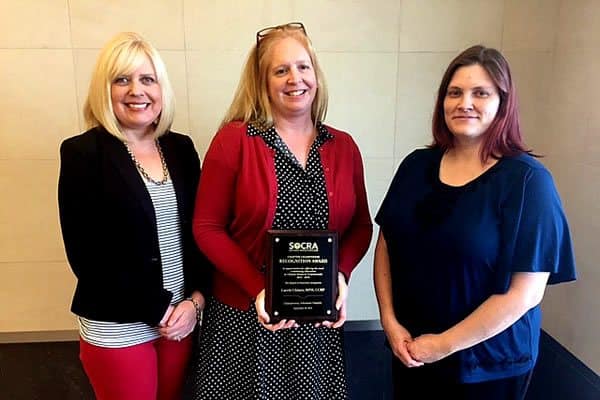
UAMS employees Carrie Chiaro (center) and Melisa Clark (right) co-chair the Arkansas chapter of SOCRA. Amy Jo Jenkins (left) is a past co-chair and has been elected to SOCRA’s Board of Directors.

For a record fifth year in a row, the Arkansas chapter of the international Society of Clinical Research Associates (SOCRA) has been recognized for ensuring the highest quality research by providing the most continuing education hours of any chapter. The annual Chapter Chairperson Recognition Award was presented to Carrie Chiaro, M.P.H., C.C.R.P., from the UAMS Office of Research Compliance, who co-chairs the SOCRA chapter with Melisa Clark, M.S., C.C.R.P., from the UAMS Office of Research Regulatory Affairs.

SOCRA Executive Director Erich Lukas, MBA, said the Arkansas chapter is the only one of 63 volunteer chapters to win the award five consecutive years.

“The success of the Arkansas chapter is a testimony to the support from Arkansas’ research institutions, the dedication of the chapter’s leaders, and the commitment of the chapter’s program participants,” Lukas said.

SOCRA chapters offer no-cost clinical research continuing education to enhance research quality, to protect research participants, and to improve the health of the global community.

Also during the annual meeting in Montreal, Amy Jo Jenkins, M.S., C.C.R.P., C.C.R.A., C.C.R.C., from the UAMS Translational Research Institute, was elected to the SOCRA Board of Directors. Jenkins, a past chapter chairperson, said the chapter’s continued success is due to the participation, collaboration, and common goals of the state’s research professionals.

“UAMS’ support, particularly from the Office of the Vice Chancellor for Research, the Translational Research Institute, Office of Research Regulatory Affairs, and the Office of Research Compliance, has allowed the chapter to flourish over the last five years,” Jenkins said. “While the award is technically given to one person, we know that it is our whole membership and those that support us that contribute to our success.”

The Arkansas chapter provided 22 continuing education credit hours from June 1, 2015, to May 31, 2016.

“The continuing education we provide ultimately improves the quality of research in our state and enhances the experience and protection of our valued participants,” Jenkins said.

Carrie Chiaro (right) accepted the award on behalf of the SOCRA chapter during the group’s annual meeting in Montreal.

The chapter also provides an avenue for career growth and development, including training and resources for new research staff and the opportunity to earn an accredited professional certification (Certified Clinical Research Professional – CCRP) that is recognized internationally by the clinical research industry as evidence of advanced competency in the profession.

The continuing education hours offered by the Arkansas SOCRA chapter also help research staff at UAMS and other sites earn or maintain their Certified Research Specialist (CRS) certification. The CRS certification program, administered by the UAMS Office of Research Compliance, ensures an understanding of, and respect for, the principles of research integrity and the protection of those who participate in research. Although the certification is not required by all departments, UAMS research employees routinely complete the 26 hours of coursework and the comprehensive CRS proficiency exam.

Filed Under: Front, News, Newsroom

TRI Launches UAMS Profiles Site Upgrade

profiles-image

The UAMS Profiles website received a significant upgrade Oct. 16 to improve user experience. Profiles, a faculty networking tool, can be accessed through the TRI webpageTRI.uams.edu, where you’ll find the UAMS Profiles link. If you have any questions, issues, or general feedback, please email the Profiles team at TRIservices@uams.edu.

Filed Under: Front, News, Newsroom

Help TRI Recognize Our UAMS Community Partners!

community-partner-celebration

The Translational Research Institute is seeking nominations from faculty and staff for its fourth annual UAMS Community Partner Celebration on Nov. 18. This celebration recognizes the outstanding community partners that have helped make our various endeavors possible, whether it involves research, education and training, or services.

Get the details and submit your community partner nominees here!

See our honorees from past years. Former honorees will be invited to attend the celebration.

NEW AWARD!!! We are happy to announce that this year we will also be awarding the inaugural Chancellor’s Community Research Partner Award. Nominate partners for the Chancellor’s Community Research Partner here!

The deadline for submissions to recognize community partners and submissions for the Chancellor’s Community Research Partner Award is Oct. 12. For more information, contact Camille Hart at cnhart@uams.edu or 501-454-1467

Filed Under: Front, News, Newsroom

‘Dos & Don’ts of Community Engagement’ Workshop for Researchers

A new workshop on the Dos and Don’ts of Community Engagement is being offered to researchers, students and staff, Oct. 18, 1 – 5 p.m., College of Public Health, G232.

The workshop was developed by the Translational Research Institute, College of Public Health and UAMS’ community partners. The workshop will include simulation and role reversal, video testimonials, and group reflection and debriefing.  The objective is to increase researchers’ knowledge of the dos and don’ts of community engaged research in the research domains of entering the community; the realities and constraints of community-based organizations; and dissemination.

The workshop is supported by the Arkansas Prevention Research Center and the Arkansas Center for Health Disparities.

For more information, contact jcoffey@uams.edu.

Filed Under: Front, News, Newsroom Tagged With: Community Engagement, Dos and Don'ts, research, Translational Research Institute, TRI, UAMS, University of Arkansas for Medical Sciences

First UAMS Community Scientist Academy Graduates 17

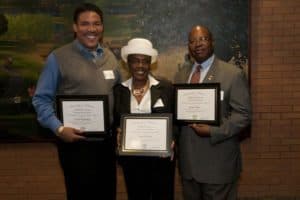
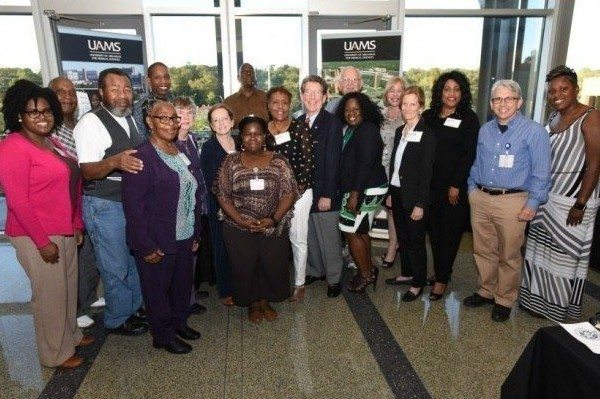
Community Scientist Academy graduates along with UAMS faculty and staff are (l-r): Camille Hart (staff), Charles Moore (back), Carl Farr, Sarah Facen, David Miller (back), Pat Kissire, Virginia Wilhelm, Nicki Spencer (staff), Willie Wade (back), Onie Norman, Larry Taylor, Marvin Hayenga (back), Sylvia Halliburton, Mary Aitken (faculty), Kate Stewart (faculty), Esther Dixon, David Robinson (staff) and Kimberly Moore. (Not pictured: Marilyn Bailey-Jefferson, Freeman McKindra, Suzanne Overgaard and Joy Rockenbach)

Seventeen Arkansans were recently recognized for their participation in the first UAMS Community Scientist Academy.

The UAMS Translational Research Institute piloted the academy to help citizens better understand how research is done at UAMS and to prepare them for bigger roles as volunteers. A second Community Scientist Academy is being planned for spring 2017.

The graduation ceremony Sept. 29 included remarks from UAMS research leaders Kate Stewart, M.D., M.P.H., and Mary Aitken, M.D., M.P.H., and statements of appreciation from several participants. Stewart leads the Translational Research Institute’s Community Engagement program. Aitken is a veteran community-based researcher who is well known for injury prevention work, especially ATV safety. She also co-leads the Translational Research Institute’s KL2 Mentored Research Career Development Award program to help train the next generation of translational researchers.

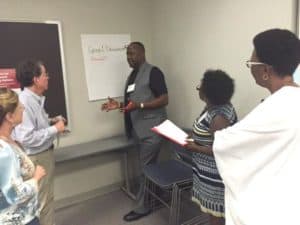
Willie Wade of Hot Springs discusses his idea for a research study during a class exercise.

Willy Wade Jr., founder and executive director of Difference Makers in Hot Springs, said what he learned about research at the academy can help him better serve poor

communities.

“I’ve been appointed to a few boards that are doing some research, so these tools will come in very handy in helping us determine different ways we want to tackle some problems and issues,” Wade said.

During weekly evening classes, attendees learned about the types of research at UAMS and steps in the study process, including Institutional Review Board approval to ensure the safety and ethical treatment of research participants. Each week they heard from UAMS researchers who were invited to share their stories, and they had small-group activities, such as discussing research questions and brainstorming their own research study ideas and methods. For example, one group discussed ways to study potential solutions to what Wade described as the “disconnect” that prevents the poorest, often older citizens from receiving needed services.

Kate Stewart, M.D., M.P.H., speaks to the graduates.
Kate Stewart, M.D., M.P.H., explains the significance of the graduation venue – Bruce Commons in the College of Public Health.

Academy graduate Onie Norman of Dumas, thanked UAMS for the academy. “I’ve learned so much,” she said. “There were some things I thought I knew but found out I didn’t know. This has been a really good benefit for me, and I hope you all continue to have more of these types of programs.”

Academy graduate Larry Taylor, of Little Rock, has been a UAMS volunteer on several projects. He participated in a rare diseases study as the father of a son with cystic fibrosis. He also chairs the UAMS Medical Center Patient and Family Advisory Council and serves as an adjunct professor in the College of Health Professions.

“I just thoroughly enjoy knowing what’s going on and learning new things,” Taylor said.

Both Stewart and Aitken noted the symbolism of hosting the graduation ceremony at the College of Public Health. It was held in Bruce Commons on the first floor, which was named for the late Thomas Bruce, M.D., D.Sc., first dean of the college.

“He really made sure the college was based on the idea that community lies at the heart of public health,” Stewart said. “He’s the reason we’re here, because of his vision for incorporating community into everything that we do and always making sure that we’re listening and partnering.”

Mary Aitken, M.D., M.P.H., tells graduates how she learned to be a better community-based researcher.

“This academy is part of his legacy,” said Aitken, who served with Bruce on the college’s planning committee before it was established in 2001.

She told the group that when she began conducting community engaged research 20 years ago, she quickly realized she had a lot to learn. Aitken had come to Arkansas from Seattle and had never seen an ATV but was embarking on a plan to prevent ATV injury and death. As a pediatrician with a noticeably different accent, she discovered that she wasn’t effective with her safety message in rural Arkansas.

“Sometimes as a researcher you have to learn that you’re not the right messenger,” she said. “I could have all the right information but I wasn’t the person to deliver it, so I hired a gentleman who was a hunter from the Delta area of the state, and he was very successful.”

In another learning experience, Aitken said she was skeptical when her staff bought ATV covers as giveaways at events where they

took their safety message. At a rodeo, she said, a man attending the event told them he had first assumed their intent was to take away people’s ATVs. Then he saw they were giving away ATV covers, so he understood that wasn’t the case.

Sarah Facen, a TRI Community Advisory Board member, came up with the idea for the academy.

“That was an ‘aha’ moment for me,” she said.

The idea for the Community Scientist Academy came from Sarah Facen, of Little Rock, a member of the Translational Research Institute Community Advisory Board.

“I am very happy to have seen this academy move forward,” she said. “It has been a privilege for me to serve on this board because the Translational Research Institute absolutely listens to the community.”

See more graduation photos! 

Filed Under: Front, News, Newsroom

New TRI Profiles Newsletter Helps Researchers Plug-In!

This month, the UAMS Translational Research Institute (TRI) introduces Profiles Plug-In, a newsletter that will be researchers’ monthly guide to all things Profiles. Each issue will cover a variety of topics, including user tricks and tips, updates and upcoming changes, successes, etc. We hope you find the newsletter useful and continue to read the Plug-In each month.

View Newsletter

Go to Profiles

Filed Under: Front, News, Newsroom

The September TRIbune Newsletter is Here!

tribune-september-2016_800

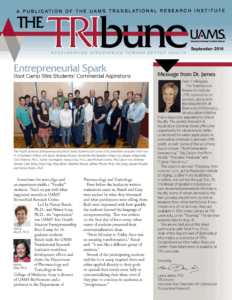
TRI’s September newsletter, The TRIbune, features a new initiative to help UAMS graduate students learn how to become entrepreneurs. Led by Nancy Rusch, Ph.D., and Nancy Gray, Ph.D., TRI co-sponsored the recent Health Sciences Entrepreneurship Boot Camp for graduate students. It was a hit! Special thanks to Phil Mayeux, Ph.D., whose T32 grant created an opportunity for supplemental funding to conduct the boot camp, and to Drs. Rusch and Gray for their successful application. You can read about it here, along with comments from several students.

In addition, Dr. Gray, director of UAMS BioVentures, offers her perspective on TRI in the TRI & Me feature, and you can read about the recent NIH grant to a large multidisciplinary team of UAMS researchers that stems from a TRI pilot award. We also list your publications that have cited TRI support. 

Read The TRIbune.

Filed Under: Front, News, Newsroom

  • «Previous Page
  • Page 1
  • Interim pages omitted …
  • Page 12
  • Page 13
  • Page 14
  • Page 15
  • Page 16
  • Interim pages omitted …
  • Page 29
  • Next Page»
Translational Research Institute LogoTranslational Research InstituteTranslational Research Institute
Mailing Address: 4301 West Markham Street, Little Rock, AR 72205
Phone: (501) 686-7000
  • Facebook
  • X
  • Instagram
  • YouTube
  • LinkedIn
  • Pinterest
  • Disclaimer
  • Terms of Use
  • Privacy Statement
  • Legal Notices

© 2026 University of Arkansas for Medical Sciences