• Skip to primary navigation
  • Skip to main content
  • Skip to primary navigation
  • Skip to main content
Choose which site to search.
University of Arkansas for Medical Sciences Logo University of Arkansas for Medical Sciences
Translational Research Institute
  • UAMS Health
  • Jobs
  • Giving
  • About TRI
    • What We Offer
    • Leadership & Governance
    • Staff
    • Citing Translational Research Institute CTSA Support
    • What is Translational Research?
    • Contact TRI
  • Funding Opportunities
    • Grants
      • Pilot Award Program
      • ARLife Small Grants Program
      • Team Science Voucher Program
      • Consortium of Rural States (CORES) Multi-Institutional Pilot Award Program
      • Winthrop P. Rockefeller Cancer Institute Rural Research Award Program
    • Scholarships
      • K12 Mentored Research Career Development Scholar Awards Program
      • Health Sciences Innovation and Entrepreneurship Postdoctoral Training Program
      • Implementation Science Scholar Program
      • Strategies for Training and Advancing Researchers (STARs) Program
      • Scholars in Mentored Applied Research & Translational Science (SMART) Program
    • Community
      • Community Based Participatory Research (CBPR) Scholars Program
      • Community Partners Educated as Arkansas Research Leaders (CPEARL) Program
    • Awardee Responsibilities
  • Services & Resources
    • Services
      • Biostatistics, Epidemiology and Research Design (BERD) Consultation
      • Clinical Data Repository (AR-CDR)
      • Comprehensive Informatics Resource Core
      • Mock Study Sections
      • Research Participant Recruitment
      • Research Support: Clinical Trials Innovation Unit (CTIU)
      • Implementation Science Program
      • Research Ethics Consultation
    • Resources
      • ARresearch Registry
      • Center for Health Literacy
      • Data Safety Monitoring
      • Grant Writing & Dissemination
      • UAMS Profiles
      • UAMS Rural Research Network
      • Other Resources
      • COVID-19 Research Guidelines
      • Community Partner Research Training
  • Career Development & Scholarships
    • Scholarship Opportunities
      • K12 Mentored Research Career Development Scholar Awards Program
      • Health Sciences Innovation and Entrepreneurship Postdoctoral Training Program
      • Data Science Scholars Program
      • Implementation Science Scholar Program
      • SMART Program
      • Translational Research Innovations and Partners (TRIP) Program
    • Training & Educational Opportunities
      • innOVATION Seminar Series
      • Path 2 K Program
      • Translational Workforce Development
      • Graduate Certificate in Implementation Science
      • SMART Program [Master’s in Clinical and Translational Sciences (MS-CTS)]
      • Good Clinical Practice Training
    • Didactic Training
  • Community
    • Community Engagement Leadership
    • Community Advisory Board
    • Community Engagement Partners
      • Community Partner Celebration
      • Faith-Academic Initiatives for Transforming Health (FAITH) Network
    • Community Engagement Services
      • Consultations and Technical Assistance
      • Community Review Boards
      • Community Partner Research Training
      • Equipment Library
    • Programs and Funding
      • Community Partners Educated as Arkansas Research Leaders (CPEARL) Program
      • Community Based Participatory Research (CBPR) Scholars Program
      • Community Scientist Academy
    • Toolkits
      • CSA Online Toolkit
  • Events
    • Research Day
    • Clinical Trials Learning Collaborative
  • Newsroom
  • TRI Talks Translational Science
  1. University of Arkansas for Medical Sciences
  2. Translational Research Institute
  3. Newsroom
  4. Page 30

Newsroom

How TRI Became a Catalyst for a Governor’s Cup Victory

Governor’s Cup
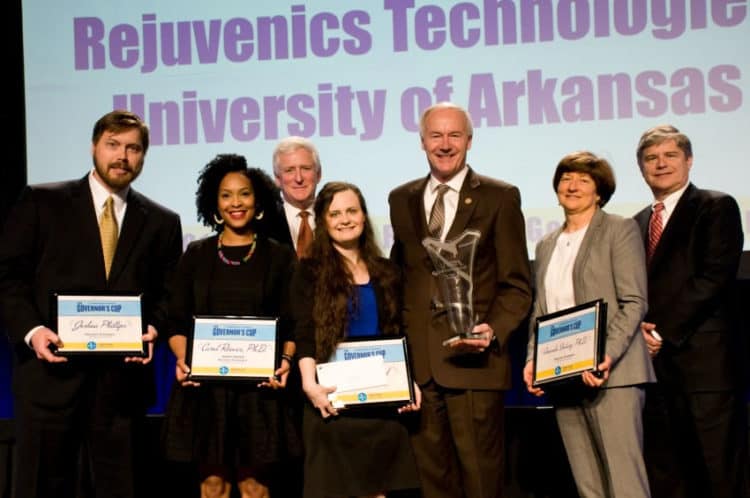
Winners of the Governor’s Cup business plan competition are (l-r): team members Joshua Phillips, Tiffany Jarrett and Amanda Stolarz. They are joined by (back left) Rush Deacon, CEO, Arkansas Capital Corporation; Gov. Asa Hutchinson, Carol Reeves, team adviser, and Kevin Burns, chairman of the board, Arkansas Capital Corporation.

UAMS’ Amanda Stolarz, Pharm.D., Ph.D., recently celebrated her team’s victory in the Donald W. Reynolds Governor’s Cup business plan competition. The team, Rejuvenics Technologies, won the $25,000 top prize with its idea for commercializing a drug-delivery system to reduce the harmful side effects of chemotherapy.

Just under a year ago, the business side of research was hardly on her radar. Her mindset was: “I don’t want to do business at all; I want to do science.”

But Stolarz, having just received her Ph.D. last summer, soon gained new perspective.

As a postdoctoral fellow, she was encouraged to attend last summer’s Health Sciences Entrepreneurship Boot Camp by Nancy Rusch, Ph.D., who explained that discoveries don’t magically go from the laboratory to the clinic. Rusch chairs the College of Medicine Department of Pharmacology and Toxicology and leads the Translational Research Institute’s (TRI) educational efforts.

“The boot camp opened my eyes,” Stolarz said. “It showed me that if you want to see what you discover in the lab actually help people, you have to go through this process.”

So when she was invited to be part of the business-plan team that won the Governor’s Cup, she was more inclined to participate.

“Without the boot camp, it would have been a much harder sell for me to join the Rejuvenics Technologies team,” she said.

The idea of establishing entrepreneurship training for researchers, Rusch said, stems from TRI. Laura James, M.D., TRI director and vice chancellor for clinical and translational research, broached the idea and it was included as a key feature of TRI’s application for a Clinical and Translational Science Award (CTSA).

When Philip Mayeux, Ph.D., alerted Rusch about a funding opportunity that could support an entrepreneurship boot camp, Rusch was able to borrow from the work she had done for the CTSA application. Working with Nancy Gray, Ph.D., director of BioVentures, they received $50,000 in supplemental funding tied to the National Institute of General and Medical Sciences T32 Systems Pharmacology and Toxicology Training Program grant led by Mayeux.

Entrepreneurial luminaries were brought in to the boot camp, including Carol Reeves, Ph.D., associate vice provost for entrepreneurship at the University of Arkansas, Fayetteville (UAF). Reeves, who has a national reputation for developing entrepreneurs, was excited to be part of the UAMS boot camp and predicted it would lead to meaningful collaborations between the sister institutions.

Stolarz is the chief science officer for Rejuvenics Technologies, a startup at the University of Arkansas, Fayetteville. Its other officers and team members are Joshua Phillips, Tiffany Jarrett and Mary Rivard, all full-time Executive MBA students at the UAF Walton School of Business.

The startup initially worked with a product that didn’t pan out in their market validation study. What they found next turned out to be a great fit for Stolarz: technology with a potentially broad application for preventing a multitude of chemotherapy side effects.

“I got really excited because my dissertation was on finding ways to treat and prevent side effects from chemotherapy,” she said.

The technology being commercialized was developed as a joint collaboration between UAF and UAMS. The lead inventor is Daniel Fologea, Ph.D., formerly at UAF and now at Boise State University, who worked with Michael Borrelli, Ph.D., in the UAMS College of Medicine Department of Radiology.

Rejuvenics Technologies is working with St. Jude Children’s Research Hospital in Memphis and hopes to also collaborate with Houston-based M.D. Anderson Cancer Treatment Center.

Stolarz is hopeful they can develop a product that will lead to improved quality of life for cancer patients.

“This technology is designed to decrease the toxic side effects of chemotherapy while potentially increasing efficacy against tumors so we can beat cancer without beating down the patient,” she said.

Filed Under: Front, News, Newsroom

The TRIbune is Here!

TRI’s March-April newsletter, The TRIbune, features a breakthrough success in research collaboration with the adoption of SMART IRB by all the CTSA sites across the country, including UAMS. This new single IRB capability is expected to spur inter-institutional collaborations for multisite clinical trials and help avoid trial delays. We also note the numerous cross-CTSA collaborations that involve UAMS researchers and TRI.  Along those lines, we highlight a recent retreat on data available to researchers through the Arkansas Center for Health Improvement. The retreat was enlightening for research leaders from UAMS, Arkansas Children’s Research Institute and the Central Arkansas Veterans Healthcare System. Our TRI & Me feature spotlights Donald Mock, M.D., Ph.D., who leads our Pilot Studies Program, and you can view the latest TRI-cited publications.

Download PDF

Newsletter Archive

Filed Under: Front, News, Newsroom

TRI Biomedical Informatics Pilot Awards

The UAMS Translational Research Institute (TRI) has approved four research pilot study awards totaling about $166,000.

Nine applicants sought awards of up to $50,000 for one-year projects that utilized translational biomedical informatics approaches to improve health and solve health care issues of rural populations.
The 2017 pilot awardees and their project titles are:

  • Kristie Hadden, Ph.D., assistant professor, College of Medicine, Division of Medical Humanities, “Patient health literacy screening: An informatics approach.”
  • Se-Ran Jun, Ph.D., assistant professor, College of Medicine, Department of Biomedical Informatics, “Genomic surveillance of mumps outbreak in Arkansas using third generation sequencing technology.”
  • Atul Kothari, M.D., assistant professor, College of Medicine, Department of Internal Medicine, “Molecular epidemiology and transmission of Clostridium difficile infections (CDI) in nosocomial settings.”
  • Bradley Martin, Ph.D., Pharm.D., professor, College of Pharmacy, “Development, validation, and implementation of an opioid risk prediction tool.”

“The purpose of our pilot awards is to help researchers develop novel technologies and methods and to test the feasibility of their approaches,” said Laura James, M.D., TRI director and associate vice chancellor for clinical and translational research. “This year’s focus on collaborations with experts in biomedical informatics will test state-of-the-art solutions to problems common in Arkansas. Each project also has high potential for extramural funding and for application to individuals beyond Arkansas.”

Applications were reviewed and scored by a study section of 23 faculty and community representatives. The study section, led by Donald Mock, M.D., Ph.D., included independent scientists from a wide range of disciplines and from across the country, and community stakeholders from across Arkansas. Inclusion of trained community stakeholders is a novel venture for this pilot program that helps realize the NIH goal of ensuring that studies have the input of the general public, clinicians and professionals in the health industry. This year was the first time that community stakeholders participated in the full review, discussion and scoring process.

Filed Under: Front, News, Newsroom

CTSA Consortium Issues Call for Inter-Institutional Pilot Award Applications

Applications Sought for CTSA Inter-institutional Pilot Awards

The Western States Consortium, which includes the UAMS Translational Research Institute (TRI) and four other Clinical and Translational Science Award (CTSA) institutions, has issued the call to all faculty for pilot award applications.

In addition to TRI, the Western States Consortium members are the University of Kentucky, University of New Mexico, University of Kansas Medical Center, and University of Utah, all part of the national CTSA consortium, supported by the National Center for Advancing Translational Sciences (NCATS) of the National Institutes of Health (NIH). (Note: The University of Kansas Medical Center is not participating in this pilot program.)

The purpose of the pilot awards is to promote inter-institutional collaboration by funding innovative, translational research projects that involve two or more of the four Western States Consortium members. Awards of up to $25,000 will be provided by each participating institution.

For additional details, view the Request for Applications (RFA) document. If you have any questions, please contact Nia Indelicato at NLIndelicato@uams.edu or 501-614-2287.

Applications are due Jan. 19, 2018, at 5 p.m. (CT). Please submit to NLIndelicato@uams.edu.

The 2017 inter-institutional RFA is the fourth pilot funding opportunity by the Western States Consortium.

Key Dates:

  • IRB Submission Deadline: Nov. 24, 2017
  • Application Deadline: Jan. 19, 2018, 5:00 pm Central Time
  • Notice of intent to fund at each CTSA: Feb. 2, 2018
  • Just In Time Period: Feb. 2, 2018 – Feb. 9, 2018
  • Submission to NIH for Prior Approval of Human Subjects: Feb. 12, 2018
  • Funding Cycle: April 1, 2018 through March 31, 2019

Download Request for Applications

Filed Under: Front, News, Newsroom

TRI Part of NIH Milestone to Accelerate Multisite Clinical Studies

CTSA Program paves way for nationwide single IRB model.

Developing new treatments for diseases often requires large numbers of clinical research participants enrolled in the same study at numerous geographical sites. These multisite clinical trials are well-positioned to discover whether a promising therapeutic is safe and effective, and may provide medical professionals with the information needed for treating their patients. However, the initiation of such studies may be delayed because each site typically relies on its own Institutional Review Boards (IRBs) to provide ethics reviews of the risks and benefits of the proposed research.

Christopher P. Austin, M.D.

The National Institutes of Health (NIH) is leading policy and programmatic initiatives to streamline this overly cumbersome process. NIH’s National Center for Advancing Translational Sciences (NCATS) announced today that all Clinical and Translational Science Awards (CTSA) Program sites (including the UAMS Translational Research Institute) have signed on to the NCATS Streamlined, Multisite, Accelerated Resources for Trials (SMART) IRB authorization agreement. This agreement — which now includes a total of more than 150 top medical research institutions — will enable all participating study sites to rely on the ethics review of one IRB for each study, making it possible to initiate multisite studies within weeks instead of months. For patients waiting to enroll in a study, this could make a life-saving difference.

The SMART IRB authorization agreement serves as a model to help investigators adhere to the NIH’s policy on single IRB use for multisite studies. This policy was designed to improve IRB efficiencies while ensuring the protection of research participants so that research can proceed expeditiously.

The authorization agreement effort was led by Harvard Catalyst, University of Wisconsin-Madison Institute for Clinical and Translational Research, and Dartmouth Synergy. Through these institutions, a team of NCATS-supported SMART IRB ambassadors facilitated and provided critical guidance and support to assist institutions in joining and implementing the SMART IRB authorization agreement.

“This milestone is a giant step toward a nationwide model for greater efficiency in IRB review, which is critical to getting more treatments to more patients more quickly,” said NCATS Director Christopher P. Austin, M.D. “It was made possible by the teamwork of hundreds of experts across the country who worked together to achieve what was thought to be impossible even a few years ago.”

In addition, the SMART IRB authorization agreement will provide the foundation for NCATS’ Trial Innovation Network central IRBs. The Trial Innovation Network is a collaborative CTSA Program initiative designed to address critical roadblocks in clinical research, and to optimize and streamline the clinical trial and studies process.

Next steps for the NCATS SMART IRB Platform include the development of education, training and harmonization of best practices for a single IRB review. Learn more at https://ncats.nih.gov/expertise/clinical/smartirb and https://smartirb.org (link is external).

About the National Center for Advancing Translational Sciences (NCATS): To get more treatments to more patients more quickly, NCATS incorporates the power of data, new technologies and strategic collaborations to develop, demonstrate and disseminate innovations in translational science. Rather than targeting a particular disease or fundamental science, NCATS focuses on what is common across all diseases and the translational process. Learn more at https://ncats.nih.gov.

About the National Institutes of Health (NIH): NIH, the nation’s medical research agency, includes 27 Institutes and Centers and is a component of the U.S. Department of Health and Human Services. NIH is the primary federal agency conducting and supporting basic, clinical, and translational medical research, and is investigating the causes, treatments, and cures for both common and rare diseases. For more information about NIH and its programs, visit www.nih.gov.

Filed Under: Front, News, Newsroom Tagged With: Christopher P. Austin, CTSA, IRB, NCATS, NIH, SMART IRB, Translational Research Institute, UAMS

K Awards Informational Session Recording, Slides Available

Download Slides | Play Video

K Award

Filed Under: Front, News, Newsroom

‘Budgeting for Grant Applications’ March 24

Renee Raines, CCRP, CRA, director of the Office of Sponsored Programs Administrative Network (OSPAN), will present “Budgeting for Grant Applications” on March 24, 8:30 – 10 a.m., at the Psychiatric Research Institute, room 136.

Her presentation, part of the TRI Research and Career Development Seminar Series, will include information on OSPAN’s services provided to researchers.

Please register via TrainingTracker. The presentation is also available via BlackBoard Collaborate.  

Download Flyer

Filed Under: Front, News, Newsroom

April 12 Webinar: Learn How to Conduct Multisite Clinical Trials with a Single IRB

The first SMART IRB webinar on April 12, 3:30 – 4:30 p.m., will provide an overview of the SMART IRB Online Reliance System, which will be available to researchers later this spring. UAMS is among the Clinical and Translational Science Award (CTSA) Consortium SMART IRB participating institutions.

The Online Reliance System is a unique tool that helps institutions establish and document single IRB review arrangements. By using this system:

  • Investigators can create and submit requests to use a single IRB for their studies.
  • Collaborating institutions can work together to identify a Reviewing IRB and track and document reliance arrangements on a study-by-study basis.
  • Users have a clear understanding of next steps and are notified when action is required.

The webinar will be led by Nichelle Cobb, Ph.D., chief regulatory operations officer for Implementation for SMART IRB, and director of the Health Sciences IRBs Office at the University of Wisconsin-Madison.

<a href=”https://urldefense.proofpoint.com/v2/url?u=https-3A__t.e2ma.net_click_cimvkb_cun0ym_4rsw6r&d=DwMFaQ&c=27AKQ-AFTMvLXtgZ7shZqsfSXu-Fwzpqk4BoASshREk&r=4LXLFJs5XBtylClwIS_UAgK8uCNIrvwWz1icOu8671Y&m=bKx0sJm3z5KdF-B_iFTQ4iZmbERtwj3sACetCQVvfLQ&s=vjgjhCpVv2Ih9CauGwHKTXeU9zptd0cTHm8GUqa4p6c&e=”Register for Webinar

Filed Under: Front, News, Newsroom

TRI Changes Process for Study Budget Development & Negotiations

The Translational Research Institute (TRI) Clinical Trials Innovation Unit (CTIU) recently revised the process for investigators submitting studies that require a Medicare coverage analysis and budget in CLARA.  

In addition to conducting full Medicare Coverage Analysis, CTIU’s Research Finance Team (RFT) offers full budget development and/or negotiation services for all non-cancer-related protocols requiring a budget. To access all services, the investigator or designee submits a request through the TRI services portal. RFT members will work with investigators and their team to complete the budget, coverage and legal process in an efficient manner.

To increase efficiency and provide feasibility data to investigators, the RFT has altered the order of its coverage and budget activities, performing the Medicare Coverage Analysis prior to budget development and review. If investigators and their team wish to develop and/or negotiate the budget themselves, the RFT highly encourages them to submit the required study documents to the RFT prior to starting budget development. The RFT will provide a Medicare Coverage Analysis Report (MCAR) that is sent to the investigator for approval and can be used as a guide for budget development. 

It is not mandatory to obtain a MCAR prior to budget development. However, if the budget is developed prior to the MCAR it will likely delay the budget approval process for the study. If investigators or study teams have questions about this process, contact Jonathan Young, JAYoung@uams.edu, 526-7984.

Filed Under: Front, News, Newsroom

UAB Entrepreneur to Speak at HSE Seminar, March 1

The next Health Sciences Entrepreneurship Seminar will feature Erik Schwiebert, Ph.D., from the University of Alabama, Birmingham (UAB), speaking March 1, from 5 – 6 p.m. at the Reynolds Institute on Aging, Jo Ellen Ford Auditorium. 

Schwiebert will present “New Paradigms for Scientist to CEO Transition and New Biotechnology Startup Creation.”

DiscoveryBioMed, Inc. is a Birmingham-based life sciences and biotechnology company, with the goal of integrating human cell physiology with the drug discovery critical path. Schwiebert, a physiologist, launched the company in October 2007. Since then DiscoveryBioMed has continued to grow and gain recognition both locally and nationally.

The UAMS Seminar Series is being offered in collaboration with UAB, University of Kansas Medical Center and the University of Utah – all Clinical and Translational Science Award (CTSA) institutions. The series is sponsored by the NIGMS Systems Pharmacology and Toxicology T32 Training Program, UAMS Translational Research Institute (TRI) and UAMS BioVentures.

Download: Health Science Entrepreneurship flier

Filed Under: Front, News, Newsroom

  • «Previous Page
  • Page 1
  • Interim pages omitted …
  • Page 28
  • Page 29
  • Page 30
  • Page 31
  • Page 32
  • Interim pages omitted …
  • Page 38
  • Next Page»
Translational Research Institute LogoTranslational Research InstituteTranslational Research Institute
Mailing Address: 4301 West Markham Street, Little Rock, AR 72205
Phone: (501) 686-7000
  • Facebook
  • X
  • Instagram
  • YouTube
  • LinkedIn
  • Pinterest
  • Disclaimer
  • Terms of Use
  • Privacy Statement
  • Legal Notices

© 2026 University of Arkansas for Medical Sciences