• Skip to primary navigation
  • Skip to main content
  • Skip to primary navigation
  • Skip to main content
Choose which site to search.
University of Arkansas for Medical Sciences Logo University of Arkansas for Medical Sciences
Translational Research Institute
  • UAMS Health
  • Jobs
  • Giving
  • About TRI
    • What We Offer
    • Leadership & Governance
    • Staff
    • Citing Translational Research Institute CTSA Support
    • What is Translational Research?
    • Contact TRI
  • Funding Opportunities
    • Grants
      • Pilot Award Program
      • Consortium of Rural States (CORES) Multi-Institutional Pilot Award Program
      • Team Science Voucher Program
      • Winthrop P. Rockefeller Cancer Institute Rural Research Award Program
    • Scholarships
      • K12 Mentored Research Career Development Scholar Awards Program
      • Health Sciences Innovation and Entrepreneurship Postdoctoral Training Program
      • Implementation Science Scholar Program
      • (STARs) Program – Strategies for Training and Advancing Researchers
      • SMART Program [Master’s in Clinical and Translational Sciences (MS-CTS)]
    • Community
      • Community Based Participatory Research (CBPR) Scholars Program
      • Community Partners Educated as Arkansas Research Leaders (CPEARL) Program
    • Awardee Responsibilities
  • Services & Resources
    • Services
      • Biostatistics, Epidemiology and Research Design (BERD) Consultation
      • Clinical Data Repository (AR-CDR)
      • Comprehensive Informatics Resource Core
      • Mock Study Sections
      • Research Participant Recruitment
      • Research Support: Clinical Trials Innovation Unit (CTIU)
      • Implementation Science Program
      • Research Ethics Consultation
    • Resources
      • ARresearch Registry
      • Center for Health Literacy
      • Data Safety Monitoring
      • Grant Writing & Dissemination
      • UAMS Profiles
      • UAMS Rural Research Network
      • Other Resources
      • COVID-19 Research Guidelines
      • Community Partner Research Training
  • Career Development & Scholarships
    • Scholarship Opportunities
      • K12 Mentored Research Career Development Scholar Awards Program
      • Health Sciences Innovation and Entrepreneurship Postdoctoral Training Program
      • Data Science Scholars Program
      • Implementation Science Scholar Program
      • SMART Program
      • Translational Research Innovations and Partners (TRIP) Program
    • Training & Educational Opportunities
      • innOVATION Seminar Series
      • Path 2 K Program
      • Translational Workforce Development
      • Graduate Certificate in Implementation Science
      • SMART Program [Master’s in Clinical and Translational Sciences (MS-CTS)]
      • Good Clinical Practice Training
    • Didactic Training
  • Community
    • Community Engagement Leadership
    • Community Advisory Board
    • Community Engagement Partners
      • Community Partner Celebration
      • Faith-Academic Initiatives for Transforming Health (FAITH) Network
    • Community Engagement Services
      • Consultations and Technical Assistance
      • Community Review Boards
      • Community Partner Research Training
      • Equipment Library
    • Programs and Funding
      • Community Partners Educated as Arkansas Research Leaders (CPEARL) Program
      • Community Based Participatory Research (CBPR) Scholars Program
      • Community Scientist Academy
    • Toolkits
      • CSA Online Toolkit
      • CPEARL Toolkit
  • Events
    • Research Day
    • Clinical Trials Learning Collaborative
  • Newsroom
  1. University of Arkansas for Medical Sciences
  2. Translational Research Institute
  3. News
  4. Page 33

News

‘Dos & Don’ts of Community Engagement’ Workshop for Researchers

A new workshop on the Dos and Don’ts of Community Engagement is being offered to researchers, students and staff, Oct. 18, 1 – 5 p.m., College of Public Health, G232.

The workshop was developed by the Translational Research Institute, College of Public Health and UAMS’ community partners. The workshop will include simulation and role reversal, video testimonials, and group reflection and debriefing.  The objective is to increase researchers’ knowledge of the dos and don’ts of community engaged research in the research domains of entering the community; the realities and constraints of community-based organizations; and dissemination.

The workshop is supported by the Arkansas Prevention Research Center and the Arkansas Center for Health Disparities.

For more information, contact jcoffey@uams.edu.

Filed Under: Front, News, Newsroom Tagged With: Community Engagement, Dos and Don'ts, research, Translational Research Institute, TRI, UAMS, University of Arkansas for Medical Sciences

First UAMS Community Scientist Academy Graduates 17

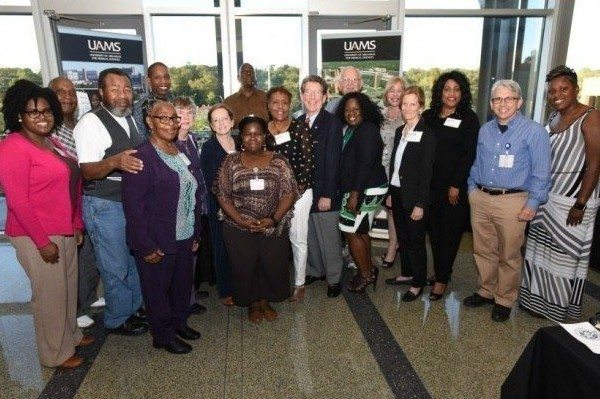
Community Scientist Academy graduates along with UAMS faculty and staff are (l-r): Camille Hart (staff), Charles Moore (back), Carl Farr, Sarah Facen, David Miller (back), Pat Kissire, Virginia Wilhelm, Nicki Spencer (staff), Willie Wade (back), Onie Norman, Larry Taylor, Marvin Hayenga (back), Sylvia Halliburton, Mary Aitken (faculty), Kate Stewart (faculty), Esther Dixon, David Robinson (staff) and Kimberly Moore. (Not pictured: Marilyn Bailey-Jefferson, Freeman McKindra, Suzanne Overgaard and Joy Rockenbach)

Seventeen Arkansans were recently recognized for their participation in the first UAMS Community Scientist Academy.

The UAMS Translational Research Institute piloted the academy to help citizens better understand how research is done at UAMS and to prepare them for bigger roles as volunteers. A second Community Scientist Academy is being planned for spring 2017.

The graduation ceremony Sept. 29 included remarks from UAMS research leaders Kate Stewart, M.D., M.P.H., and Mary Aitken, M.D., M.P.H., and statements of appreciation from several participants. Stewart leads the Translational Research Institute’s Community Engagement program. Aitken is a veteran community-based researcher who is well known for injury prevention work, especially ATV safety. She also co-leads the Translational Research Institute’s KL2 Mentored Research Career Development Award program to help train the next generation of translational researchers.

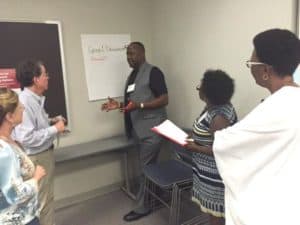
Willie Wade of Hot Springs discusses his idea for a research study during a class exercise.

Willy Wade Jr., founder and executive director of Difference Makers in Hot Springs, said what he learned about research at the academy can help him better serve poor

communities.

“I’ve been appointed to a few boards that are doing some research, so these tools will come in very handy in helping us determine different ways we want to tackle some problems and issues,” Wade said.

During weekly evening classes, attendees learned about the types of research at UAMS and steps in the study process, including Institutional Review Board approval to ensure the safety and ethical treatment of research participants. Each week they heard from UAMS researchers who were invited to share their stories, and they had small-group activities, such as discussing research questions and brainstorming their own research study ideas and methods. For example, one group discussed ways to study potential solutions to what Wade described as the “disconnect” that prevents the poorest, often older citizens from receiving needed services.

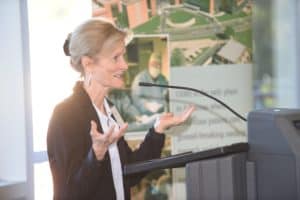
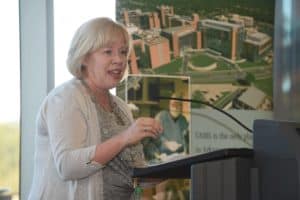
Kate Stewart, M.D., M.P.H., speaks to the graduates.
Kate Stewart, M.D., M.P.H., explains the significance of the graduation venue – Bruce Commons in the College of Public Health.

Academy graduate Onie Norman of Dumas, thanked UAMS for the academy. “I’ve learned so much,” she said. “There were some things I thought I knew but found out I didn’t know. This has been a really good benefit for me, and I hope you all continue to have more of these types of programs.”

Academy graduate Larry Taylor, of Little Rock, has been a UAMS volunteer on several projects. He participated in a rare diseases study as the father of a son with cystic fibrosis. He also chairs the UAMS Medical Center Patient and Family Advisory Council and serves as an adjunct professor in the College of Health Professions.

“I just thoroughly enjoy knowing what’s going on and learning new things,” Taylor said.

Both Stewart and Aitken noted the symbolism of hosting the graduation ceremony at the College of Public Health. It was held in Bruce Commons on the first floor, which was named for the late Thomas Bruce, M.D., D.Sc., first dean of the college.

“He really made sure the college was based on the idea that community lies at the heart of public health,” Stewart said. “He’s the reason we’re here, because of his vision for incorporating community into everything that we do and always making sure that we’re listening and partnering.”

Mary Aitken, M.D., M.P.H., tells graduates how she learned to be a better community-based researcher.

“This academy is part of his legacy,” said Aitken, who served with Bruce on the college’s planning committee before it was established in 2001.

She told the group that when she began conducting community engaged research 20 years ago, she quickly realized she had a lot to learn. Aitken had come to Arkansas from Seattle and had never seen an ATV but was embarking on a plan to prevent ATV injury and death. As a pediatrician with a noticeably different accent, she discovered that she wasn’t effective with her safety message in rural Arkansas.

“Sometimes as a researcher you have to learn that you’re not the right messenger,” she said. “I could have all the right information but I wasn’t the person to deliver it, so I hired a gentleman who was a hunter from the Delta area of the state, and he was very successful.”

In another learning experience, Aitken said she was skeptical when her staff bought ATV covers as giveaways at events where they

took their safety message. At a rodeo, she said, a man attending the event told them he had first assumed their intent was to take away people’s ATVs. Then he saw they were giving away ATV covers, so he understood that wasn’t the case.

Sarah Facen, a TRI Community Advisory Board member, came up with the idea for the academy.

“That was an ‘aha’ moment for me,” she said.

The idea for the Community Scientist Academy came from Sarah Facen, of Little Rock, a member of the Translational Research Institute Community Advisory Board.

“I am very happy to have seen this academy move forward,” she said. “It has been a privilege for me to serve on this board because the Translational Research Institute absolutely listens to the community.”

See more graduation photos! 

Filed Under: Front, News, Newsroom

New TRI Profiles Newsletter Helps Researchers Plug-In!

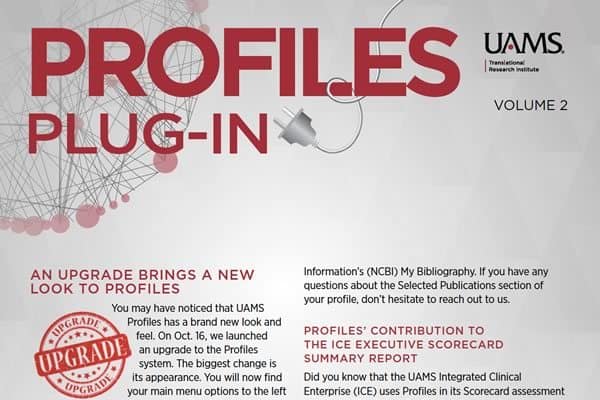
This month, the UAMS Translational Research Institute (TRI) introduces Profiles Plug-In, a newsletter that will be researchers’ monthly guide to all things Profiles. Each issue will cover a variety of topics, including user tricks and tips, updates and upcoming changes, successes, etc. We hope you find the newsletter useful and continue to read the Plug-In each month.

View Newsletter

Go to Profiles

Filed Under: Front, News, Newsroom

The September TRIbune Newsletter is Here!

tribune-september-2016_800

TRI’s September newsletter, The TRIbune, features a new initiative to help UAMS graduate students learn how to become entrepreneurs. Led by Nancy Rusch, Ph.D., and Nancy Gray, Ph.D., TRI co-sponsored the recent Health Sciences Entrepreneurship Boot Camp for graduate students. It was a hit! Special thanks to Phil Mayeux, Ph.D., whose T32 grant created an opportunity for supplemental funding to conduct the boot camp, and to Drs. Rusch and Gray for their successful application. You can read about it here, along with comments from several students.

In addition, Dr. Gray, director of UAMS BioVentures, offers her perspective on TRI in the TRI & Me feature, and you can read about the recent NIH grant to a large multidisciplinary team of UAMS researchers that stems from a TRI pilot award. We also list your publications that have cited TRI support. 

Read The TRIbune.

Filed Under: Front, News, Newsroom

Boot Camp Stirs Students’ Commercial Aspirations

The Health Sciences Entrepreneurship Boot Camp students and some of its presenters included: front row (l- r) Catheryn Wilson, Erin Bush, Amanda Stolarz, Samantha McClenahan, Xingui Liu, Dolapo Adejumobi, Carol Reeves, Ph.D., Walter Harrington, Nancy Gray, Ph.D., and Michael Owens, Ph.D. Back row: Brittney Garner, Clark Sims, Chuck Hay, Ithay Biton, Stephen Shrum, Jeffery Moran, Ph.D., Kai Carey, Lauren Russell, and Nancy Rusch, Ph.D.

Sometimes the stars align and an experiment yields a “Eureka!” moment. That’s on par with what happened recently at UAMS’ Biomedical Research Center.

Nancy Rusch, Ph.D.
Nancy Rusch, Ph.D.

Led by Nancy Rusch, Ph.D., and Nancy Gray, Ph.D., the “experiment” was UAMS’ first Health Sciences Entrepreneurship Boot Camp for 16 graduate students. Rusch leads the UAMS Translational Research Institute’s workforce development efforts and chairs the Department of Pharmacology and Toxicology in the College of Medicine. Gray is director of UAMS BioVentures and a professor in the Department of Pharmacology and Toxicology.

Even before the laudatory written evaluations came in, Rusch and Gray were excited by what they witnessed and what participants were telling them. Both were impressed with how quickly the students learned the language of entrepreneurship. That was evident on the final day of boot camp, when teams of students presented their commercialization ideas.

“From Monday to Friday there was an amazing transformation,” Rusch said. “It was like a different group of students.”

Several of the participating students said the boot camp inspired them and either applied directly to their goals or opened their minds more fully to commercializing their ideas, even if they plan to continue in academia as “intrapreneurs.”

Erin Bush, R.N.C.-M.N.N.

“The presenters that were brought in were absolute rock stars,” said Erin Bush, R.N.C., M.N.N., a graduate student in the UAMS College of Nursing. “One of the things that I most want to do with my nursing Ph.D. is be an entrepreneur and translate the nursing science that’s coming out of research into something that can be commercialized. So the boot camp has incredible applications for my career goals.”

Heavy Hitters

The boot camp’s success was aided by the participation of UAMS’ entrepreneurial faculty as well as other heavy hitters in Arkansas’ entrepreneurial community. The roster included the University of Arkansas’ Carol Reeves, Ph.D., whose MBA students have led the world in business plan competitions the last six years, and Paul Mlakar, MBA, a serial entrepreneur.

Other outside presenters included Jeff Stinson, MBA, director of entrepreneurship at Arkansas Regional Innovation Hub; Rebecca Norman, M.S., an innovation consultant at the Arkansas Small Business & Technology Development Center; and Lee Watson, president of The Venture Center.

“We’ve developed a wonderful spirit of collegiality with all of our presenters and there’s great cooperation between UAMS and UA, Fayetteville,” Rusch said. “Their participation really made this possible.”

A Rising Tide

The boot camp was supported by $50,000 in supplemental funding tied to a National Institute of General and Medical Sciences T32 Systems Pharmacology and Toxicology Training Program grant led by Phil Mayeux, Ph.D., who alerted Rusch about the supplemental funding opportunity. Rusch and Gray applied for the funding and developed the boot camp agenda.

There are now 58 faculty at UAMS with entrepreneurial experience. Their success is good for them as well as UAMS, which receives intellectual property revenues for the licensed technologies. UAMS’ intellectual property revenue is about $1.6 million per year. BioVentures has been involved in over 50 spinoff companies. Of those, 23 are still in operation and had an aggregate payroll of $7.2 million at the end of 2014.

Nancy Gray, Ph.D.
Nancy Gray, Ph.D.

Rusch said she hopes UAMS can increase these numbers through entrepreneurship training. She is leading the educational effort for the Translational Research Institute, and she credits institute Director/Associate Vice Chancellor for Clinical and Translational Research Laura James, M.D., with the idea of making it a key component of TRI’s mission and Clinical and Translational Science Award application. The goal is to offer a certificate program.

“I see the need for entrepreneurship training with my students all the time,” Rusch said. “They come into my office and say ‘I have this idea and it could really improve clinical care, but I don’t know how to proceed.’”

UAMS faculty entrepreneurs who shared their stories at the boot camp:

  • Jay Gandy, Ph.D., professor and chair, Fay W. Boozman College of Public Health; Founding Partner, Center for Toxicology & Environmental Health, LLC
  • Bill Gurley, Ph.D., professor, College of Pharmacy; chief science officer, Balm Innovations LLC
  • Amy Hester, Ph.D., R.N., assistant professor, College of Nursing; chief scientific officer, HD Nursing, LLC
  • Laura James, M.D., professor, College of Medicine; director, UAMS Translational Research Institute; associate vice chancellor for Clinical and Translational Research; chief medical officer, Acetaminophen Toxicity Diagnostics, LLC
  • Jeffery Moran, Ph.D., assistant professor, College of Medicine; CEO and founding partner, Pinpoint Testing, LLC
  • Michael Owens, Ph.D., professor, College of Medicine, chief scientific officer, InterveXion Therapeutics

Filed Under: Front, News, Newsroom

TRI Makes Community Engagement Resources Available to UAMS Investigators

hart_camille_tri_8-8-14-on-white

Researchers who need participation from communities across the state can get the resources they need from the Translational Research Institute’s (TRI) Community Engagement component. TRI provides consultations and technical assistance, establishes one-time, study-specific Community Review Boards, and has an equipment library that includes electronics such as iPads, LCD projector and screen, and public address system; and other equipment, such as tents, misting fans, and folding tables with wheels. The community engagement team works closely with the Office of Community-Based Public Health at the UAMS Fay W. Boozman College of Public Health, as well as the UAMS Office of Community Health and Research and Center for Pacific Islander Health, both located at the UAMS Northwest Campus in Fayetteville.

Additional TRI Services

TRI offers a range of services to investigators at UAMS, Arkansas Children’s Research Institute and Central Arkansas Veterans Healthcare System, including advice and consultation, biomedical informatics, biostatistics, regulatory matters, and protocol development. Visit our website to learn more about our services: TRI.uams.edu.

Filed Under: Front, News, Newsroom

Video Now Available for Community Engagement/Cancer Survivorship Disparities Research Lecture

Meneses_Karen

The recent UAMS lecture, “Lessons Learned in Engagement with the Community in Cancer Survivorship Disparities Research,” by Karen Meneses, Ph.D., R.N., F.A.A.N., from the University of Alabama, Birmingham (UAB), is now available in TRI’s Video Library.  

The Dalme-Rickel Distinguished Visiting Lectureship in Oncology/Community Health is sponsored by the College of Nursing. Meneses is professor and associate dean for research and scholarship at the UAB School of Nursing. She is the co-leader of the Cancer Control and Population Sciences Program at the UAB Comprehensive Cancer Center and multiple principal investigator of the R25 Cancer Prevention and Control Training Program. 

Filed Under: Front, News, Newsroom

Register Now for Mini-Symposium on Pediatric Precision Medicine

Registration is now open for the first Mini-Symposium on Pediatric Precision Medicine. The event will be Aug. 30, 8 a.m. – 1 p.m., Arkansas Children’s Hospital, Chairman’s Hall, and will feature several distinguished speakers who are experts in this area. The symposium will be the formal kick-off for the new Pediatric Precision Medicine program.

Register here. 

Note: This event is free. On the registration page under “Payment Method,” please select the following from the dropdown: “Fee Waived – No credit card necessary” 

View the Program.

Filed Under: Front, News, Newsroom

UAMS Invites Public to First Community Scientist Academy

CSASu-smgrpresized
The Community Scientist Academy will allow the public to interact with UAMS researchers, such as during a recent UAMS Research Information Session for the public.

Arkansans interested in helping ensure that research programs at the University of Arkansas for Medical Sciences (UAMS) represent the needs of their communities are invited to participate in UAMS’ first Community Scientist Academy.

Sponsored by the UAMS Translational Research Institute, the Community Scientist Academy will be every Thursday in September, beginning Sept. 1, from 5 – 7:30 p.m., on the UAMS campus in Little Rock, Fay W. Boozman College of Public Health building, room G228. The academy is being offered at no cost to participants. Validated parking is available in Parking 2.

For questions and to RSVP, contact Nicki Spencer at ndspencer@uams.edu, or (501) 526-6629.

Participants in the Community Scientist Academy will interact with UAMS researchers and community members involved in research in small roundtable discussions and other interactive sessions. They will learn:

  • How researchers decide what health issues to study
  • The research process
  • The benefits of individual and community organizations’ involvement in research
  • Ways they can volunteer to help with research such as serving on community advisory boards, community review boards for individual studies, as a community grant reviewer and as a research participant
  • How a volunteer organization can become involved

“The Academy will create a group of community members who can influence research by serving on steering committees, mentoring committees, review committees, and research projects, and in other leadership roles,” said Kate Stewart, M.D., M.P.H., whose research is conducted in partnership with Arkansas communities.

UAMS researchers conduct clinical studies and community-based studies. Its clinical studies are conducted at UAMS Medical Center and in clinics across the state, including at its main campus in Little Rock, Northwest Campus, eight Regional Centers, Arkansas Children’s Research Institute, and at the Central Arkansas Veterans Healthcare System.

“We hope the Community Scientist Academy can help demystify the research we do at UAMS,” said Stewart, who leads the Translational Research Institute’s Community Engagement program. “It’s critically important that people understand what we do because we can’t improve health without their help.”

Filed Under: Front, News, Newsroom

July TRIbune Features Clinical Trials Gains

The Translational Research Institute (TRI) is finding innovative ways to accelerate the pace of clinical trials while taking on more studies than ever. This month’s TRIbune highlights the advances of the Project Support Unit, which helps UAMS researchers conduct clinical trials. The newsletter spotlights a Project Support Unit stalwart, Mtonya Hunter-Lewis, in its TRI & Me feature. You will also read about the recent NIH K awards received by two recent TRI KL2 alumni, and the latest TRI-cited publications by your colleagues.

Download Newsletter | Newsletter Archive

TRIbune July 2016

Filed Under: Front, News, Newsroom

  • «Previous Page
  • Page 1
  • Interim pages omitted …
  • Page 31
  • Page 32
  • Page 33
  • Page 34
  • Page 35
  • Interim pages omitted …
  • Page 48
  • Next Page»
Translational Research Institute LogoTranslational Research InstituteTranslational Research Institute
Mailing Address: 4301 West Markham Street, Little Rock, AR 72205
Phone: (501) 686-7000
  • Facebook
  • X
  • Instagram
  • YouTube
  • LinkedIn
  • Pinterest
  • Disclaimer
  • Terms of Use
  • Privacy Statement
  • Legal Notices

© 2026 University of Arkansas for Medical Sciences