• Skip to primary navigation
  • Skip to main content
  • Skip to primary navigation
  • Skip to main content
Choose which site to search.
University of Arkansas for Medical Sciences Logo University of Arkansas for Medical Sciences
Translational Research Institute
  • UAMS Health
  • Jobs
  • Giving
  • About TRI
    • What We Offer
    • Leadership & Governance
    • Staff
    • Citing Translational Research Institute CTSA Support
    • What is Translational Research?
    • Contact TRI
  • Funding Opportunities
    • Grants
      • Pilot Award Program
      • Consortium of Rural States (CORES) Multi-Institutional Pilot Award Program
      • Team Science Voucher Program
      • Winthrop P. Rockefeller Cancer Institute Rural Research Award Program
    • Scholarships
      • K12 Mentored Research Career Development Scholar Awards Program
      • Health Sciences Innovation and Entrepreneurship Postdoctoral Training Program
      • Implementation Science Scholar Program
      • (STARs) Program – Strategies for Training and Advancing Researchers
      • SMART Program [Master’s in Clinical and Translational Sciences (MS-CTS)]
    • Community
      • Community Based Participatory Research (CBPR) Scholars Program
      • Community Partners Educated as Arkansas Research Leaders (CPEARL) Program
    • Awardee Responsibilities
  • Services & Resources
    • Services
      • Biostatistics, Epidemiology and Research Design (BERD) Consultation
      • Clinical Data Repository (AR-CDR)
      • Comprehensive Informatics Resource Core
      • Mock Study Sections
      • Research Participant Recruitment
      • Research Support: Clinical Trials Innovation Unit (CTIU)
      • Implementation Science Program
      • Research Ethics Consultation
    • Resources
      • ARresearch Registry
      • Center for Health Literacy
      • Data Safety Monitoring
      • Grant Writing & Dissemination
      • UAMS Profiles
      • UAMS Rural Research Network
      • Other Resources
      • COVID-19 Research Guidelines
      • Community Partner Research Training
  • Career Development & Scholarships
    • Scholarship Opportunities
      • K12 Mentored Research Career Development Scholar Awards Program
      • Health Sciences Innovation and Entrepreneurship Postdoctoral Training Program
      • Data Science Scholars Program
      • Implementation Science Scholar Program
      • SMART Program
      • Translational Research Innovations and Partners (TRIP) Program
    • Training & Educational Opportunities
      • innOVATION Seminar Series
      • Path 2 K Program
      • Translational Workforce Development
      • Graduate Certificate in Implementation Science
      • SMART Program [Master’s in Clinical and Translational Sciences (MS-CTS)]
      • Good Clinical Practice Training
    • Didactic Training
  • Community
    • Community Engagement Leadership
    • Community Advisory Board
    • Community Engagement Partners
      • Community Partner Celebration
      • Faith-Academic Initiatives for Transforming Health (FAITH) Network
    • Community Engagement Services
      • Consultations and Technical Assistance
      • Community Review Boards
      • Community Partner Research Training
      • Equipment Library
    • Programs and Funding
      • Community Partners Educated as Arkansas Research Leaders (CPEARL) Program
      • Community Based Participatory Research (CBPR) Scholars Program
      • Community Scientist Academy
    • Toolkits
      • CSA Online Toolkit
      • CPEARL Toolkit
  • Events
    • Research Day
    • Clinical Trials Learning Collaborative
  • Newsroom
  1. University of Arkansas for Medical Sciences
  2. Translational Research Institute
  3. Author: uamsonline
  4. Page 5

uamsonline

The June TRIbune

June TRIbune
June TRIbune

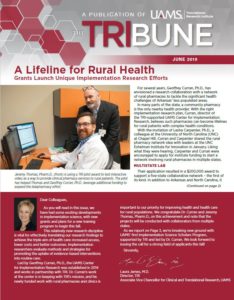
In this month’s TRIbune we feature some exciting developments in implementation science. Geoffrey Curran, Ph.D., and Jeremy Thomas, Pharm.D., are leading newly funded efforts to address critical health care issues for rural residents. Implementation science is a relatively new field that aims to promote the uptake of evidence-based interventions into routine care.

Curran, who leads the UAMS Center for Implementation Research, is also spearheading the TRI-supported Implementation Science Scholars Program, a first at UAMS.

The New TRI Study of the Month highlights Mitch McGill, Ph.D., the principal investigator on an acetaminophen study involving liver cirrhosis patients.

Also included are the latest publications citing TRI support.
Read The TRIbune.

Filed Under: Front, News, Newsroom Tagged With: Geoffrey Curran, Implementation Science, Jeremy Thomas, rural health, Telehealth, Translational Research Institute, TRI, UAMS

The May TRIbune Is Here!

This month’s TRIbune features UAMS’ contributions to solving a complex research problem that affects all federally funded multisite clinical trials.

The team led by Meredith Zozus, Ph.D., in the Department of Biomedical Informatics, is part of a multi-site effort that includes Duke and Vanderbilt universities. It is funded by a $1.88 million National Center for Advancing Translational Sciences (NCATS) supplemental award.

We also feature our first high school graduates of the Community Scientist Academy. Their comments at graduation revealed the value of the academy to a younger audience.

Our Study of the Month features W. Conan Mustain, M.D., the UAMS principal investigator on a multisite data collection study of surgical outcomes for patients with ulcerative colitis.

Read The TRIbune

Filed Under: Front, News, Newsroom

Community Scientist Academy Graduates First High School Class

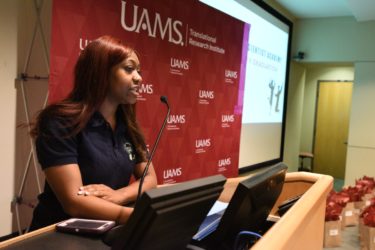
Shanell Young, a senior at Little Rock Parkview, wasn’t sure what to expect during the spring 2019 UAMS Translational Research Institute Community Scientist Academy. After receiving her

Shannell Young said the Community Scientist Academy taught her that research isn't just googling.
Shannell Young said the Community Scientist Academy taught her that research isn’t just googling.

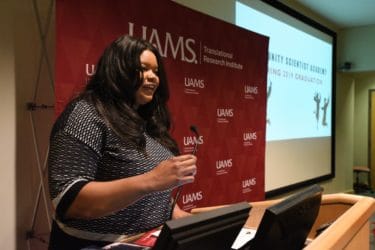
graduation certificate at a UAMS ceremony, she went to the lectern to share her takeaways.

“What people actually refer to as research nowadays is really just googling,” she said. “After 10 weeks of participating in the Community Scientist Academy, we definitely feel different now. Research is not just googling.”

Young and her fellow graduates – the first high school students to attend the academy – came from across the Little Rock School District as Excel students in the Advanced Medical Sciences Program.

The academy, which held its first class in 2016, has graduated 81 community members. Its purpose is to increase community understanding about the research process and offer research decision-making opportunities to communities, patients and other stakeholders. It will remain focused on adult participants, although the Translational Research Institute will continue its partnership with the school district.

The opportunities offered academy graduates include reviewing grant applications; advising on research

UAMS' Nakita Lovelady, Ph.D., M.P.H., challenged the students to find their passion.
UAMS’ Nakita Lovelady, Ph.D., M.P.H., challenged the students to find their passion.

projects; serving on community review boards, community advisory boards and patient and family advisory councils; and assisting with ARresearch, a Translational Research Institute program that signs up potential volunteers for UAMS research studies.

Nakita Lovelady, Ph.D., M.P.H., challenged the high school students to discover their passion. Raised in Helena-West Helena, Lovelady witnessed up close the devastating impacts of chronic diseases, depression and violence in her community.  She recently earned her doctorate with a focus on interventions that address gun violence.

“Figure out what keeps the fire burning inside of you,” she said. “What do you talk about or read about all day? What issue is important to you? Who will you help? What difference do you want to make in this world or your community? Think about that and then identify how you can use research to achieve those goals. There are communities like mine, like yours, all across this nation that need you.”

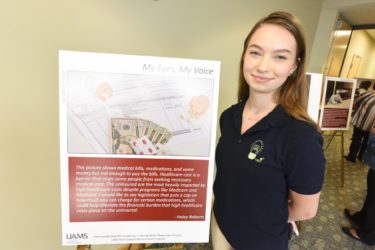
Students were required to write a paper and create a poster using “photovoice,” which required them to

Haley Roberts said the academy exceeded her expectations.

take a photo that depicts a health-related issue and write a long caption explaining the photo.

Haley Roberts, a senior at Central High School, said the academy exceeded her expectations.

“Coming in and actually getting to talk to people who are excited about what they’re talking about, who are excited about their job, that excitement spreads to you, too, and you become excited about it,” she said. “I think the whole program took us off guard. It wasn’t something that I expected to learn, to appreciate. Everyone is affected by research whether they know it or not.”

Roberts said she became engrossed in the topic she chose to write about – health care costs. “My paper was twice as long as it needed to be because I just enjoyed what I was writing about,” she said.

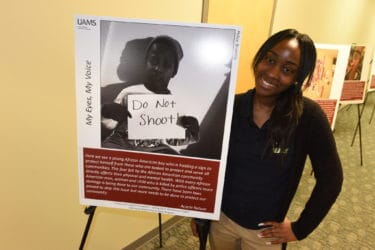
Acacia Nelson, a senior at Central High, said the academy showed her the role research can play in improving lives. The daughter of two law enforcement officers displayed a poster with a young boy holding a sign that says “Do Not Shoot!”

Acacia Nelson said the academy has inspired her to consider community research as a career.

with a caption about the physical and mental issues associated with police brutality.

Prior to attending the academy, she had a narrow view of the jobs available in health care, but now she is revisiting her idea of becoming a nurse practitioner.

“It’s kind of opened my eyes to see that there’s different areas in the medical field that you can give back to the community. I’m really interested in public health. Just helping people – homeless people, foster kids, I feel like research can make a difference.”

Zandria Brewer, a senior at Central High, displayed a poster of a young boy playing by himself in the rural Arkansas Delta. Her poster noted the health challenges for certain communities where there is often no phone service, grocery stores or hospitals.

“If someone is really hurt, they may not make it,” said Brewer, who lived in Marianna near the Mississippi River when she was younger.

Zandria Brewer said the academy has inspired her to think about research as a career.

The poster project was perfect for her, she said. “I’m a visual learner, and during this academy we did a lot of visual things,” she said. “We got to choose what we wanted to research and it got to be something interesting and something relevant. The poster project helped me voice what’s happening now and ways to change it.”

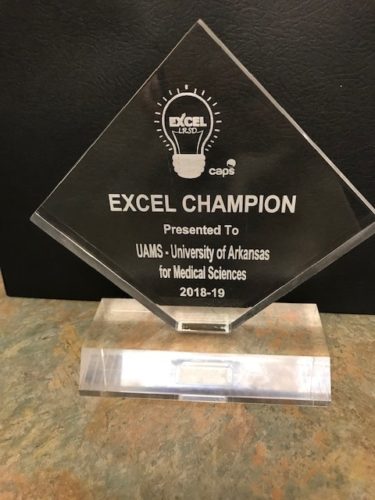
TRI received the EXCEL Champion Award from the Little Rock School District after graduating students who participated in the TRI Community Scientist Academy.
The Translational Research Institute received the EXCEL Champion Award from the Little Rock School District after graduating students who participated in the Community Scientist Academy.

Filed Under: Front, News, Newsroom Tagged With: Community Scientist Academy, Little Rock School District, Translational Research Institute, UAMS

TRIbune Newsletter Celebrates ARresearch 3-Year Anniversary

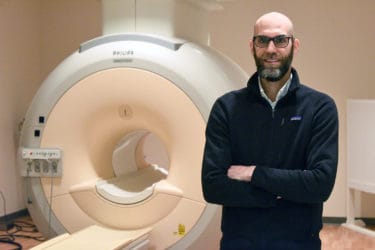
This month’s TRIbune newsletter celebrates TRI’s three-year anniversary of ARresearch with a spotlight on Keith Bush, Ph.D., a UAMS researcher who extols the benefits of the ARresearch

Keith Bush, Ph.D., is ahead of his participant enrollment goals for two studies thanks to the ARresearch volunteer registry.

registry. He is also conducting potentially groundbreaking research using an MRI to test people’s ability to regulate their emotions.

TRI Director Laura James, M.D., notes in her letter that 48% of studies fail to meet participant accrual goals. The ARresearch registry has nearly 6,000 potential volunteers signed up, providing the capacity to help more researchers.

We also highlight the work of Kate Stewart, M.D., M.P.H., and Alex Marshall, Ph.D., M.P.H., who will lead a PCORI-funded multistate collaborative to address health care discrimination for transgender/nonbinary individuals.

Clare Nesmith, M.D., is the principal investigator on our New Study of the Month.

Read The TRIbune.

Filed Under: Front, News, Newsroom Tagged With: ARresearch, Keith Bush, study, Translational Research Institute, UAMS

The TRIbune Features UAMS Neurosurgeons’ Research

The latest TRIbune features the research of neurosurgeons J.D. Day, M.D., and Thomas W. Morris III. The co-principal investigators hope to help determine if a relatively new surgical procedure is better than standard medical management in certain cases of intracerebral hemorrhage. We also highlight the work of our Community Engagement program and its Community Scientist Academy, which has been adapted for the first time to teach students in the Little Rock School District’s Excel Program. We include news that TRI’s innovative methods for incorporating community members into the grant review process will be studied at five institutions (including UAMS) with support from the NIH National Center for Advancing Translational Sciences. The newsletter has our new study of the month led by Clare Nesmith, M.D., and recently cited publications by researchers who received TRI support.

Read The TRIbune

Filed Under: Front, News, Newsroom Tagged With: Clare Nesmith, J.D. Day, Kate Stewart, Laura James, newsletter, Thomas W. Morris, Translational Research Institute, TRI, TRIbune, UAMS

TRI Now Accepting Applications for KL2 Scholar Awards

Junior faculty, here’s your chance to jump-start your careers!

The Translational Research Institute (TRI) is now accepting applications for its KL2 Mentored Research Career Development Scholar Awards.

  • Letters of Intent are due April 29, 2019.
  • Applications are due June 10, 2019.

Benefits of the two-year program:

  • 75 percent salary support (up to $95,000 per year)
  • $25,000 per year research funding
  • Professional development support

Eligible candidates are faculty with professional doctorates committed to academic careers in translational research.

Special for 2019, one of the four KL2 awards will go to an early-career breast cancer researcher.

More information is available on the TRI Website.

Potential applicants are encouraged to attend the KL2 Information Session on April 11 at noon in the Cancer Institute, Betsy Blass Boardroom, Room 1013. For those offsite, the session is available via Blackboard Collaborate.

For more information, please contact Nia Indelicato, NLIndelicato@uams.edu, 501-526-0363.

Filed Under: Front, News, Newsroom Tagged With: career development, KL2, research, training, Translational Research Institute, UAMS, University of Arkansas for Medical Sciences

Apply Now for UAMS Commercialization Course – Deadline Extended to March 22

The application deadline for the second annual UAMS fastPACE Course has been extended to Friday, March 22. The 4-week biomedical commercialization course is designed for busy researchers and clinicians with an early stage project. It begins March 29.

The course was developed by FastForward Medical Innovations at the University of Michigan and is modeled after the successful National Science Foundation I-Corps program. It blends in-person and online education to help faculty researchers and clinicians learn the basic components of biomedical commercialization and prepare a successful business case for funding and development partnerships.

Enrollment is open to faculty, clinical practitioners, and post-doctoral fellows who have an early stage biomedical innovation or idea. More information and a link to the application can be found at https://bioventures.uams.edu/fastpace/. If you are a graduate or medical student interested in entrepreneurship and wish to simply join a team, please fill out the fastPACE Intake Survey, at https://bioventures.uams.edu/fastpace/intake-survey/.

Questions? Contact Nancy Gray, Ph.D., president, BioVentures LLC, nmgray@uams.edu.

Filed Under: Front, News, Newsroom Tagged With: entrepreneurship training, fastPace, Nancy Gray, UAMS, University of Arkansas for Medical Sciences

The February TRIbune Newsletter

This month’s TRIbune newsletter highlights exciting developments with the TRI-supported Arkansas Clinical Data Repository (AR-CDR) team, led by Ahmad Baghal, M.D. This talented team

is making UAMS clinical data, as well as data from other institutions, more accessible to researchers.

Read The TRIbune.

Filed Under: Front, News, Newsroom Tagged With: Arkansas Clinical Data Repository, Baghal, data warehouse, newsletter, Translational Research Institute, TRI, TRIbune, UAMS, University of Arkansas for Medical Sciences

TRI Helps Busy Neurosurgeon Lead Multiple Studies

Erika Petersen, M.D., saw the outlines of her career when she was just 16. As a participant in a summer research program at Duke Cancer Institute, she gained insights beyond the lab work.

“As part of the program, I got to stand beside an anesthesiologist and watch open-heart surgery,” she said. “That was the moment I knew I was interested in medicine.”

Petersen, a UAMS neurosurgeon and associate professor in the College of Medicine, also noted at the time how her Duke mentor, a breast oncologist, was able to run a research lab in addition to seeing patients.

“That helped me see a model of how doctors could do research in different ways,” she said.

Futuristic Therapies
Petersen came to UAMS in 2010 and sees patients at the Stephens Spine & Neurosciences Institute. Her expertise in neuromodulation is unique to the region, futuristic even, with her ability to use deep brain stimulation and implant other devices to treat movement disorders and chronic pain.

“I have a friend who jokes that I’m creating cyborgs,” she said.

She’s not, of course. But by working at the cutting edge of medicine, she can help patients who don’t respond to conventional therapies.

“When you meet people who have seen dozens of practitioners, and they come to you saying, ‘I’ve heard great things about you, can you please help me?’ you want to offer every single possibility you can,” Petersen said.

Unfortunately, some of her work isn’t covered by insurance because the procedures are still considered experimental. It’s distressing for her and her patients.

“The compassion to treat versus the business decision of coverage is frustrating, so I’m motivated to create the evidence that will remove the disconnect between the two,” she said.

Prolific PI
Although she has no protected time for research, Petersen has been a prolific principal investigator. She is overseeing two active industry-sponsored clinical trials and three more are in the works. The active studies are testing implanted nerve stimulation devices for chronic amputation pain and diabetic neuropathy. The pending studies will test devices designed for treating chronic back pain (failed back surgery syndrome), and headache pain, including migraines. Another study involves the use of stem cells for stroke patients.

Her leadership of multiple clinical trials is a lot of extra work, but it’s doable for a couple of reasons: One, she is able to blend the trials into her clinical practice, and two, she can get the clinical trial services she needs from the Translational Research Institute (TRI).

Leveraging TRI
“A single clinician with a single nurse doesn’t have the institutional context like TRI for navigating the regulatory issues, the budget negotiations, and legal negotiations,” Petersen said. “Having the team of coordinators at TRI who are backing each other up also ensures that a research participant always has support, and that’s been essential.”

TRI has also helped her promote her research to the general public. “A clinical trial is only as successful as what you can do through recruitment,” she said. “Working with TRI, we’ve done a lot in terms of media and outreach and in identifying subjects in the UAMS Epic (electronic medical record) system. So having those resources to help with recruiting is phenomenal.”

Despite her busy schedule, Petersen has appeared on four local broadcast stations to advocate for the amputation pain study and diabetic neuropathy study. Her public education efforts, which also include an active Twitter account, have contributed to her growing national reputation in the field. UAMS is among a select group of institutions chosen to conduct neuromodulation research. In fact, she said UAMS’ management of the amputation pain study will be a model used by Neuros, the sponsor, for the remaining research centers preparing for participant enrollment.

“When you have a good system and support to successfully manage the research, it leads to ongoing partnerships across multiple studies,” Petersen said.

Filed Under: Front, News, Newsroom Tagged With: Erika Petersen, neuromodulation, neurosurgery, research, Translational Research Institute, TRI, UAMS, University of Arkansas for Medical Sciences

Promise Garden Project Earns Unity Award for TRI, CAVHS

The Translational Research Institute (TRI) was named winner of the Unity Award during the UAMS 2019 Dr. Martin Luther King Jr. Day Celebration, sponsored by the UAMS Center for Diversity Affairs.

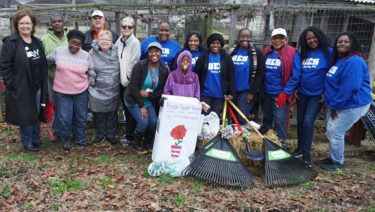
Representatives from TRI, CAVHS and Order of the Eastern Stars, Tariq Chapter #6 presented the donations at a recent visit to the Promise Garden.

The Unity Award celebrated the legacy of service advocated by King with a challenge to UAMS groups to partner with others on community service projects. TRI and its partner on the project, the Central Arkansas Veterans Healthcare System, were recognized for a donation drive to benefit the Promise Garden, a community garden at 12th and Peyton streets in Little Rock. Their efforts were bolstered by participation from the women’s sorority Order of the Eastern Stars, Tariq Chapter #6.

Billy Thomas, M.D., M.P.H., vice chancellor, said the center hosts the event not just to celebrate King, but to remind the campus and the broader community that his work is still ongoing.

“In these types of celebrations, we think about all of the things that Dr. King stood for and all the things that he did. But I think we should take this opportunity to build upon his legacy and leave this celebration with the idea that we can do things, not only individually but as an institution, to accomplish that,” he said.

The event included remarks from UAMS Chancellor Cam Patterson, M.D., MBA, as well as a keynote address from Tracey Steele, the first executive director of the Arkansas Martin Luther King Jr. Commission and a former state senator who is now the director of the Health Services Permit Agency.

“Here at UAMS you are a shining example,” he said. “I’m so proud of this institution. I brag on it everywhere I go. I tell people from all over the world of the health care they can receive at this institution. But even when you’re the best, it’s time to step it up. Because you can be even a greater example of what is right.”

In his remarks, Chancellor Patterson said he’s influenced by King in three ways: his urging to do the right thing and avoid doing wrong, the importance of doing the right thing even when facing adversity, and remembering that there is always a vision of a better world, even if it does not exist yet today.

“We cannot give up the struggle until we are there. While we may not get there in our lifetimes, we cannot give up,” Patterson said. “That’s the work that I invest myself in, and I’m reminded of that every year when we celebrate Dr. King.”

Five teams were recognized:

UAMS Translational Research Institute and Central Arkansas Veterans Healthcare System – Health and Wellness Committee: Collected and distributed items needed by the Promise Garden at 12th and Peyton streets in Little Rock. Collection included seeds and tools, as well as cash for chicken feed with the hope of offering sustainable assistance.

College of Medicine – Office of Admissions and UAMS student chapter of the League of United Latin American Citizens: Leading up to Christmas, collected and distributed toys in a drive benefitting community service organization Integrity, Inc. and Bethany Christian Services.

Department of Lab Animal Medicine and Division of Endocrinology – Research: Organized a collection drive of bedding, linens, toiletries and other products and donated them to the Compassion Center, a shelter for homeless, transient, and displaced people in the Little Rock metro area.

Campus Operations – Operational Support Services and Institutional Compliance: Organized a collection for a variety of items, from toiletries to blankets to tents, and provided them to the Van, a nonprofit that reaches out and brings such essentials to homeless camps directly.

Office of Sponsored Programs Administrative Network, Office of Research and Sponsored Programs, Science Communication Group and Grants Management Program Alumni: Organized two fundraisers to supply Christmas gifts to students in three Head Start classrooms and arranged a collection to buy gifts for young people in the care of Immerse Arkansas, which serves youth in crisis not served by the state foster care system.

In an effort to encourage the message of community service so prominent in King’s work, the celebration included a volunteer fair, in which a number of local organizations in need of volunteers were invited to provide staff and students an outlet for community service. They included:

Arkansas Youth Challenge Program

Goodwill Arkansas

Habitat for Humanity of Central Arkansas

Heart of Arkansas United Way

Hospice Home Care

Humane Society of Pulaski County

Jericho Way Day Resource Center

Literacy Action of Central Arkansas

Little Rock Zoo

Our House

UAMS Volunteer Services

Filed Under: Front, News, Newsroom Tagged With: CAVHS, Celebration, Martin Luther King, Promise Garden, Translational Research Institute, TRI, UAMS, Unity Award

  • «Previous Page
  • Page 1
  • Interim pages omitted …
  • Page 3
  • Page 4
  • Page 5
  • Page 6
  • Page 7
  • Interim pages omitted …
  • Page 29
  • Next Page»
Translational Research Institute LogoTranslational Research InstituteTranslational Research Institute
Mailing Address: 4301 West Markham Street, Little Rock, AR 72205
Phone: (501) 686-7000
  • Facebook
  • X
  • Instagram
  • YouTube
  • LinkedIn
  • Pinterest
  • Disclaimer
  • Terms of Use
  • Privacy Statement
  • Legal Notices

© 2026 University of Arkansas for Medical Sciences