• Skip to primary navigation
  • Skip to main content
  • Skip to primary navigation
  • Skip to main content
Choose which site to search.
University of Arkansas for Medical Sciences Logo University of Arkansas for Medical Sciences
Translational Research Institute
  • UAMS Health
  • Jobs
  • Giving
  • About TRI
    • What We Offer
    • Leadership & Governance
    • Staff
    • Citing Translational Research Institute CTSA Support
    • What is Translational Research?
    • Contact TRI
  • Funding Opportunities
    • Grants
      • Pilot Award Program
      • Consortium of Rural States (CORES) Multi-Institutional Pilot Award Program
      • Team Science Voucher Program
      • Winthrop P. Rockefeller Cancer Institute Rural Research Award Program
    • Scholarships
      • K12 Mentored Research Career Development Scholar Awards Program
      • Health Sciences Innovation and Entrepreneurship Postdoctoral Training Program
      • Implementation Science Scholar Program
      • (STARs) Program – Strategies for Training and Advancing Researchers
      • SMART Program [Master’s in Clinical and Translational Sciences (MS-CTS)]
    • Community
      • Community Based Participatory Research (CBPR) Scholars Program
      • Community Partners Educated as Arkansas Research Leaders (CPEARL) Program
    • Awardee Responsibilities
  • Services & Resources
    • Services
      • Biostatistics, Epidemiology and Research Design (BERD) Consultation
      • Clinical Data Repository (AR-CDR)
      • Comprehensive Informatics Resource Core
      • Mock Study Sections
      • Research Participant Recruitment
      • Research Support: Clinical Trials Innovation Unit (CTIU)
      • Implementation Science Program
      • Research Ethics Consultation
    • Resources
      • ARresearch Registry
      • Center for Health Literacy
      • Data Safety Monitoring
      • Grant Writing & Dissemination
      • UAMS Profiles
      • UAMS Rural Research Network
      • Other Resources
      • COVID-19 Research Guidelines
      • Community Partner Research Training
  • Career Development & Scholarships
    • Scholarship Opportunities
      • K12 Mentored Research Career Development Scholar Awards Program
      • Health Sciences Innovation and Entrepreneurship Postdoctoral Training Program
      • Data Science Scholars Program
      • Implementation Science Scholar Program
      • SMART Program
      • Translational Research Innovations and Partners (TRIP) Program
    • Training & Educational Opportunities
      • innOVATION Seminar Series
      • Path 2 K Program
      • Translational Workforce Development
      • Graduate Certificate in Implementation Science
      • SMART Program [Master’s in Clinical and Translational Sciences (MS-CTS)]
      • Good Clinical Practice Training
    • Didactic Training
  • Community
    • Community Engagement Leadership
    • Community Advisory Board
    • Community Engagement Partners
      • Community Partner Celebration
      • Faith-Academic Initiatives for Transforming Health (FAITH) Network
    • Community Engagement Services
      • Consultations and Technical Assistance
      • Community Review Boards
      • Community Partner Research Training
      • Equipment Library
    • Programs and Funding
      • Community Partners Educated as Arkansas Research Leaders (CPEARL) Program
      • Community Based Participatory Research (CBPR) Scholars Program
      • Community Scientist Academy
    • Toolkits
      • CSA Online Toolkit
      • CPEARL Toolkit
  • Events
    • Research Day
    • Clinical Trials Learning Collaborative
  • Newsroom
  1. University of Arkansas for Medical Sciences
  2. Translational Research Institute
  3. News
  4. Page 20

News

National Cancer Database at UAMS Becomes U.S. Storehouse for COVID-19 Images

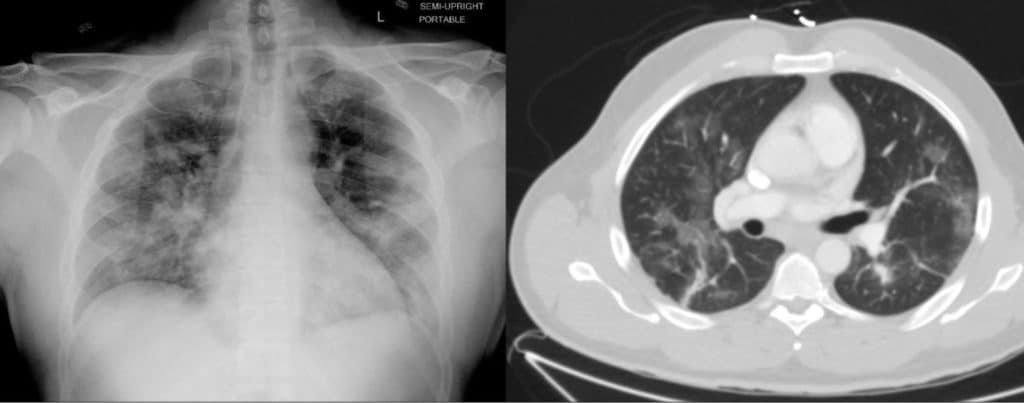
A Chest Radiograph (left) and Computed Tomography (CT) image (right) of the same COVID-19 patient taken one day apart. These UAMS images, now publicly available in the national Cancer Imaging Archive, show COVID-19 lung infection similar to pneumonia. Medical experts refer to the appearance as ground glass opacities, a haziness overlying the lung that is common with COVID-19 patients.

LITTLE ROCK — A national database for patient cancer images at UAMS will become the storage site for COVID-19 clinical images from across the United States and around the globe, including chest x-rays and CT scans of the body.

Fred Prior, Ph.D.

This week, UAMS also became the first research institution to contribute de-identified images of COVID-19 to the storage site, called The Cancer Imaging Archive. The archive is funded by the National Cancer Institute (NCI) at the National Institutes of Health (NIH).

The archive is led by UAMS’ Fred Prior, Ph.D., professor and chair of the Department of Biomedical Informatics in the College of Medicine.

With Arkansas data being the first to arrive, it will be a unique opportunity for researchers across the U.S. to see how COVID-19 is affecting a rural population.

“Researchers are clamoring for this data,” Prior said. “At UAMS, we want to make sure the unique characteristics of our rural population in Arkansas are represented. Our state’s inclusion is really important as scientists are trying to figure out how this disease is evolving, how it’s impacting different groups of people, and why there are such a wide variety of symptoms and outcomes.”

The majority of the COVID-19 images are chest X-rays, the most commonly used imaging procedure for COVID-19 in the U.S., Prior said. About 20% of UAMS cases also have CT scans, allowing more detailed analyses. In addition, many of the CT scans included the chest, abdomen and pelvis.

“We’re looking at internal organs other than just the lungs, which is important because more and more we’re seeing this disease impacting the kidneys and the liver,” Prior said.

Laura James, M.D.

The first batch of published de-identified images comes from 105 UAMS COVID-19 patients and includes a representative sample of the viral genomes found in the patients.  The collection and publication of the data was funded by the UAMS Translational Research Institute, which is supported by the NIH National Center for Advancing Translational Sciences, grant UL1TR003107.

The data is publicly available on the archive website: https://www.cancerimagingarchive.net/collections/

“Making this de-identified image and genetic data available nationally is an important step as we work to better understand a disease that’s unlike anything we’ve ever seen,” said Laura James, M.D., director of the Translational Research Institute. “UAMS is helping to lead the way, and we expect there will soon be thousands more patients represented in the imaging database from across the country.”

In addition, she noted, her institute’s Comprehensive Informatics Resource Center, which Prior leads, is helping the NIH National Center for Advancing Translational Sciences (NCATS) build a large central repository for COVID-19 research. That storehouse of data will be cross-linked with the imaging archive.

The 62 NCATS-funded Clinical and Translational Science Award  institutions, such as UAMS, have been invited to share their COVID-19 data in the repository, called the National COVID Cohort Collaborative (N3C).

Prior and Ahmad Baghal, M.D., director of the UAMS Arkansas Clinical Data Repository, will pilot test the N3C’s mechanism for linking with UAMS clinical data in the repository and data from The Cancer Imaging Archive.

“We are uniquely positioned to help lead these national efforts,” said Prior, who serves on the NCATS Governance Working Group and Tools Working Group. “The Cancer Imaging Archive was shovel-ready for this sort of project, and UAMS is fortunate to have superb data infrastructure thanks to the support of our UAMS and Translational Research Institute leadership.”

Filed Under: News

ARresearch – UAMS’ Research Volunteer Registry

Jean Mcsweeney

Learn about the ARresearch Registry, how we recruit, and how you can use it for your research.

Download Flyer

Download PDF

ARresearch - UAMS' Research Volunteer Registry

Filed Under: News

Budgeting for Grant Applications

Hear important information about how to build a budget for your grant applications.

Budgeting for Grant Applications

Filed Under: News

TRI Invites LOIs and RFPs for New Scholars Program

TRI has issued the call for Letters of Intent and Request for Proposals for its Community-Based Participatory Research (CBPR) Scholars Program.

The Scholars Program, which begins January 2021, was established to increase community-partnered research at UAMS to better serve the research needs of the Arkansas community and ultimately to reduce health disparities.

This program is led by TRI’s Community Engagement Program and will provide participants with the foundational knowledge of CBPR and skills to:

  • Develop meaningful, equitable partnerships (academic researcher and community partner)
  • Learn together how to conduct community-based participatory research
  • Jointly develop and submit a scientifically sound funding proposal for targeted pilot funding of up to $50,000 from TRI. (Participation in this course does not guarantee an award)

Find additional information here.

Apply here.

Deadlines: 

  • Letters of Intent (encouraged but not required): Aug. 15, 2020
  • Grant Proposal: Oct. 1, 2020

For any questions, contact: Rachel Hale rbhale@uams.edu

Filed Under: Front, News, Newsroom

TRI Celebrates Researchers, Innovation in New Publication

TRI is excited to release its 2020 Annual Report, a celebration of the work we are supporting at UAMS and with our partner institutions.

Since 2009, translational research has become embedded in our culture at UAMS, and last year’s Clinical and Translational Science Award has created exciting new opportunities to further advance our goals.

This engagingly crafted Annual Report highlights the innovation derived from our programs and support and that reach communities across Arkansas.

View it here. 

Filed Under: Front, News, Newsroom

UAMS-Developed High-Accuracy COVID-19 Antibody Testing Begins in Arkansas

LITTLE ROCK — The University of Arkansas for Medical Sciences (UAMS) has developed and begun using high-accuracy antibody testing to determine the magnitude of COVID-19 infection in Arkansas and inform the decisions of policymakers.

Josh Kennedy, M.D.
Josh Kennedy, M.D.

As part of the research program, UAMS will collect blood samples from nearly 7,500 Arkansas adults and children through October. By early August, a robotic-assisted immunoassay machine will enable processing of 2,500 samples per day for workplace, school and other community settings. UAMS researchers are now processing only up to 180 samples per day by hand.

The effort is supported by $3.3 million in federal coronavirus aid that was then allocated by the Arkansas Coronavirus Aid, Relief and Economic Security Act Steering Committee created by Gov. Asa Hutchinson.

Unlike diagnostic tests, COVID-19 antibody testing looks back into the immune system’s history. A positive antibody test  means the person was exposed to the virus and developed antibodies against the virus. It will give state leaders a good idea how many Arkansans have been infected with the virus since it first came to the state, even if they did not become ill or have symptoms.

“It will be critical for policymakers to estimate how many Arkansans have been previously infected as they consider reopening schools, allowing mass gatherings, and keeping workplaces safe,” said UAMS Chancellor Cam Patterson, M.D., MBA.

“As much as we may want to, we know we can’t test everyone with the antibody test right now, but we can design a program that will give us an estimate of how many Arkansans have

Craig Forrest, Ph.D.

had COVID-19,” said Laura James, M.D., director of the UAMS Translational Research Institute.

Seroprevalence is the proportion of people in a population whose blood serum tests positive for a particular disease. There are two study components: a laboratory component and a statewide epidemiology component.

The lab component was initiated in early March by Josh Kennedy, M.D., associate professor, College of Medicine, Department of Pediatrics, along with Karl Boehme, Ph.D., and Craig Forrest, Ph.D., both associate professors in the College of Medicine, Department of Microbiology and Immunology.

Boehme and Forrest developed and validated the high-accuracy antibody test using components provided by Florian Krammer, Ph.D., a microbiology colleague at the Icahn School of Medicine at Mount Sinai in New York, and blood samples that Kennedy acquired.

“This vital research would not have been possible without their collaboration and original laboratory science,” said James, also associate vice chancellor for Clinical and Translational Research.

The researchers’ achievement inspired leaders across UAMS and Arkansas Children’s Hospital to come together in support of the statewide project.

The epidemiology component of the study, led by the UAMS College of Public Health, will utilize the contact tracing call center to enroll study participants and college health histories and blood samples from individuals who represent the entire state. It will provide the first results about the prevalence of asymptomatic Arkansans.

The epidemiology component is being led by College of Public Health Dean Mark Williams, Ph.D., and Benjamin Amick, Ph.D., associate dean for research. Key College of Public Health team members are epidemiologists Wendy Nembhard, Ph.D., Victor Cardenas, M.D., Ph.D., and Lori Fischbach, Ph.D., and biostatistician James Selig, Ph.D.

Dean Mark Williams, Ph.D.
Mark Williams, Ph.D.

“Providing accurate estimates is vitally important in helping policymakers plan for implementing protective and treatment measures in Arkansas,” Williams said. “Without this information, public health officials are just guessing, and there is a chance they will guess wrong.”

Significant UAMS guidance and resources have also come from Shuk-Mei Ho, Ph.D., vice chancellor for Research and Innovation, and Stephanie Gardner, Ed.D., Pharm.D., provost, chief academic officer and chief strategy officer.

Other collaborators and support have come from the Translational Research Institute’s Clinical and Translational Science Award from the National Center for Advancing Translational Sciences, including its informatics core, led by Fred Prior, Ph.D., chair of the Department of Biomedical Informatics in the College of Medicine. Other collaborators from the College of Medicine include Erika Olgaard, M.D., assistant professor, Department of Pathology, and Jeff Moran, Ph.D., assistant professor, Department of Pharmacology and Toxicology, who will oversee the robotic component of the study; and Jessica Snowden, M.D., associate professor, Department of Pediatrics, will oversee the pediatric component.

“This is truly a team science effort involving the expertise of diverse but complimentary experts who have come together to develop a solution to address COVID-19 in Arkansas,” James said.

“This is a great opportunity for us as basic scientists to be able to apply our skillset to a question that has huge public health ramifications potentially worldwide and definitely for the state of Arkansas,” Forrest said. “Many tests on the market have proven to be inaccurate or provide no useful information beyond a positive or negative result. We’re confident we have a test that’s reliable and meaningful and will serve Arkansas well.”

The UAMS antibody test requires a small amount of blood, although more than a pin prick. Its validity testing shows it is not fooled by antibodies for other coronaviruses.

Boehme said the antibody testing will serve as a springboard for researchers to answer deeper questions about COVID-19 in other studies, such as:

  • How many antibodies are present when tested?
  • How robust is the immune response?
  • How much antibody is required to provide immunity?
  • How long does immunity last?

“For other coronaviruses, the antibody response may wane after a year or two,” Boehme said. “The duration of immunity has implications for a vaccine; will the vaccine be effective for life or will it be a yearly vaccine like with the flu?”

Filed Under: Front, News, Newsroom

TRI Announces Pilot Awardees for Biomedical Informatics Studies

The UAMS Translational Research Institute (TRI) today announced four recipients of its biomedical informatics-focused pilot

grants.

The recipients are required to use translational biomedical informatics approaches to health care issues that particularly affect rural individuals and/or that directly examine or impact rural health. They will receive up to $50,000 for their one-year projects and are expected to develop findings that lead to larger programs of research with national funding.

The awardees, all from the College of Medicine, are:

Hari Eswaran, Ph.D.; Professor, Department of Obstetrics & Gynecology; Identification of Pregnant Women at High Risk of Maternal Morbidity

Hari Eswaran, Ph.D. - Identification of Pregnant Women at High Risk of Maternal Morbidity

Se-Ran Jun, Ph.D.; Assistant Professor, Department of Biomedical Informatics; Using Genomics to Track Carbapenem-Resistant Enterobacteriaceae (CRE) Linking Rural and Urban Health in Arkansas

Se-Ran Jun, Ph.D.

Sacha McBain, Ph.D.; Assistant Professor, Department of Psychiatry; Digital PTSD Screening and Intervention to Meet Rural Needs

Sacha McBain, Ph.D.

Tuhin Virmani, M.D., Ph.D.; Associate Professor, Department of Neurology; Utilization of a Neuroinformatics Research Platform (ARIES) to Develop Quantitative Tools for Clinical Assessment and Treatment of Parkinson’s Disease Patients in Rural Arkansas

Tuhin Virmani, M.D.,Ph.D.

Recipients of the Translational Biomedical Informatics Awards were selected by a study section of UAMS and external faculty reviewers, as well as community reviewers.

TRI is supported by a Clinical and Translational Science Award (CTSA) from the National Center for Advancing Translational Sciences of the National Institutes of Health, grant UL1 TR003107.

Filed Under: Front, News, Newsroom

Celebrating Clinical Trials Day in the Time of COVID-19

Clinical Trials Day is Wednesday, May 20, and TRI, along with others in UAMS’ research community, are celebrating all week. Why? Because with COVID-19, clinical research has never been more important. There are now more than 30 COVID-19 research studies at UAMS and Arkansas Children’s Research Institute.

TRI has posted three short videos of UAMS research participants with inspirational stories on its social media channels.

View this brief video by TRI Associate Director John Arthur, M.D., Ph.D.

All of these videos are TRI’s Facebook page: https://www.facebook.com/uamstri/, and Twitter page: @TRI_UAMS.

Please visit and share!

Filed Under: Front, News, Newsroom

TRI Names 2020 KL2 Awardees

The University of Arkansas for Medical Sciences (UAMS) Translational Research Institute (TRI) has selected three early-career researchers to receive KL2 Mentored Research Career Development Awards.

The KL2 program, co-led by Elisabet Borsheim, Ph.D., and Brooks Gentry, M.D., provides two years of research training to junior faculty. It provides 75 percent salary support and up to $25,000  per year for research, tuition, travel and education.

The awardees are:

Britni Ayers, Ph.D.
Britni Ayers, Ph.D.

Britni Ayers, Ph.D., assistant professor, College of Medicine, UAMS Northwest Regional Campus; “Exploring the Feasibility of a Group Prenatal Program, Kōmmour Prenatal, to Reduce Maternal and Infant Health Challenges among Marshallese Pacific Islander Women.”

Jure Baloh, Ph.D.
Jure Baloh, Ph.D.

Jure Baloh, Ph.D., M.H.A., assistant professor, Health Policy and Management, College of Public Health; “Adapting a Supervision Strategy for Sustaining Fidelity to Evidence-Based Practices in Substance Use Disorder Treatment Settings.”

Kimberly Stephens, Ph.D.

Kimberly Stephens, Ph.D., M.P.H., assistant professor, Arkansas Children’s Research Institute (ACRI) Division/Center for Applied Research and Evaluation, Department of Pediatrics, College of Medicine; “Changes in Epigenetic Mechanisms and Symptom Clusters Associated with the Resolution of Persistent Pain following Spinal Cord Stimulation.”

The awardees were selected by a UAMS study section.

Filed Under: Education, Front, News, Newsroom

TRI Director Laura James, M.D., Named to National Science Board

Laura James, M.D., director of the UAMS Translational Research Institute, has been elected to the national Association for Clinical and Translational Science (ACTS) Board of Directors.

She joins 13 other directors at large from Clinical and Translational Science Award (CTSA) Program institutions across the United States.

James has been director of the institute since 2014 and is UAMS associate vice chancellor for Clinical and Translational Research. She has a 25-year history of translational research in clinical pharmacology and toxicology at UAMS and Arkansas Children’s Hospital. As a clinician-scientist and founder of the startup company Acetaminophen Toxicity Diagnostics LLC, she is leading development of a rapid diagnostic test for acetaminophen liver injury. In 2014 she was named inaugural fellow of the Arkansas Research Alliance (ARA).

The role of the ACTS board is to govern, establish policy and make strategic decisions about the future of the organization. ACTS supports research that continually improves team science, integrating multiple disciplines across the translational science spectrum. It is also the academic home for translational research education and career development, and is an advocate for translational science.

Translational research is the process of taking findings and discoveries (new medicines, health interventions, etc.) and “translating” or applying them to everyday practices that improve health.

The CTSA Program is administered by the National Center for Advancing Translational Sciences (NCATS) at the National Institutes of Health. TRI received a five-year, $24.2 million CTSA, grant UL1 TR003107 in July 2019 and is one of more than 60 CTSA-supported institutions nationally.

Filed Under: Front, News, Newsroom

  • «Previous Page
  • Page 1
  • Interim pages omitted …
  • Page 18
  • Page 19
  • Page 20
  • Page 21
  • Page 22
  • Interim pages omitted …
  • Page 48
  • Next Page»
Translational Research Institute LogoTranslational Research InstituteTranslational Research Institute
Mailing Address: 4301 West Markham Street, Little Rock, AR 72205
Phone: (501) 686-7000
  • Facebook
  • X
  • Instagram
  • YouTube
  • LinkedIn
  • Pinterest
  • Disclaimer
  • Terms of Use
  • Privacy Statement
  • Legal Notices

© 2026 University of Arkansas for Medical Sciences