• Skip to primary navigation
  • Skip to main content
  • Skip to primary navigation
  • Skip to main content
Choose which site to search.
University of Arkansas for Medical Sciences Logo University of Arkansas for Medical Sciences
Translational Research Institute
  • UAMS Health
  • Jobs
  • Giving
  • About TRI
    • What We Offer
    • Leadership & Governance
    • Staff
    • Citing Translational Research Institute CTSA Support
    • What is Translational Research?
    • Contact TRI
  • Funding Opportunities
    • Grants
      • Pilot Award Program
      • Consortium of Rural States (CORES) Multi-Institutional Pilot Award Program
      • Team Science Voucher Program
      • Winthrop P. Rockefeller Cancer Institute Rural Research Award Program
    • Scholarships
      • K12 Mentored Research Career Development Scholar Awards Program
      • Health Sciences Innovation and Entrepreneurship Postdoctoral Training Program
      • Implementation Science Scholar Program
      • (STARs) Program – Strategies for Training and Advancing Researchers
      • SMART Program [Master’s in Clinical and Translational Sciences (MS-CTS)]
    • Community
      • Community Based Participatory Research (CBPR) Scholars Program
      • Community Partners Educated as Arkansas Research Leaders (CPEARL) Program
    • Awardee Responsibilities
  • Services & Resources
    • Services
      • Biostatistics, Epidemiology and Research Design (BERD) Consultation
      • Clinical Data Repository (AR-CDR)
      • Comprehensive Informatics Resource Core
      • Mock Study Sections
      • Research Participant Recruitment
      • Research Support: Clinical Trials Innovation Unit (CTIU)
      • Implementation Science Program
      • Research Ethics Consultation
    • Resources
      • ARresearch Registry
      • Center for Health Literacy
      • Data Safety Monitoring
      • Grant Writing & Dissemination
      • UAMS Profiles
      • UAMS Rural Research Network
      • Other Resources
      • COVID-19 Research Guidelines
      • Community Partner Research Training
  • Career Development & Scholarships
    • Scholarship Opportunities
      • K12 Mentored Research Career Development Scholar Awards Program
      • Health Sciences Innovation and Entrepreneurship Postdoctoral Training Program
      • Data Science Scholars Program
      • Implementation Science Scholar Program
      • SMART Program
      • Translational Research Innovations and Partners (TRIP) Program
    • Training & Educational Opportunities
      • innOVATION Seminar Series
      • Path 2 K Program
      • Translational Workforce Development
      • Graduate Certificate in Implementation Science
      • SMART Program [Master’s in Clinical and Translational Sciences (MS-CTS)]
      • Good Clinical Practice Training
    • Didactic Training
  • Community
    • Community Engagement Leadership
    • Community Advisory Board
    • Community Engagement Partners
      • Community Partner Celebration
      • Faith-Academic Initiatives for Transforming Health (FAITH) Network
    • Community Engagement Services
      • Consultations and Technical Assistance
      • Community Review Boards
      • Community Partner Research Training
      • Equipment Library
    • Programs and Funding
      • Community Partners Educated as Arkansas Research Leaders (CPEARL) Program
      • Community Based Participatory Research (CBPR) Scholars Program
      • Community Scientist Academy
    • Toolkits
      • CSA Online Toolkit
      • CPEARL Toolkit
  • Events
    • Research Day
    • Clinical Trials Learning Collaborative
  • Newsroom
  1. University of Arkansas for Medical Sciences
  2. Translational Research Institute
  3. News
  4. Page 39

News

September TRIbune

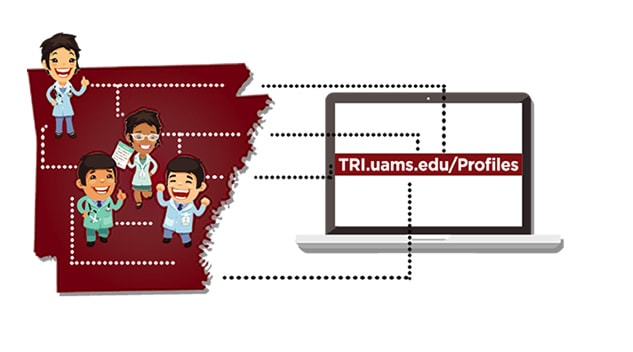
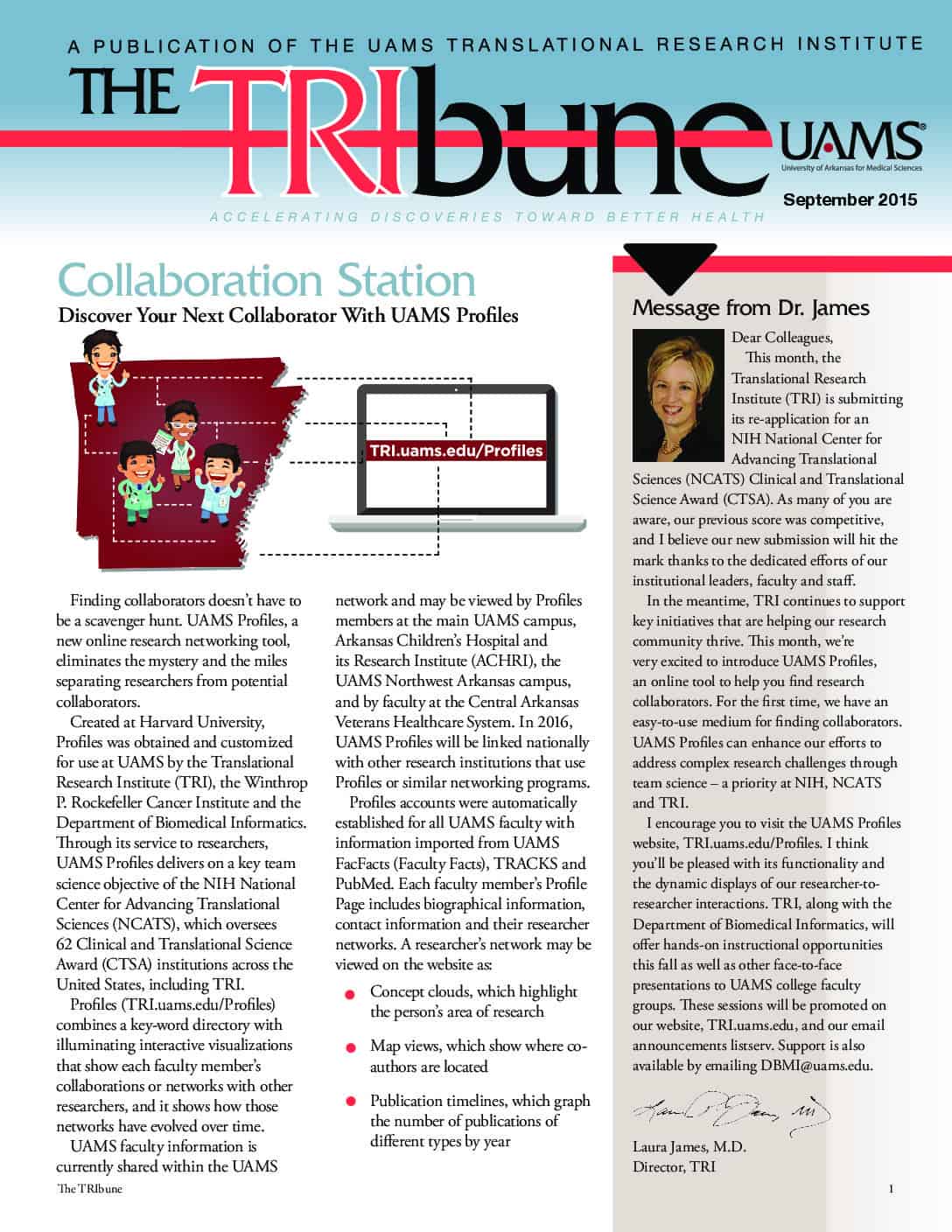
You’ll want to check out the September TRIbune, which features UAMS Profiles, the exciting new platform for finding collaborators.  This issue also highlights a TRI-supported stroke researcher who received a Genentech grant, as well as TRI-cited publications by your colleagues.

TRIbuneSeptember2015

Download PDF | View Newsletter Archive

Filed Under: Front, News, Newsroom

UAMS BioVentures Director to Researchers: ‘Call Me’

Nancy Gray, Ph.D., has spent her first six months as UAMS BioVentures director focused on getting to know researchers and staff. She’s met with researchers interested in generating intellectual property, those who have generated intellectual property, and some who aren’t sure if they have.

“What I’ve found is that most researchers are so involved in the day-to-day of their programs that, generally, they aren’t thinking about whether they have invented something,” she said. “I believe there’s a lot more intellectual property here that we can capture.”

Gray’s outreach so far as generated an increasing number of researcher phone calls and emails, but she would like to receive more.

“If you have a question, call BioVentures,” she said. “Even if we don’t have an answer, we’ll find an answer. I would like to see BioVentures viewed as a resource as people think about their research work and what it might lead to in terms of commercialization.”

Gray has encountered a few misconceptions here, as well, such as that intellectual property relates only to patents, while in reality it may also involve copyright material and know-how.

BioVentures’ role includes finding licensees for a researcher’s intellectual property if the researcher chooses not to create a spin-off company. Gray has also focused on finding partners for UAMS researchers either through licensing of intellectual property or for sponsored research. While BioVentures does not manage sponsored research agreements, she said, there are opportunities for corporate sponsorships to develop early stage intellectual property through sponsored research or product licenses.

“If a researcher knows a certain company might be interested in their work, I would encourage them to reach out to BioVentures,” she said.

Another misconception Gray noted is that BioVentures offers a source of funding, as implied by its name. Although it doesn’t provide funding, Gray is in a position to help with that too.

“We’re not a venture group, per se, but we have the expertise here,” she said, noting BioVentures staff with business and financial backgrounds and her more than 30 years in biomedical industries, including medicinal chemistry research, management of pharmaceutical research and development, and business operations. Her experience and professional connections allow Gray to direct researchers to the right people.

“Each piece of intellectual property might have a different audience,” she said. “If it’s diagnostic based, the audience of companies would be much different than if it’s a therapeutic or vaccine or device.”

Gray’s experience also includes that of researcher and product developer. She is the inventor on 31 issued U.S. patents and the author of 23 publications. Her research on central nervous system diseases resulted in three products being accepted for clinical development in five years. She was also instrumental in the development of two marketed second generation antihistamines, Allegra and Xyxal.

UAMS Translational Research Institute (TRI) Director Laura James, M.D., noted that BioVentures is important to UAMS’ mission to improve its translation of new knowledge and discoveries into better health and health care. Gray participated in TRI’s strategic planning retreat just weeks after she arrived in March and is working with TRI on a program to reach a broader audience of researchers with an introduction to the concepts of intellectual property and the importance of protecting inventions.

Gray came to UAMS from the Southern Research Institute in Birmingham, Alabama, where she was vice president for corporate development. There, she led corporate development opportunities, including mergers and acquisitions, strategic alliances, joint ventures, minority investments, technology licenses and divestitures for the life sciences, engineering, and environment and energy business. Gray completed one joint venture agreement, 30 license agreements and 37 collaboration agreements.

Prior to her time at the Southern Research Institute, Gray worked in various executive roles at Beijing Med-Pharm Corporation, Vaxinnate Corportation and Elan Corporation.  She received her bachelor’s degree in chemistry from Bucknell University and her doctorate in medicinal chemistry from the University of Illinois.

Gray can be reached at nmgray@uams.edu or (501) 686-6696.

Filed Under: Front, News, Newsroom

KL2 Scholar Award Applications Due Oct. 1

The application deadline has been extended to Oct. 1 for the UAMS Translational Research Institute (TRI) KL2 Mentored Research Career Development Scholar Awards. Benefits of the two-year program for early career researchers include:

  • Up to $95,000 each year for salary support
  • Up to $25,000 each year for research, tuition, travel and education materials

Eligible candidates are those with professional doctorates committed to academic careers in multidisciplinary translational research.

Revised Important Dates

  • Monday, September 14, 2015: Deadline to request biostatistics consult
  • Thursday, October 1, 2015, at 12 p.m. (noon):  Application packet due
    • Projects must be submitted for all necessary regulatory approval(s)
  • Week of November 23, 2015:  Awardees announced
  • Tuesday, December 1, 2015:  Project start date
    • All regulatory approval letter(s) must be submitted to TRI

Download TRI’s 2015 Request for Applications.

Contact: TRIservices@uams.edu

Filed Under: News

Why TRI?

Andres Duarte-Rojo, M.D., Ph.D., says the services provided by the UAMS Translational Research Institute are helping him advance his research.

Filed Under: News

July TRIbune

Check out the latest TRI news in the July TRIbune. This issue features new efforts to track the quality of TRI’s services to researchers, a story about a College of Pharmacy team’s promising TRI-supported radiation therapeutic, and the latest TRI-cited publications.

July 2015

Newsletter Archive

Filed Under: News

UAMS Research Support Group Wins International Award Fourth Consecutive Year

Amy Jo Jenkins, M.S., C.C.R.P., C.C.R.A., C.C.R.C., at the UAMS Translational Research Institute (TRI), and Lyndsey Avery, C.C.R.P., R.A.C., in the UAMS Office of Research Regulatory Affairs (ORRA), are the recipients of the international Society of Clinical Research Associates (SOCRA) 2015 Chapter Chairperson Recognition Award for their work as co-chairs of the Arkansas SOCRA chapter.

This marks the fourth year in a row – and each year of its existence – that the Arkansas SOCRA chapter has won the award, which recognizes the chapter for offering the most continuing education hours for clinical research professionals of any chapter around the globe. The UAMS chapter offered 29.7 continuing education credit hours from June 1, 2014, to May 31, 2015. The group’s continued success can be attributed to support from TRI, ORRA, and the UAMS Office of Research Compliance and its members who actively participate in sponsored activities, Jenkins said

“Everyone in our research community is very excited to see Amy Jo and Lyndsey earn this award,” said TRI Director Laura James, M.D. “Their achievement demonstrates a commitment to research quality that is unparalleled.”

The award will be presented at the SOCRA Annual Conference in Denver, Sept. 18.

SOCRA developed a certification program to create an internationally-accepted standard of knowledge, education, and experience by which clinical research professionals are recognized as certified clinical research professionals (CCRP®s) in the clinical research community.

The continuing education hours offered by the Arkansas SOCRA chapter help research staff at UAMS and other sites earn or maintain their Certified Research Specialist (CRS) certification.

The CRS certification program, administered by the UAMS Office of Research Compliance, ensures an understanding of, and respect for, the principles of research integrity and the protection of those who participate in research. Although the certification is not required by all departments, UAMS research employees routinely complete the 26 hours of coursework and the comprehensive CRS proficiency exam.

Filed Under: News

TRI Awards $350,000 for Seven Pilot Research Studies

The UAMS Translational Research Institute (TRI) has approved research pilot study awards for seven researchers totaling about $350,000.

The annual awards of about $50,000 each are made to studies with the strongest likelihood of leading to improved health and health care. For the first time this year, pilot awards were also offered for studies that address common barriers to research, such as the development of tools or approaches that could be used in the future by other researchers.

“The Translational Research Institute is excited about the potential findings that will be generated from this year’s group of pilot awardees,” said Laura James, M.D., institute director. “The awards span diverse areas ranging from better approaches to identify cancer using state-of-the-art detection systems to understanding how a particular drug class could improve the treatment of depression. In addition, for the first time, a portion of our pilot awards will focus on developing methods and tools that can help facilitate research for others in the future.”

Also a first this year, TRI invited community and professional stakeholders to participate in the evaluation of the pilot studies alongside scientific reviewers. The practice is in keeping with the translational research goal of ensuring that studies have stakeholder engagement, meaning the input of lay people, clinicians and professionals in the health industry.

The 2015 pilot awardees and their project titles are:

Laura Hutchins, M.D., College of Medicine, Department of Internal Medicine, Hematology: Development and implementation of video assisted process for the UAMS tissue biorepository and procurement service
Magomed Khaidakov, M.D., Ph.D., College of Medicine, Department of Internal Medicine, Gastroenterology: Sessile serrated adenomas/polyps – search for biomarkers of malignant potential
Il-Young Kim, Ph.D., College of Medicine, Department of Geriatrics: Role of dietary protein intake on whole body protein in the elderly
Tamara Perry, M.D., College of Medicine, Department of Pediatrics: Exploring the effects of sleep patterns and physical activity on asthma in adolescents with wrist-worn smart devices
Ronald Salomon, M.D., College of Medicine, Department of Psychiatry: Ketamine effects on dorsal raphé function in depression
Scott Warmack, Pharm.D., College of Pharmacy, UAMS Northwest Campus: Participant preferred dissemination methods
Vladimir Zharov, Ph.D., D.Sc., College of Medicine, Department of Otolaryngology: Photoacoustic diagnosis of circulating clots in cancer patients

Filed Under: News

Survey Shows Strength of TRI’s Research Services

In its mission to ensure that it provides high quality and diverse translational research services, the Translational Research Institute (TRI) recently conducted a survey of researchers and staff that revealed a high level of satisfaction with TRI services.

The online survey went to 135 employees who used TRI’s research services portal (TRIservices@uams.edu) and yielded 69 completed surveys from researchers at all TRI Hub sites: the main UAMS campus, Arkansas Children’s Hospital and its Research Institute, the UAMS Northwest Campus, and the Central Arkansas Veterans Healthcare System.

Overseen by Beatrice Boateng, Ph.D., director of TRI’s Evaluation Program, the survey was conducted one year after the email portal was introduced. She noted that the survey only includes researchers and staff who used the portal to request services.

“The survey report helps capture the breadth of services offered by TRI and shows that TRI staff are committed to helping UAMS investigators achieve their research goals,” Boateng said.

On the question of “the extent to which services received were ideal” respondents scored TRI at 8.17 on a 1-10 scale, exceeding its benchmark of 8.

Graph shows the level of satisfaction with services provided by TRI.Graph shows the level of satisfaction with services provided by TRI.
The responsiveness of TRI staff to requests also slightly exceeded the goal. On a 1-7 scale, survey respondents gave TRI staff responsiveness a 6.08.

The survey also produced a number of positive comments about TRI programs and staff. Examples include:

Community Engagement: “I participated in the Community Review Board process with Dr. (Kate) Stewart and Ms. (Camille) Hart. They were both extraordinary in their help and generous with their time.”

Recruitment Unit: “Ashley (Sides) was wonderful and did a great job recruiting …”

Mock Study Section: “The mock grant review was excellent.”

Regulatory Affairs: “Regulatory affairs are managed in a very timely and efficient fashion.”

Graph shows services that were sought via TRIservices@uams.edu during the survey period.Graph shows services that were sought via TRIservices@uams.edu during the survey period.
On TRI employees:

“(Dr.) Laura James was outstanding in her willingness to work with me one on one and to give straight-forward feedback.”

“Donna (Mattingly) went out of her way to help accommodate our training program.”

“Michael (Charles) Bailey did an outstanding job. Very prompt, helpful, resourceful, very nice to work with. I would specifically request him again!”

“Kudos to Amy Jo Jenkins who organized an internal review for an RO1 proposal. The TRI put together a highly qualified team to review the proposal and they gave excellent feedback and suggestions on how to improve the proposal.”

TRI will frequently seek feedback from researchers and staff for continuous improvement of TRI services to ensure that TRI is responsive and provides resources for evolving research needs.

Help is available for all research needs through TRI’s research services portal: TRIservices@uams.edu.

Filed Under: News

Applications Invited for Inter-Institutional Research Pilot Awards, Due Sept. 1

The Western States Consortium, which includes the UAMS Translational Research Institute (TRI) and three other institutions, is inviting pilot award applications for collaborative studies among the institutions.

In addition to TRI, the consortium members are the University of New Mexico, Kansas University Medical Center, and the University of Utah, all recipients of Clinical and Translational Science Awards (CTSA) from the National Institutes of Health (NIH) National Center for Advancing Translational Sciences (NCATS).

The purpose of the pilot awards is to promote inter‐institutional collaboration across the CTSA consortium by funding innovative, translational research projects that involve two or more of these CTSA institutions. Awards of up to $25,000 will be provided by each participating institution. The total funding available for a particular collaborative project will depend on the number of participating institutions and the level of funding that each institution devotes to the program.

The application deadline is 5 p.m., Sept. 1, 2015. Read the Request for Applications (RFA) document. Send completed applications via e‐mail in one PDF file to Kelly Bulloch at kwbulloch@uams.edu. Questions may also be directed to her email.

The 2015 inter-institutional RFA is the third funding opportunity by the Western States Consortium.

“This is a great opportunity for UAMS faculty to showcase their collaborative spirit with three of our sister CTSAs,” TRI Director Laura James, M.D., said.

Applications are being solicited from all faculty members—senior as well as junior investigators—for pilot projects that will exemplify the CTSA mission of developing clinical and translational research, to promote and support the “bench to bedside to community and practice and back” goal of the NIH.

Filed Under: News

TRI, ORC Help UAMS Certified Research Specialist Numbers Grow Nearly 60 Percent

The UAMS Translational Research Institute (TRI), in partnership with the UAMS Office of Research Compliance (ORC), recently helped increase participation in UAMS’ Certified Research Specialist (CRS) Program from 100 to 170 employees, thanks to a supplemental training grant from the National Institutes of Health (NIH) National Center for Advancing Translational Sciences (NCATS).

The 59 percent increase over a six-month period came as TRI and ORC introduced progressive, high-level training opportunities to encourage seasoned investigators and research staff to pursue ongoing research education at an advanced level. As part of the effort, all training sessions are being offered via live WebEx and courses have been converted to an online format via LearnOnDemand, including: Writing Standard Operating Procedures, Advanced Research Ethics, Expanded Access to Investigational Drugs, and Data Collection.

“Expanding participation in the program has fostered an environment of confidence and provided increased numbers of research staff with the peer support needed to carry out the human subjects’ studies in their respective departments,” said TRI’s Amy Jo Jenkins, M.S., who led implementation of the new training approaches in partnership with Darri Scalzo, UAMS’ Research Compliance Officer.

The CRS program, managed by the ORC, requires that participants maintain Collaborative Institutional Training Initiative (CITI) Human Subjects Research training, complete 28 hours of relevant coursework, and pass a comprehensive proficiency exam. Graduates of the program earn the “CRS” designation and maintain their certification status by completing 6 contact hours in applicable coursework in subsequent years. TRI continues to require its research support staff complete and maintain CRS certification and other departments within the institution have also adopted CRS certification as a job requirement for certain research-related positions.

Also as part of the training grant, TRI co-sponsored a day-long workshop in basic human subjects research training and offered advanced training opportunities on topics such as data collection, research ethics, expanded access to investigational drugs, genetic and genomic research, 21 CFR Part 11, in-vitro diagnostics, recruitment, and research fraud and misconduct.

In addition, TRI is pursuing the purchase of the Association of Clinical Research Professionals’ (ACRP) eLearning Modules and plans to work with the ORC to incorporate the Good Clinical Practice (GCP) activities as a requirement in the CRS program. The modules will be available to all investigators and research staff at TRI Hub sites (Arkansas Children’s Hospital and its Research Institute, Central Arkansas Veterans Healthcare System and the UAMS Northwest Campus).

Filed Under: News

  • «Previous Page
  • Page 1
  • Interim pages omitted …
  • Page 37
  • Page 38
  • Page 39
  • Page 40
  • Page 41
  • Interim pages omitted …
  • Page 48
  • Next Page»
Translational Research Institute LogoTranslational Research InstituteTranslational Research Institute
Mailing Address: 4301 West Markham Street, Little Rock, AR 72205
Phone: (501) 686-7000
  • Facebook
  • X
  • Instagram
  • YouTube
  • LinkedIn
  • Pinterest
  • Disclaimer
  • Terms of Use
  • Privacy Statement
  • Legal Notices

© 2026 University of Arkansas for Medical Sciences