• Skip to primary navigation
  • Skip to main content
  • Skip to primary navigation
  • Skip to main content
Choose which site to search.
University of Arkansas for Medical Sciences Logo University of Arkansas for Medical Sciences
Translational Research Institute
  • UAMS Health
  • Jobs
  • Giving
  • About TRI
    • What We Offer
    • Leadership & Governance
    • Staff
    • Citing Translational Research Institute CTSA Support
    • What is Translational Research?
    • Contact TRI
  • Funding Opportunities
    • Grants
      • Pilot Award Program
      • ARLife Small Grants Program
      • Team Science Voucher Program
      • Consortium of Rural States (CORES) Multi-Institutional Pilot Award Program
      • Winthrop P. Rockefeller Cancer Institute Rural Research Award Program
    • Scholarships
      • K12 Mentored Research Career Development Scholar Awards Program
      • Health Sciences Innovation and Entrepreneurship Postdoctoral Training Program
      • Implementation Science Scholar Program
      • Strategies for Training and Advancing Researchers (STARs) Program
      • Scholars in Mentored Applied Research & Translational Science (SMART) Program
    • Community
      • Community Based Participatory Research (CBPR) Scholars Program
      • Community Partners Educated as Arkansas Research Leaders (CPEARL) Program
    • Awardee Responsibilities
  • Services & Resources
    • Services
      • Biostatistics, Epidemiology and Research Design (BERD) Consultation
      • Clinical Data Repository (AR-CDR)
      • Comprehensive Informatics Resource Core
      • Mock Study Sections
      • Research Participant Recruitment
      • Research Support: Clinical Trials Innovation Unit (CTIU)
      • Implementation Science Program
      • Research Ethics Consultation
    • Resources
      • ARresearch Registry
      • Center for Health Literacy
      • Data Safety Monitoring
      • Grant Writing & Dissemination
      • UAMS Profiles
      • UAMS Rural Research Network
      • Other Resources
      • COVID-19 Research Guidelines
      • Community Partner Research Training
  • Career Development & Scholarships
    • Scholarship Opportunities
      • K12 Mentored Research Career Development Scholar Awards Program
      • Health Sciences Innovation and Entrepreneurship Postdoctoral Training Program
      • Data Science Scholars Program
      • Implementation Science Scholar Program
      • SMART Program
      • Translational Research Innovations and Partners (TRIP) Program
    • Training & Educational Opportunities
      • innOVATION Seminar Series
      • Path 2 K Program
      • Translational Workforce Development
      • Graduate Certificate in Implementation Science
      • SMART Program [Master’s in Clinical and Translational Sciences (MS-CTS)]
      • Good Clinical Practice Training
    • Didactic Training
  • Community
    • Community Engagement Leadership
    • Community Advisory Board
    • Community Engagement Partners
      • Community Partner Celebration
      • Faith-Academic Initiatives for Transforming Health (FAITH) Network
    • Community Engagement Services
      • Consultations and Technical Assistance
      • Community Review Boards
      • Community Partner Research Training
      • Equipment Library
    • Programs and Funding
      • Community Partners Educated as Arkansas Research Leaders (CPEARL) Program
      • Community Based Participatory Research (CBPR) Scholars Program
      • Community Scientist Academy
    • Toolkits
      • CSA Online Toolkit
  • Events
    • Research Day
    • Clinical Trials Learning Collaborative
  • Newsroom
  1. University of Arkansas for Medical Sciences
  2. Translational Research Institute
  3. News
  4. Page 23

News

Students See Career Possibilities at Community Scientist Academy

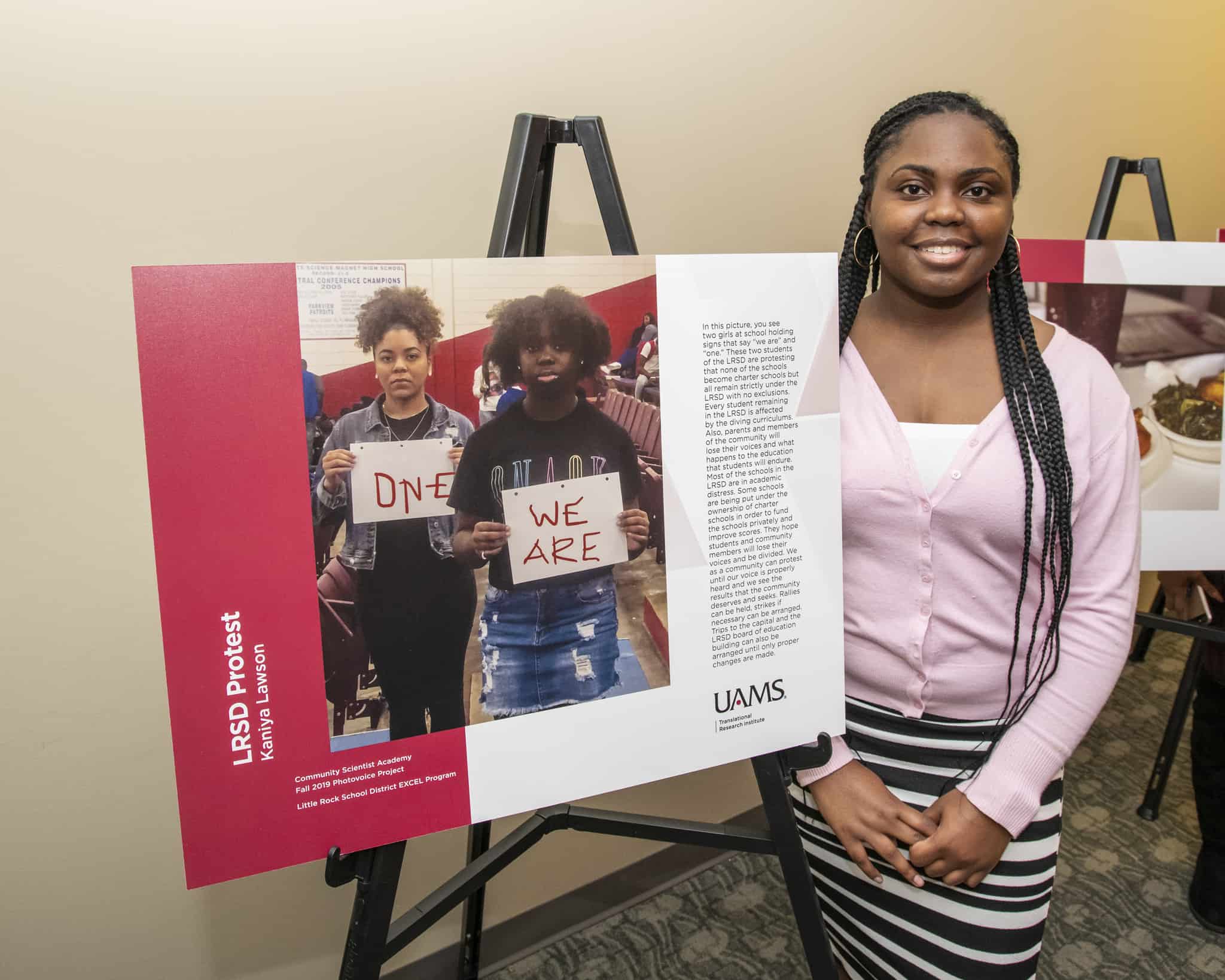
High school student Kaniya Lawson was excited to learn that research could be part of her possible career as a psychiatric nurse practitioner. She was among the 24 Little Rock School District students who graduated from the fall 2019 UAMS Translational Research Institute’s  Community Scientist Academy.

Kaniya Lawson with her PhotoVoice poster.

“They had actual researchers come in and show us professions that I didn’t even know existed,” said Lawson, a member of the academy’s fall graduating class of Little Rock School District EXCEL students.

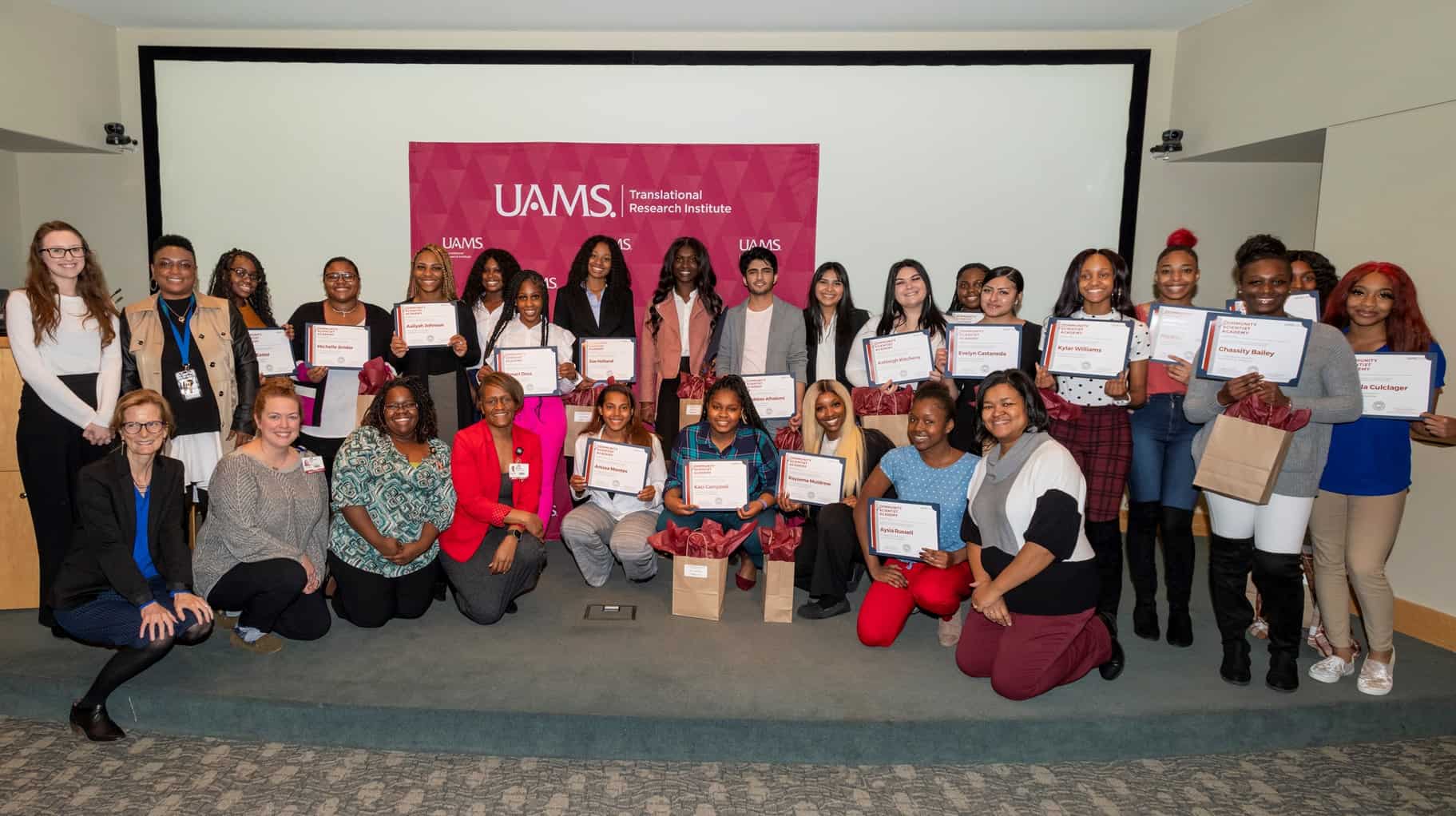
Lawson and her fellow graduates came from across the school district as students in the EXCEL Advanced Medical Sciences Program. The 10-week academy that ended Nov. 21 helped her understand that she could incorporate research into patient care.

“I never thought about that direction of the health care field at all,” she said. “You can be hands-on with patients and still be a researcher.”

The students worked closely with the institute’s Community Engagement team on their PhotoVoice project. The project included taking a photo that depicted a health-related issue affecting themselves, their family, and/or their community. The students wrote a caption to accompany their photos to explain the issue, what has been done and what can be done to help address the issue.

Jaky’ra Bolden, whose poster was titled, “Grief and Mental Health Stigma,” spoke at the graduation, telling her fellow graduates, parents and teachers that the exercise was valuable to her.

Jaky'ra Bolden discusses her poster with visitors.
Jaky’ra Bolden discusses her poster with visitors.

“Photovoice gives us a chance to express ourselves,” she said. “We also get a chance to address real-world problems.”

Brian Gittens, Ed.D., vice chancellor, congratulated the students and gave an inspirational talk before they received their graduation certificates. Afterward, the students stood by their posters and discussed them with graduation attendees and other interested visitors outside the UAMS Rahn Building auditorium. During these presentations, the students used the public speaking skills they learned in the academy.

“There is a story in every picture,” Bolden said, encouraging the audience to visit the poster presenters. “Let us take you on a journey through our minds.”

Zoe Holland’s poster was about the harm to sea turtles from discarded plastic straws. She read about the issue and watched videos showing how straws can become lodged in the turtles’ noses. “I wanted to figure out how to prevent it.”

Zoe Holland with her poster.

Holland said the academy made her think of research in new ways.

“When I first came in I didn’t really think we were going to learn much – they were just going to talk at us the whole time,” she said. “I wasn’t really a big research person when I first came in, and now I’m more open-minded to it, because they really explained the different kinds of research, and the people that work at UAMS came and spoke to us every single class. That really opened my mind to more options for research.”

In the past two years, the academy has been modified to reach different populations by increasing the academy length, including the PhotoVoice project for the students, and adding a one-day intensive academy session for veterans in Arkansas.

The traditional version of the academy, which held its first class in 2016, is six weeks and designed for community members to increase community understanding about the research process and offer research decision-making opportunities to communities, patients and other stakeholders.

Twenty-four Little Rock School District EXCEL students graduated from the Community Scientist Academy.

Opportunities offered to academy graduates include reviewing grant applications; advising on research projects; serving on community review boards, community advisory boards, and patient and family advisory councils.

Filed Under: Front, News, Newsroom

TRI Names Five Implementation Science Scholars

The Translational Research Institute (TRI) and the Center for Implementation Research (CIR) have selected five UAMS/ACH clinical faculty as UAMS’ first class of Implementation Science Scholars.

Using the principles of implementation science, CIR faculty will guide the scholars through 10 didactic sessions per year and provide oversight and mentoring for their experiential implementation science projects. The two-year program will provide 20% salary support (up to salary cap).

Below are the scholars and their project titles:

[twocolumn col1=”Kapil%20Arya%2C%20M.D.%0AAssistant%20Professor%2C%20Division%20of%20Pediatric%20Neurology%0ADepartment%20of%20Pediatrics%2C%20College%20of%20Medicine%0AArkansas%20Children%E2%80%99s%20Hospital%2FUAMS%0A%0A%3Cstrong%3E%E2%80%9CImplementation%20of%20Newborn%20Screening%20(NBS)%20for%20Spinal%20Muscular%20Atrophy%20(SMA)%20and%20Operationalizing%20Appropriate%20Patient%20Management%E2%80%9D%3C%2Fstrong%3E%3C%2Fstrong%3E%3C%2Fli%3E%0A” col2=”%3Cimg%20class%3D%22wp-image-9465%22%20src%3D%22https%3A%2F%2Ftri.uams.edu%2Fwp-content%2Fuploads%2Fsites%2F116%2F2019%2F11%2FKapil-Arya-150×250.jpg%22%20alt%3D%22Kapil%20Arya%2C%20M.D.%22%20width%3D%22150%22%20height%3D%22200%22%20%2F%3E%20″ ratio=”threequarters-quarter” /]

[twocolumn col1=”Johnathan%20Goree%2C%20M.D.%0AAssistant%20Professor%20and%20Director%2C%20Division%20of%20Chronic%20Pain%2C%C2%A0Department%20of%20Anesthesiology%0ACollege%20of%20Medicine%2C%C2%A0UAMS%0A%3Cstrong%3E%E2%80%9CImplementation%20of%20Safe%20Post-operative%20Opioid%20Prescribing%20at%20University%20of%20Arkansas%20for%20Medical%20Sciences%E2%80%9D%3C%2Fstrong%3E%3C%2Fstrong%3E%3C%2Fli%3E” col2=”%3Cimg%20class%3D%22alignnone%20wp-image-9466%22%20src%3D%22https%3A%2F%2Ftri.uams.edu%2Fwp-content%2Fuploads%2Fsites%2F116%2F2019%2F11%2FJohnathan-Goree-150×250.png%22%20alt%3D%22Goree%22%20width%3D%22150%22%20height%3D%22204%22%20%2F%3E%0A” ratio=”threequarters-quarter” /]

[twocolumn col1=”Emily%20Kocurek%2C%20M.D.%0AAssistant%20Professor%2C%20Division%20of%20Pulmonary%20%26amp%3B%20Critical%20Care%20Medicine%2C%20Department%20of%20Medicine%0ACollege%20of%20Medicine%2C%20UAMS%0A%3Cstrong%3E%3Cstrong%3E%E2%80%9CICU%20Liberation%20Bundle%22%3C%2Fstrong%3E%3C%2Fstrong%3E%0A%0A” col2=”%5Bcaption%20id%3D%22attachment_9467%22%20align%3D%22alignright%22%20width%3D%22150%22%5D%3Cimg%20class%3D%22wp-image-9467%22%20src%3D%22https%3A%2F%2Ftri.uams.edu%2Fwp-content%2Fuploads%2Fsites%2F116%2F2019%2F11%2FEmily-Kocurek-150×250.png%22%20alt%3D%22Kocurek%22%20width%3D%22150%22%20height%3D%22179%22″ ratio=”threequarters-quarter” /]

[twocolumn col1=”Debopam%20Samanta%2C%20M.D.%0AAssociate%20Professor%20and%20Interim%20Section%2FService%20Chief%2C%20Division%20of%20Pediatric%20Neurology%0ADepartment%20of%20Pediatrics%2C%20College%20of%20Medicine%0AArkansas%20Children%E2%80%99s%20Hospital%2FUAMS%0A%3Cstrong%3E%E2%80%9CQuality%2FImplementation%20Gap%20in%20Epilepsy%20Surgery%20Evaluation%E2%80%9D%3C%2Fstrong%3E%0A” col2=”%3Cimg%20class%3D%22wp-image-9468%20%22%20src%3D%22https%3A%2F%2Ftri.uams.edu%2Fwp-content%2Fuploads%2Fsites%2F116%2F2019%2F11%2FDebopam-Samanta-150×250.jpg%22%20alt%3D%22Samanta%22%20width%3D%22150%22%20height%3D%22180%22%20%2F%3E” ratio=”threequarters-quarter” /]

[twocolumn col1=”Megha%20Sharma%2C%20M.D.%2C%20FAAP%0AAssistant%20Professor%2C%20Division%20of%20Neonatology%0ADepartment%20of%20Pediatrics%2C%20College%20of%20Medicine%0AArkansas%20Children%E2%80%99s%20Hospital%2FUAMS%0A%0A%3Cstrong%3E%E2%80%9CMinimizing%20Iatrogenic%20Blood%20Loss%20and%20Reducing%20Cost%20of%20Lab%20Testing%20in%20Very%20Low%20Birth%20Weight%20(VLBW)%20Nneonates%20by%20Raising%20Staff%20Awareness%20and%20Optimal%20Use%20of%20EMR%E2%80%9D%3C%2Fstrong%3E%0A%0A” col2=”%3Cimg%20class%3D%22wp-image-9469%22%20src%3D%22https%3A%2F%2Ftri.uams.edu%2Fwp-content%2Fuploads%2Fsites%2F116%2F2019%2F11%2FMegha-Sharma-150×250.jpg%22%20alt%3D%22Sharma%22%20width%3D%22150%22%20height%3D%22209%22%20%2F%3E%20″ ratio=”threequarters-quarter” /]

Filed Under: Front, News, Newsroom

The October TRIbune Is Here

In this month’s TRIbune newsletter, we feature the recent success of Pearl McElfish, Ph.D., MBA, in acquiring multiple national awards. McElfish and her

The TRIbune - October 2019
The TRIbune – October 2019

team are testing a promising intervention to address the diabetes crisis in the Marshallese community of northwest Arkansas. In recent months she has been awarded more than $10 million, which is in addition to the more than $20 million in federal funding that she was already overseeing as principal investigator. McElfish says a TRI pilot award and community engagement assistance were springboards for her success.

We also highlight the leadership of TRI Executive Director Amy Jo Jenkins, M.S., CCRP, CCRC, CCRA, in her work with the Society of Clinical Research Associates Inc. (SOCRA). This year, Jenkins took over the international organization as its president.

In addition, our Study of the Month features Benjamin Tharian, M.D., principal investigator, and we report what attendees had to say about the first UAMS Research Expo, which TRI co-sponsored with the UAMS Office of Research Compliance.

Read The TRIbune.

Filed Under: Front, News, Newsroom

Showcase Affirms Maturity of Community-Engaged Research at UAMS

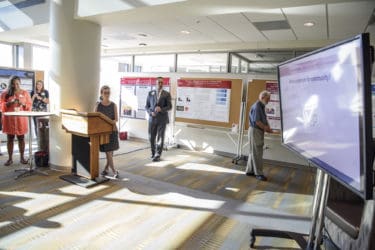
Kate Stewart, M.D., M.P.H., was smiling as she gestured toward the room packed with community engagement-themed research posters at the Sept. 25

Kate Stewart, M.D., M.P.H., led attendees through survey questions about community-engaged research that they answered on their smartphones, providing instant results.

UAMS Showcase of Medical Discoveries.

“Community-engaged research has grown a lot in the 22 years I have been here,” said Stewart, who leads the UAMS Translational Research Institute’s Community Engagement Program. “We would not have been able to do this 22 years ago, so it’s very exciting to me.”

In fact, there were more poster applicants than organizers had room to display.

Shuk-mei Ho, Ph.D., UAMS vice chancellor for research, approached Stewart about having the community-engaged theme for the Showcase.

“Community-based research is going to be in all of our research going forward,” Ho told attendees at the Showcase.

Involving the community as partners is already helping researchers generate exciting new hypotheses and questions to address health, she said.

“Researchers are receiving grants because they are able to understand the community in such a deep manner,” Ho said. “Community-engaged research also

Showcase sponsor Shuk-mei Ho, Ph.D., (left) vice chancellor for research, chats with Pebbles Fagan, Ph.D.

ties in really well with our efforts to address rural health issues and disparities in health care using digital health technologies such as smart phones, interactive live video, wearable devices and personal computers.”

She also noted that UAMS researchers have been extremely successful in winning Patient-Centered Outcomes Research Institute (PCORI) grants, established under the 2010 Patient Protection and Affordable Care Act to advance community-based/engagement research.

Among the poster presenters, Keneshia Bryant-Moore, Ph.D., A.P.R.N., FNP-BC, associate professor in the UAMS College of Public Health, has been the recipient of numerous PCORI grants. Her research has focused on developing a network of faith leaders across Arkansas to address depression and other health disparities for African Americans.

The poster she was presenting with her colleague, Tiffany Haynes, Ph.D., assistant professor in the College of Public Health, speaks to their efforts to increase the number of faith-based partners by

Pearman Parker, Ph.D., M.P.H., presents her poster on the role of health literacy with chemotherapy knowledge in women with breast cancer.
Pearman Parker, Ph.D., M.P.H., presents her poster on the role of health literacy with chemotherapy knowledge in women with breast cancer. Parker is a recent TRI KL2 Award recipient.

training them to become partners and co-investigators on research.

The poster was accepted for presentation at a recent PCORI conference and was well received, Bryant-Moore said.

“We were approached by a number of people from across the United States that were interested in the program,” she said, adding that she plans to apply for a PCORI award that will allow her team to disseminate tool kits and trainings on the program beyond Arkansas.

Stewart, a professor in the College of Public Health, noted that community-engaged research is critical to addressing fear and distrust of research due to past unethical treatment of research participants, especially minorities.

She was presenting a poster that showed her team’s work leading the UAMS Community Scientist Academy, a Translational Research Institute program.

“It’s really taken off,” she said of the academy, which invites the public to learn about the process of

Kisa Vaughn, M.P.A., presents her poster to Reza Hakkak, Ph.D., on the Passion Project, which showed how additional health resources can improve health in African-American women with substance use disorder.

research at UAMS. “We’re giving them a 30,000-foot level introduction to the process, and the reason for the process. A lot of times for people in the community, research needs to be demystified, so we also give them an opportunity to meet and interact with our researchers.”

Filed Under: Front, News, Newsroom

TRI’s Jenkins Installed as SOCRA President

Amy Jo Jenkins, M.S., CCRP, CCRA, CCRC, TRI Executive Director, was installed as president of the Society of Clinical Research Associates (SOCRA) during a Sept. 27 ceremony in San Antonio, Texas.

Jenkins led the establishment of the Arkansas chapter of SOCRA and is a past chair. SOCRA  chapters offer no-cost clinical research continuing education to enhance research quality, to protect research participants, and to improve the health of the global community.

This year’s SOCRA Annual Conference welcomed about 1,200 attendees. The three-day conference offered the latest information and tools, best practices and training to help its members stay up to date and compliant in their clinical research practice. The program featured over 100 academic sessions, a peer-driven poster session, and an exhibit program.

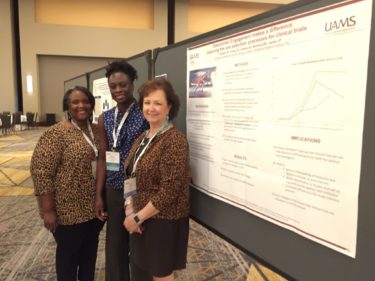
Mtonya Hunter-Lewis, Beatrice Boateng and Pam Christie

TRI had three scientific posters accepted for presentation at the conference. The posters and their presenters are:

Beatrice Boateng, Ph.D., TRI director of evaluation and associate professor, College of Medicine Department of Pediatrics; “Sensitive Research Study Records: Do they Belong in the Patient Medical Record? – A Preliminary Study”

Pam Christie, B.A., CRS, TRI senior project manager, research recruitment, stakeholder engagement, “Stakeholder Engagement Makes a Difference: Improving the Site Selection Processes for Clinical Trials”

Mtonya Hunter-Lewis, MBA, CPC, CCRP, TRI associate director, regulatory support, “Utility of a Web-based Research Protocol Development Tool: One Institution’s Experience”

Filed Under: Front, News, Newsroom

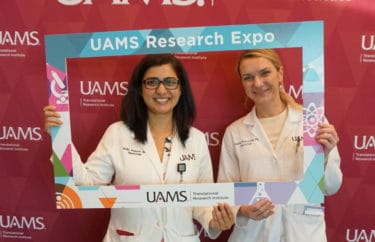
Researchers Discover Services and Opportunities at First UAMS Research Expo

The UAMS Research Expo was a new experience for Yuet-Kin “Ricky” Leung, Ph.D., and one that will help get his research on solid footing as a new faculty member.

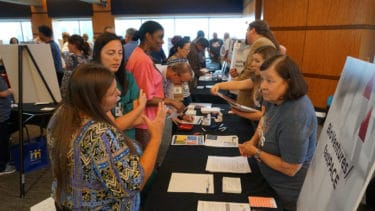
Nancy Gray, Ph.D., (right, front) president of BioVentures LLC, helped visitors to her booth understand the services BioVentures provides to UAMS researchers.

“I’ve never seen this kind of expo before, and it’s very helpful for me,” said Leung, an associate professor in the College of Medicine Department of Pharmacology and Toxicology. “I had no clue before how many units or service groups were available to help me.”

Leung, along with about 150 other UAMS faculty and research staff, stopped by the Jackson T. Stephens Spine & Neurosciences Institute to check out the 30-plus research services represented at the Sept. 10 Research Expo.

This year’s Expo marked an expansion of the Translational Research Institute (TRI) Open Houses held the past two years. TRI and the UAMS Office of Research Compliance co-sponsored the event, inviting all UAMS-wide research service providers as well as its partners, Arkansas Children’s Research Institute (ACRI) and the Central Arkansas Veterans Healthcare System.

The Expo is a fun, relaxed way for researchers to talk directly to the research service providers all in one place. This year’s event also included ice cream, hors d’oeuvres and door prizes drawn by Stephanie Gardner, Ed.D., UAMS provost and chief strategy officer.

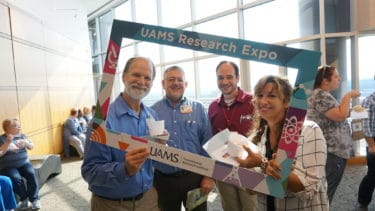
After making the rounds at the Expo, researchers enjoyed ice cream. (l-r) Kirk Smith, Phillip Farmer, Michael Rutherford and Debra Napoli.

Gardner also welcomed attendees, noting that the Expo helps researchers find critical resources that will help them get their studies off the ground more quickly and produce high quality findings.

Nidhi Kapoor, M.D., assistant professor in the College of Medicine Department of Neurology, is already familiar with many of TRI’s research services, she said, but the event made her aware of additional research amenities. “Every time I go to one of these meetings, whether it’s the Research Expo or the faculty resource fair last month, I tend to learn something new. I meet more people, and I learn about new resources and more help that’s available to busy clinicians like me.”

New this time for her, Kapoor said, was TRI’s Implementation Science Scholars program, which is accepting applications through Sept. 20.  “I am considering submitting an application,” she said.

The first UAMS Research Expo drew about 150 attendees.

She also gleaned other valuable information, such as protocol building services with the Institutional Review Board, and how the Office of Research & Sponsored Programs can help with her with future grant applications.

Jami Jones, research program director at the Center for Childhood Obesity Prevention, was finding some promising new connections for her center’s researchers based at ACRI.

“I’ve been visiting booths looking for ways that our researchers can utilize the various services offered through UAMS,” Jones said. “I think that both ACRI and UAMS offer great support for research and it was exciting to learn about new resources and opportunities for collaboration. It was very interesting to learn about the data warehouse (Arkansas Clinical Data Repository – AR-CDR); I didn’t know about it, and I think we can utilize that.”

She also discovered exciting possibilities in her visit with the Institute for Digital Health & Innovation booth. She said researchers at ACRI are

Nidhi Kapoor, M.D., with Jolanta Marszalek, M.D., learned of new programs that could help her research.
Nidhi Kapoor, M.D., with Jolanta Marszalek, M.D., said she learned of new programs that could help her research.

interested in using mobile applications in their studies but app developers are lacking. The institute, she learned, is working on finding app developers. “I’m very excited about that,” Jones said.

Chenghui Li, Ph.D., an associate professor in the College of Pharmacy Department of Pharmaceutical Evaluation and Policy i, said having all the services in one place helped her clarify what each p rogram does.

“I just didn’t realize how many different services were part of the research enterprise; I knew some of them,” Li said, who is new to UAMS.

Li found assistance from TRI’s Clinical Trials Innovation Unit.

“I actually have a specific project that I needed information for, and they were very helpful,” she said. “They also provided individuals’ names for further contact. Gary D. Lewis, M.D., a new assistant professor in the College of Medicine Department of Radiation Oncology, enjoyed the whole Expo experience.

“I thought it was great as a new faculty member to learn and meet all these people who I’m going to be working with, and to figure out what resources are available,” Lewis said.  “Since I am new here, I just wanted to try to make sense of all the resources that are available.”

While he is still plotting his research path, he sees promise in TRI’s ARresearch participant registry, its Community Engagement program and the resources available at the Institute for Digital Health & Innovation.

Filed Under: Front, News, Newsroom

UAMS Offering Research Leadership Training to Community-Based Organizations

Community-based organizations are invited to apply for a new research leadership training program at the University of Arkansas for Medical Sciences (UAMS) that includes seed funding for community projects.

Applications are due by Oct. 14, 2019, for the Community Partners Educated as Arkansas Research Leaders (CPEARL) Program, supported by the UAMS Translational Research Institute.

Up to six community-based organizations will be selected, with two or three leaders or emerging leaders per organization invited to participate. Up to $2,500 in seed funding will be provided to each organization to tackle a health-related community project.

The one-year program will begin Jan. 15, 2020, with a six-week intensive training offered by the Translational Research Institute in partnership with the Arkansas Department of Health.

“UAMS research can play a bigger role in improving health, especially if we can engage communities most burdened by poor health in influencing our research,” said Kate Stewart, M.D., M.P.H., director of the research institute’s Community Engagement Program. “We will use this new program to build capacity of community leaders and empower them with the knowledge to partner in research addressing our state’s health disparities.”

Experts in community-based research, clinical and public health practice and community engagement will provide interactive learning sessions during the six-week intensive training. Each team will have a UAMS researcher assigned to mentor them throughout the year and the opportunity for one-on-one consultations with a community mentor. The program is free and all trainings will be held in Little Rock.

Interested community-based organizations may contact

Funding for the project is supported by the Translational Research Institute, Clinical and Translational Science Award UL1 TR003107, through the National Center for Advancing Translational Sciences at the National Institutes of Health.

For more information, visit the CPEARL Program Page.

Applications may be submitted to triceteam@uams.edu.

Questions? Contact RBHale@uams.edu.

Filed Under: Front, News, Newsroom

TRI Names Five Pilot Awardees

Five UAMS faculty have received pilot awards in research targeting the health challenges of rural and underrepresented populations.

The one-year awards of up to $50,000 each were made possible through the UAMS Office of Vice Chancellor for Research and are being administered by the TRI.

Below are the awardees and their research project titles:

Sara Landes, Ph.D., Associate Professor, Psychiatry/Health Services Research, “Evaluating Rural Community Pharmacists’ Perceptions of Integrating Mental Health Services to Reach Underserved Populations”

Pearl McElfish Ph.D., MBA, Assistant Professor, Office of Community Health and Research, “DSMES+SHES to reduce health disparities among rural, minority participants.”

Robert Pesek, M.D., Associate Professor ,Pediatrics, Allergy/Immunology; “Comparison between Telemedicine and In-Home Asthma Assessments for Identification and Reduction of Asthma Triggers”

Theresa Prewitt , Dr.P.H.,  Associate Professor, COPH, Health Policy and Management, “Examining National Diabetes Prevention Program Implementation in a Rural Federally Qualified Health Center Network”

Leanne Whiteside-Mansell, Ed.D., Professor, Department of Family and Preventive Medicine / Research and Evaluation Division, “Adverse Childhood Experiences of Rural and Underserved Arkansans: Identification of Risk and Links to Outcomes”

Filed Under: Front, News, Newsroom

TRI Seeking Applications for Implementation Science Scholars Program

The Translational Research Institute (TRI) is seeking applications for UAMS’ first Implementation Science Scholars Program, with awards available for up to five UAMS clinical faculty.

Read the Request for Applications.

Supported by TRI and its Clinical and Translational Science Award, the program will fund faculty interested in learning more about how to implement new practice guidelines and/or other implementation or de-implementation approaches that will improve medical care.

Geoffrey Curran, Ph.D., director of the UAMS Center for Implementation Research, is leading the scholars program.

Using the principles of implementation science, Curran and colleagues will guide faculty through 10 didactic sessions per year and provide oversight and mentoring for experiential implementation science projects. The two-year program will provide 20% salary support and prepare faculty to publish the results of their implementation science projects. Scholars who want to pursue research grants to expand on their accomplishments would receive assistance from the UAMS Center for Implementation Research.

The program is open to all UAMS faculty, including at Arkansas Children’s Hospital. Those interested are encouraged to attend Thursday’s information session at ACH. An information session was held Monday on the UAMS campus.

Contact: Cindy Mosley, CLMosley@uams.edu

Filed Under: Front, News, Newsroom

Five UAMS Researchers Receive Translational Research Training Awards

The UAMS Translational Research Institute has awarded five early-career UAMS researchers with KL2 Mentored Research Career Development Program Scholar Awards.

The program provides two years of instruction and mentored research training. Scholars receive 75% salary support and up to $25,000 per year for research, tuition, travel expenses and education materials.

The KL2 Scholars were chosen from 11 applicants, and six finalists were interviewed by an independent faculty review committee.

“All of the applications had significant strengths,” said W. Brooks Gentry, M.D., co-director of the institute’s KL2 program. “The awardees are a very strong group with broad representation across disciplines at UAMS.”

He noted that the scholars’ work includes two child health projects, one geriatric project, three clinical trials and one basic science study.

“All of their projects are translational,” Gentry said. Research that is translational seeks to produce more meaningful, applicable results that directly benefit human health. The goal of translational research is to move science discoveries more quickly and efficiently into everyday practice.

Below are the new scholars, their college, department and title of their KL2 project:

  • Tara Johnson, M.D.; College of Medicine, Department of Pediatrics, Neurology; “Implementation and Quantification of the General Movement Assessment for Early Detection of Neurodevelopmental Disabilities in Infants”
  • Stefanie Kennon-McGill, Ph.D.; College of Public Health, Department of Environmental and Occupational Health; “Fetal Exposure to Cannabinoids: Exposure, Methylation and Neurodevelopmental Effects”
  • Pearman Parker, Ph.D., M.P.H., RN; College of Nursing, Department of Nursing Science; “An exploration of the mental health needs of young women with breast cancer and implications for developing patient educational materials”
  • Isabelle Racine Miousse, Ph.D.; College of Medicine, Department of Biochemistry; “Decreasing Methionine Intake to Improve Survival in Patients with Metastatic Melanoma”
  • Jennifer Vincenzo, Ph.D., M.P.H., PT; College of Health Professions, Department of Physical Therapy; “Development of a Falls Prevention Self-Management Plan to Improve Older Adults Adherence to Prevention Strategies after Community-Based Falls Risk Screenings”

Vincenzo is the first KL2 Scholar from the UAMS Northwest Regional Campus and first from the College of Health Professions.

 Including this group, a total of 26 UAMS researchers have received KL2 Scholar Awards since 2009. Those who have completed the program have raised more than $43 million in funding outside UAMS to support their research projects and help jump-start their careers.

The KL2 Program is supported by the Translational Research Institute’s Clinical and Translational Science Award, funded by the National Institutes of Health National Center for Advancing Translational Sciences, grant UL1 TR003107. Funding support for this group of KL2 Scholars also came from the Arkansas Children’s Research Institute (Johnson), and the Arkansas Breast Cancer Research Program (Parker).

Filed Under: Front, News, Newsroom Tagged With: Arkansas for Medical Sciences, Brooks Gentry, Isabel Racine-Miousse, Jennifer Vincenzo, KL2 award, Laura James, Pearman Parker, Stefanie Kennon-Mcgill, Tara Johnson

  • «Previous Page
  • Page 1
  • Interim pages omitted …
  • Page 21
  • Page 22
  • Page 23
  • Page 24
  • Page 25
  • Interim pages omitted …
  • Page 48
  • Next Page»
Translational Research Institute LogoTranslational Research InstituteTranslational Research Institute
Mailing Address: 4301 West Markham Street, Little Rock, AR 72205
Phone: (501) 686-7000
  • Facebook
  • X
  • Instagram
  • YouTube
  • LinkedIn
  • Pinterest
  • Disclaimer
  • Terms of Use
  • Privacy Statement
  • Legal Notices

© 2026 University of Arkansas for Medical Sciences