• Skip to primary navigation
  • Skip to main content
  • Skip to primary navigation
  • Skip to main content
Choose which site to search.
University of Arkansas for Medical Sciences Logo University of Arkansas for Medical Sciences
Translational Research Institute
  • UAMS Health
  • Jobs
  • Giving
  • About TRI
    • What We Offer
    • Leadership & Governance
    • Staff
    • Citing Translational Research Institute CTSA Support
    • What is Translational Research?
    • Contact TRI
  • Funding Opportunities
    • Grants
      • Pilot Award Program
      • Consortium of Rural States (CORES) Multi-Institutional Pilot Award Program
      • Team Science Voucher Program
      • Winthrop P. Rockefeller Cancer Institute Rural Research Award Program
    • Scholarships
      • K12 Mentored Research Career Development Scholar Awards Program
      • Health Sciences Innovation and Entrepreneurship Postdoctoral Training Program
      • Implementation Science Scholar Program
      • (STARs) Program – Strategies for Training and Advancing Researchers
      • SMART Program [Master’s in Clinical and Translational Sciences (MS-CTS)]
    • Community
      • Community Based Participatory Research (CBPR) Scholars Program
      • Community Partners Educated as Arkansas Research Leaders (CPEARL) Program
    • Awardee Responsibilities
  • Services & Resources
    • Services
      • Biostatistics, Epidemiology and Research Design (BERD) Consultation
      • Clinical Data Repository (AR-CDR)
      • Comprehensive Informatics Resource Core
      • Mock Study Sections
      • Research Participant Recruitment
      • Research Support: Clinical Trials Innovation Unit (CTIU)
      • Implementation Science Program
      • Research Ethics Consultation
    • Resources
      • ARresearch Registry
      • Center for Health Literacy
      • Data Safety Monitoring
      • Grant Writing & Dissemination
      • UAMS Profiles
      • UAMS Rural Research Network
      • Other Resources
      • COVID-19 Research Guidelines
      • Community Partner Research Training
  • Career Development & Scholarships
    • Scholarship Opportunities
      • K12 Mentored Research Career Development Scholar Awards Program
      • Health Sciences Innovation and Entrepreneurship Postdoctoral Training Program
      • Data Science Scholars Program
      • Implementation Science Scholar Program
      • SMART Program
      • Translational Research Innovations and Partners (TRIP) Program
    • Training & Educational Opportunities
      • innOVATION Seminar Series
      • Path 2 K Program
      • Translational Workforce Development
      • Graduate Certificate in Implementation Science
      • SMART Program [Master’s in Clinical and Translational Sciences (MS-CTS)]
      • Good Clinical Practice Training
    • Didactic Training
  • Community
    • Community Engagement Leadership
    • Community Advisory Board
    • Community Engagement Partners
      • Community Partner Celebration
      • Faith-Academic Initiatives for Transforming Health (FAITH) Network
    • Community Engagement Services
      • Consultations and Technical Assistance
      • Community Review Boards
      • Community Partner Research Training
      • Equipment Library
    • Programs and Funding
      • Community Partners Educated as Arkansas Research Leaders (CPEARL) Program
      • Community Based Participatory Research (CBPR) Scholars Program
      • Community Scientist Academy
    • Toolkits
      • CSA Online Toolkit
      • CPEARL Toolkit
  • Events
    • Research Day
    • Clinical Trials Learning Collaborative
  • Newsroom
  1. University of Arkansas for Medical Sciences
  2. Translational Research Institute
  3. Author: uamsonline
  4. Page 9

uamsonline

TRI Co-Sponsored CTSA Workshop Using AI to Mine Research Data

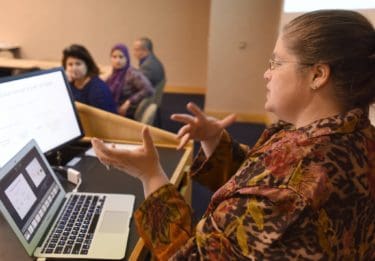
As an ontologist, UAMS’ Mathias Brochhausen, Ph.D., teaches computers the meaning of words. He takes a term, such as “informed consent,” and writes a definition in language the computer can interpret.

“Here’s something about ontologies that is very cool: Ontologies are actually an artificial intelligence product,” he said.

Brochhausen’s expertise and enthusiasm for ontology/AI solutions will be in play Feb. 26 and 27. He will be hosting and collaborating with a national group of researchers to create semantically-enabled products that support access to more data across research institutions.

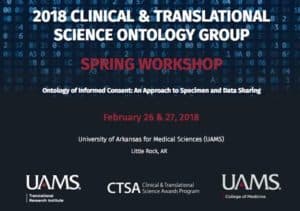
The work will be performed during the 2018 Clinical and Translational Science Ontology Group Spring Workshop, “Ontology of Informed Consent: An Approach to Specimen and Data Sharing.”

The workshop is supported by Department of Biomedical Informatics, where Brochhausen is an associate professor, the UAMS Translational Research Institute (TRI), and the NIH National Center for Advancing Translational Sciences (NCATS) Clinical and Translational Science Awards (CTSA) Program.

As a piece of code or software, an ontology can use logical inferences to bypass barriers caused by the absence of agreement in biomedical data representation. For example, Brochhausen said, consider the wide variation in informed consent language that tells researchers whether they may re-contact participants.

“Using ontologies, we can define re-contacting, and everything that falls under that definition the computer will automatically sort into re-contacting,” he said.

The field of ontology has strong roots at UAMS and the Department of Biomedical Informatics. The discipline has also continued to grow along with the department; Brochhausen now oversees the research group Biomedical Ontologies Arkansas (BOAR).

“It’s an exciting time for UAMS to host this workshop,” he said. “The spirit of collaboration with clinical scientists, which is so strongly emphasized by the TRI, really makes UAMS stand out.”
Filed Under: Front, News, Newsroom

Informatics Track, First in U.S., Has Key CTSA Role

Amy Jones, M.S., often studies at a back table at Cheers in the Heights restaurant in Little Rock, where she also waitresses. Over the years she’s come to know the regulars, who include UAMS physicians and researchers.

They’ve watched her grow up there, she said, and they have always encouraged her scholarship. Last summer when she mentioned her plans to apply for UAMS’ new Clinical Research Informatics Certificate program, she got an enthusiastic response from a UAMS faculty physician based at Arkansas Children’s.

“You need to run, not walk towards that opportunity,” he told Jones.

The demand for clinical research informaticists is exploding, and UAMS last fall became the first in the United States to offer a full curriculum in clinical research informatics, with the certificate and master and doctorate degrees. The degree program is offered by the Department of Biomedical Informatics in the College of Medicine with support by the UAMS Translational Research Institute (TRI).

Today Jones is part of the seven-student inaugural graduate certificate class.

“We’re excited,” said Meredith Zozus, Ph.D., who led development of the curriculum as associate professor and vice chair for academic programs at the Department of Biomedical Informatics in the College of Medicine. “It’s a really big deal at UAMS, and it’s an advance for TRI – our CTSA (Clinical and Translational Science Award) Program.”

The NIH’s National Center for Advancing Translational Sciences (NCATS) has tasked its 62 CTSAs with making the translational research cycle spin faster. CTSAs are also looking for ways to improve reproducibility of study findings, an issue that received negative publicity nationally in 2015.

Clinical research informaticists could play key roles on both counts. Graduates of the program will learn to design data collection and management processes for clinical studies. Their efforts are a large part of:

  • Ensuring that data are of sufficient quality to support study conclusions
  • Ensuring data are documented and archived properly so study findings are reproducible
  • Integrating clinical research with ongoing clinical care
  • Ensuring data quality control in compliance with federal regulations
Amy Jones

A Dance

The clinical research informatics program trains professionals to work with investigators to identify the best data source and to design a data flow and a work flow to best capture and clean that information in a way that keeps the translational research cycle turning.  It also trains how to integrate clinical care and clinical research.

For example, a clinical research informaticist would work with researchers and clinicians to devise data capture within routine care through Epic or devices so that one capture of data serves multiple purposes.

“Patients in trials are people in health care, and the research cycle has to operate within health care,” Zozus said. “There’s a dance that has to be choreographed between the data flow and the work flow and between the processes needed for the clinical study and the processes ongoing anyway in the health care environment.”

Wild, Wild West

Zozus said a wake-up call came in 2015 when the journal Nature reported that over half of psychology studies failed reproducibility tests. In addition to the fact that most researchers aren’t trained in data handling, she said the story put a spotlight on another issue in academic research.

“It’s kind of the wild, wild West because the authority and autonomy of individual investigators is so respected in academia, very few institutions have set expectations or standards for documenting or managing research data,” she said. “And today, these activities are undertaken by individuals with varied education and skills.”

Few universities have policies for archiving and maintaining study data, Zozus said. “I think NCATS would like to see its CTSAs fix the research reproducibility issues, and there are now efforts to do so.”

Other Informatics Tracks

The clinical research informatics track is one of four tracks in the new biomedical informatics graduate degree program offered at UAMS. Other new tracks are:

  • Translational bioinformatics
  • Imaging informatics
  • Clinical informatics

Fred Prior, Ph.D., who chairs the Department of Biomedical Informatics, said the beefed-up curriculum is helping fulfill his vision for a nationally recognized graduate program.  It also addresses key clinical and research workforce issues in Arkansas, benefiting students like Jones.

Jones said she’s excited to see where her new clinical research informatics skills will lead. She envisions working in clinical trials in a collaborative environment.

“I have a strong biology background, and some students have strong computational backgrounds,” she said. “That’s the way the real world works, too, especially in science and research. You have to collaborate and use people’s strengths, and the UAMS faculty have been encouraging us to do that.”

More information about the specialty tracks is available on the Department of Biomedical Informatics website, dbmi.uams.edu/education/graduate-programs.

Filed Under: Newsroom

Jan/Feb TRIbune 

Jan/Feb TRIbune 
View Newsletter Archive

This issue of the TRIbune highlights nationally significant TRI partnerships with the Department of Biomedical Informatics (DBMI) in the UAMS College of Medicine. Our main story is about the first-of-its-kind Clinical Research Informatics track in the U.S. being offered by DBMI. This program, supported by TRI, helps address a national concern about study reproducibility and the integration of clinical care with research. Our TRIbutary features a national Clinical and Translational Science Awards (CTSA) Program workshop being hosted at UAMS by DBMI’s Mathias Brochhausen, Ph.D. During the two-day workshop, participants will be producing artificial intelligence products known as ontologies. This is a significant undertaking because it will help researchers overcome the absence of standardized biomedical language across institutions. Our TRI & Me feature highlights a fruitful partnership with DBMI’s Ahmad Baghal, M.D., who directs the Arkansas Clinical Data Repository.

[button text=”Download Jan/Feb TRIbune” url=”https://tri.uams.edu/wp-content/uploads/sites/80/2018/02/TRIbune-JANFEB-2018.pdf” type=”btn-pdf” /]

Filed Under: Front, News

Faculty Invited to National CTSA Workshop at UAMS: ‘Ontology of Informed Consent’ Feb. 26, 27

CTSOG

Faculty with an interest in informed consent are invited to attend a national, multidisciplinary workshop at UAMS on Feb. 26 and 27. Titled, “Ontology of Informed Consent: An Approach to Specimen and Data Sharing,” the workshop will be held at the Reynolds Institute on Aging, Room 1180.

The Clinical and Translational Science Ontology Group Spring Workshop is sponsored by the UAMS Translational Research Institute, the Department of Biomedical Informatics, and the Clinical and Translational Science Awards (CTSA) Program.

Register Now.            Learn More.

Contact: Mathias Brochhausen, Ph.D., MBrochhausen@uams.edu

Filed Under: News

Doctor, Researcher, Inventor Offers Lessons in Perseverance

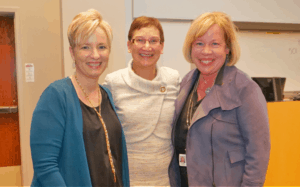
Carrie Byington, M.D., is flanked by TRI Director Laura James and Mary Aitken, M.D., who co-directs TRI's KL2 Scholars program.
Carrie Byington, M.D., is flanked by TRI Director Laura James and Mary Aitken, M.D., who co-directs TRI’s KL2 Scholars program.

Drawing on her early career experiences with rejection, Carrie Byington, M.D., offered some advice during a Jan. 29 lecture at UAMS.

As a new physician researcher, Byington, now dean of the Texas A&M College of Medicine, said all of her initial research papers in 1995 were rejected.

“Not by one reviewer – by reviewers 1, 2 and 3,” said the UAMS Translational Research Institute Distinguished Lecturer. “And they all said the same thing: PCR (polymerase chain reaction) will never be used in the clinical lab.”

PCR is now a common technique for rapidly diagnosing infectious diseases.

“It seems laughable now,” she said. “Just don’t listen when people tell you it will never happen.”

Byington spent two days in Little Rock, visiting the UAMS and Arkansas Children’s campuses.  Her visit was sponsored by the UAMS Translational Research Institute (TRI).

Byington joined Texas A&M in 2017 after a 21-year career at the University of Utah, where she was the H.A. and Edna Benning Presidential Professor of Pediatrics, vice dean for academic affairs and faculty development in the School of Medicine, and associate vice president for faculty and academic affairs at the University of Utah Health Sciences Center.

A federally funded investigator with continuous support as principal or co-investigator totaling about $80 million since 1998, Byington’s research spans the translational spectrum from basic laboratory science to health services research and has focused primarily on bacterial and viral respiratory pathogens in children. Her scholarship led to the co-invention of FilmArray®, a novel diagnostic platform that automates the detection of over 100 infectious organisms in a single sample in about an hour with BioFire Diagnostics of Salt Lake City, later acquired by bioMérieux. The FilmArray® System is used in hospitals in the United States, Europe and Asia and has changed the landscape for the detection of infectious disease diagnostics and research.

Her research background in translational science also led to the development of the Utah Center for Clinical and Translational Science, a member of the National Institutes of Health (NIH) Clinical and Translational Science Awards Program national consortium since 2008.

Byington noted that during her career, her work has taken her through all phases of translational research.

“I’ve moved back and forth across this continuum, and what I’ve learned is that it’s all important. Every single bit of it,” she said. “I hook, line and sinker believe in translational medicine, translational science.”

Addressing an audience that included many TRI faculty leaders, Byington said: “I know you all are working hard here with your CTSA application, and I just can’t tell you how important it is to break down barriers and to really move your science in directions you never could take it by yourself.”

In May, TRI will submit its application for five years of Clinical and Translational Science Awards (CTSA) Program funding from the NIH National Center for Advancing Translational Sciences (NCATS).

A nationally renowned physician scientist, Byington has had numerous career accomplishments including awards from the Robert Wood Johnson Foundation, the Centers for Disease Control and Prevention, and NIH.  She is an elected member of the National Academy of Medicine and serves as chair of the American Academy of Pediatrics Committee on Infectious Diseases. She also served as chair of the Infectious Diseases Advisory Group to the U.S. Olympic Committee and was tasked with protecting Team USA athletes and staff during the 2016 Olympic and Paralympic Games in Rio de Janeiro, Brazil.

Filed Under: Front, Newsroom

Mobile Health Gathering Draws a Crowd, Sparks Potential Collaborations

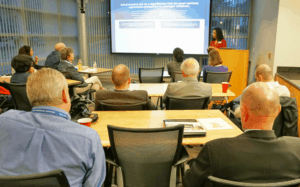
Tamara Perry, M.D., spoke about her work developing an asthma management app for adolescents.

Tamara Perry, M.D., an early adopter of mobile health technology in research, was excited to see more than 35 other like-minded professionals at the first UAMS Mobile Health and Wearable Innovations Mingle in November.

“The mHealth Mingle provided investigators an opportunity to learn about exciting research at UAMS,” said Perry, who developed a mobile app to help adolescents manage their asthma. “I was surprised to see so many of my colleagues who were interested in advancing mHealth projects at UAMS and hope that events like this will lead to future collaborations.”

Held at BioVentures on the UAMS campus, the event brought together clinicians, researchers, technology companies and anyone else interested in developing or using mobile and wearable devices for health care and research. It was organized by Anita Walden, an instructor in the Department of Biomedical Informatics, College of Medicine, and Aaron Kemp, a research program manager in the Department of Psychiatry, College of Medicine. Event sponsors were the Willow Agency and Metova. The event hosts/co-sponsors were the Department of Biomedical Informatics, the Translational Research Institute and BioVentures.

For those with a BOX account, view slides here.

The first part of the event featured “rapid blitz presentations” followed by an informal session of discussion among attendees.

The gathering sparked interest between Sarah Rhoads, Ph.D., D.N.P., at the UAMS Center for Distance Health, and Christopher Harris, the digital inclusion coordinator at the Little Rock Metropolitan Housing Alliance.

“I was very interested in Mr. Harris’ presentation because I think there’s potential for research collaborations and the use of telehealth at the Housing Alliance,” Rhoads said.

Harris, a public policy doctoral student at the University of Arkansas, Fayetteville, agreed.

“The meeting was absolutely beneficial to the Metropolitan Housing Alliance,” he said. “We’re trying to help our residents address a number of chronic health conditions, and I believe there’s a lot of low-hanging fruit from a research perspective. Technology has to be part of the equation.”

Harris is one of 28 digital inclusion coordinators across the U.S. funded by AmeriCorps, the corporation for national and community service. The goal is to advance digital inclusion in low income communities.

Others at the meeting included representatives of Arkansas Innovation Hub, University of Arkansas at Little Rock, Dextera, Central Arkansas Veterans Healthcare System, BMR Management Resources, Elder Stay at Home, MKP Inspired, and the Arkansas Small Business and Technology Development Center.

“We thought that having this event would not only identify interested parties but to bring together people to form relationships and collaborations that could potentially lead to new research, applications or devices,” Walden said. “It was also a forum to learn about existing resources that can be utilized to support initiatives.”

She said such events can also generate ideas that can result in breakthroughs and identify problems that need solutions.

“Ultimately, we hope to expand the use of mHealth in Arkansas to improve health care and research methods,” she said. “We hope to have more of these types of events during the year which may have different focuses all related to mHealth.

Filed Under: Front, News, Newsroom

November/December TRIbune

The Translational Research Institute (TRI) is wrapping up 2017 with good tidings!

The November/December TRIbune features some helpful new developments with clinical trials: Trails Today, a CTSA initiative that makes it easier for the public to find clinical trials of interest; TriNetX, which is matching UAMS investigators with industry sponsored Clinical Trials; and ClinCard, a new more efficient way of compensating research participants. You’ll also read about our latest pilot awardees – the first time we’ve offered pilots in implementation science. Our TRI & Me features Geoffrey Curran, Ph.D., who leads TRI’s implementation science efforts and directs the UAMS’ Center for Implementation Research. You’ll also find the latest TRI-supported publications cited by your colleagues.

Download PDF

Newsletter Archive

Filed Under: Front, News, Newsroom

UAMS, TRI Honor Community Partners at 2017 Celebration

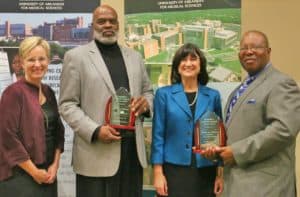
Pastors Johnny Smith and Jerome Turner accepted the Chancellor’s Community Research Partner Award for the Phillips and Jefferson Counties Faith Task Forces

The UAMS Translational Research Institute honored UAMS’ many Arkansas community partners Nov. 17 with its fifth annual Community Partner Celebration.

During the event at the Centre at University Park in Little Rock, the Phillips and Jefferson Counties Faith Task Force, led by pastors Johnny Smith and Jerome Turner, received the Chancellor’s Community Research Partner Award. The task force is using a faith-based intervention study with UAMS to prevent depression and promote emotional wellness in the Arkansas Delta.

The award, which focuses on partnerships that involve research, was presented by interim UAMS Chancellor Stephanie Gardner, Pharm.D., Ed.D.

Nominees for the Chancellor’s Award also included Ashley County Cares and the Arkansas Birthing Project.

“I enjoyed reading the applications for these,” Gardner said during her keynote address to about 150 attendees at the Centre at University Park in Little Rock. “In my book they were all winners.”

Other awards/winners:

  • The Community Based Organization of the Year: Samaritan Community Center

    The center aids underserved populations in the Rogers area through community garden development, pantries, community meal programs, snack pack program, resale shops, and social and dental services.
  • Community Advisory Board of the Year: Northwest Arkansas Marshallese Community Health Advisory Board

    The board provides significant direction and consultation to the UAMS Office of Community Health and Research via active involvement with community based participatory approaches related to diabetes self-management education, diabetes prevention programs, physical activity, medication adherence, and the translation of health materials and health survey instruments.
  • Community Partnership Student: Steven Keller

    Keller devoted his time to a student project working with a research team to develop home exercise programs for Marshallese community health workers. This project allowed the community health workers to teach exercise to the Marshallese population.
  • Institutional Health Partner Award: University of Arkansas Clinton School of Public Service

    Since 2010, the Clinton School has awarded five practicum teams, groups of students who spend two semesters completing a project directly related to the work of an organization, to the Access to Healthy Foods Research Group at the Arkansas Children’s Research Institute. The students completed work and provided the research group with deliverables that the team would not have had time to do.

“It’s just a joy to know so many people across our state are engaged in this effort of trying to make our communities healthier,” Gardner said. “It’s a celebration of the extraordinary service that non-UAMS organizations provide to UAMS.”

More photos

Watch the Video

Marshallese Community Health Advisory Board members Rumina Lakmis and Rotha Mejbon-Samuel.
Hilary Trudell of the Clinton School of Public Service
Steven Keller

Filed Under: Front, Newsroom Tagged With: Awards, Community Engagement, community partners, Stephanie Gardner, Translational Research Institute, UAMS

TRI Names Four Implementation Science Pilot Awardees

The UAMS Translational Research Institute (TRI) has approved research pilot study awards for four researchers totaling $200,000.

The annual awards of up to $50,000 each are made to projects with the strongest likelihood of leading to improved health and health care. This is the first year TRI has offered awards for pilots focused on implementation science projects.

Implementation science is the study of methods to promote the systematic uptake of research findings and other evidence-based practices into routine practice to improve the quality and effectiveness of health services.

Awardees were selected using a Study Section modeled after an NIH review panel, with internal, external and community reviewers. The awardees are:

Pearl McElfish, Ph.D., MBA, Associate Vice Chancellor, Northwest Regional Campus, Director of the Office of Community Health and Research, Co-Director of the Center for Pacific Islander Health, Assistant Professor, Internal Medicine
Pilot project: Implementation of Family Model DSME in an Underserved Marshallese Population in a Clinical Setting

Benjamin Teeter, Ph.D., Assistant Professor, Pharmacy Practice, Center for Implementation Research
Pilot project: Testing Implementation Strategies to Support Community Pharmacist-Initiated Prescription and Distribution of Naloxone to Reduce Overdose by Opioids

Jeremy Thomas, Pharm.D., Associate Professor, Department of Pharmacy Practice
Pilot project: Implementation of Clinical Pharmacy Services Delivered via Telehealth to Federally Qualified Healthcare Centers

Kristin Zorn, M.D., Associate Professor, Gynecology Oncology and Genetics
Pilot project: An Implementation Strategy to Increase Appropriate Referrals for Genetic Counseling and Testing Among Patients at High Risk for Hereditary Cancer Syndromes

Filed Under: Front, News, Newsroom

Accelerating Discovery Aided by New NCATS Award

James
TRI Director Laura James, M.D., speaks to researchers at the recent TRI Open House.

Accelerating Discovery Aided by New NCATS Award

The UAMS Translational Research Institute (TRI) has received funding for a Clinical and Translational Science Award (CTSA) totaling $3,497,558 through Aug. 31, 2018.

The 11 months of bridge funding comes from the National Center for Advancing Translational Sciences (NCATS) of the National Institutes of Health (NIH).

“We are very excited and proud to receive this award so that we can expand translational research at UAMS and improve the health of Arkansans through collaboration with our partner institutions – the Arkansas Children’s Research Institute and the Central Arkansas Veterans Healthcare System,” said TRI Director Laura James, M.D., UAMS associate vice chancellor for clinical and translational research.

TRI will apply for five years of CTSA funding in May 2018. If the May application is fully funded, the award would likely total more than $25 million. The first CTSA grant was awarded to UAMS in 2009.

James, also principal investigator for the award, said the CTSA ensures that UAMS remains a member of the national CTSA consortium, made up of 62 academic research institutions across the country.

As a CTSA-funded site, UAMS directly helps researchers overcome long-standing obstacles to their work and provides patients opportunities to participate in cutting-edge clinical trials. In addition, UAMS will continue to harness extremely large data sets, in concert with other institutions, to develop state-of-the-art solutions to health challenges.

“TRI has been a significant contributor to the CTSA consortium in helping it meet its goals,” said Lawrence Cornett, Ph.D., UAMS vice chancellor for research. “This award ensures that UAMS clinical and translational investigators have ready access to diverse resources and approaches that TRI provides.”

In the last three years, TRI has launched or improved several of its research resources for investigators, such as:

  • ARresearch.org, a volunteer research participant registry and website, was established in collaboration with the community so that researchers have access to a pool of over 3,600 individuals interested in hearing more about research volunteer opportunities.
  • Arkansas Clinical Data Repository, a research data warehouse with de-identified patient data that researchers can use to understand patterns in data that will provide a framework to guide future studies testing new treatments or approaches.
  • UAMS Profiles, an online researcher-to-researcher networking/collaboration tool, which gives researchers a user-friendly way to locate potential research partners locally and nationally.
  • TRI Portal, a cost-saving electronic request system for researchers, which allows the researcher to select from a menu of over 30 unique services and receive customized help with a research-related task in an efficient manner.

The CTSA also supports TRI’s partnership with the UAMS Fay W. Boozman College of Public Health to provide a robust Community Engagement program to increase public involvement in research at UAMS. Two key components of the program are:

  • TRI’s Community Advisory Board, represented by broad segments of the state’s population. The board provides critical viewpoints, including logistical and other perspectives that researchers need to make their studies operational.
  • TRI’s Community Scientist Academy, which teaches the public how research is conducted and provides readiness training so that community members can serve as consultants to researchers and help plan the design and tools used in their research.

The new CTSA will also support a new informatics research consultation service, a new research participant recruitment program, and statistical services to ensure studies are properly designed to answer research questions. TRI will also use the grant for dissemination services so that the findings of research studies are communicated to numerous audiences, including research participants, the local community, other researchers, treating physicians and national audiences.

The NCATS/NIH award is under Award Number U54TR001629.

Filed Under: News

  • «Previous Page
  • Page 1
  • Interim pages omitted …
  • Page 7
  • Page 8
  • Page 9
  • Page 10
  • Page 11
  • Interim pages omitted …
  • Page 29
  • Next Page»
Translational Research Institute LogoTranslational Research InstituteTranslational Research Institute
Mailing Address: 4301 West Markham Street, Little Rock, AR 72205
Phone: (501) 686-7000
  • Facebook
  • X
  • Instagram
  • YouTube
  • LinkedIn
  • Pinterest
  • Disclaimer
  • Terms of Use
  • Privacy Statement
  • Legal Notices

© 2026 University of Arkansas for Medical Sciences