• Skip to primary navigation
  • Skip to main content
  • Skip to primary navigation
  • Skip to main content
Choose which site to search.
University of Arkansas for Medical Sciences Logo University of Arkansas for Medical Sciences
Translational Research Institute
  • UAMS Health
  • Jobs
  • Giving
  • About TRI
    • What We Offer
    • Leadership & Governance
    • Staff
    • Citing Translational Research Institute CTSA Support
    • What is Translational Research?
    • Contact TRI
  • Funding Opportunities
    • Grants
      • Pilot Award Program
      • Consortium of Rural States (CORES) Multi-Institutional Pilot Award Program
      • Team Science Voucher Program
      • Winthrop P. Rockefeller Cancer Institute Rural Research Award Program
    • Scholarships
      • K12 Mentored Research Career Development Scholar Awards Program
      • Health Sciences Innovation and Entrepreneurship Postdoctoral Training Program
      • Implementation Science Scholar Program
      • (STARs) Program – Strategies for Training and Advancing Researchers
      • SMART Program [Master’s in Clinical and Translational Sciences (MS-CTS)]
    • Community
      • Community Based Participatory Research (CBPR) Scholars Program
      • Community Partners Educated as Arkansas Research Leaders (CPEARL) Program
    • Awardee Responsibilities
  • Services & Resources
    • Services
      • Biostatistics, Epidemiology and Research Design (BERD) Consultation
      • Clinical Data Repository (AR-CDR)
      • Comprehensive Informatics Resource Core
      • Mock Study Sections
      • Research Participant Recruitment
      • Research Support: Clinical Trials Innovation Unit (CTIU)
      • Implementation Science Program
      • Research Ethics Consultation
    • Resources
      • ARresearch Registry
      • Center for Health Literacy
      • Data Safety Monitoring
      • Grant Writing & Dissemination
      • UAMS Profiles
      • UAMS Rural Research Network
      • Other Resources
      • COVID-19 Research Guidelines
      • Community Partner Research Training
  • Career Development & Scholarships
    • Scholarship Opportunities
      • K12 Mentored Research Career Development Scholar Awards Program
      • Health Sciences Innovation and Entrepreneurship Postdoctoral Training Program
      • Data Science Scholars Program
      • Implementation Science Scholar Program
      • SMART Program
      • Translational Research Innovations and Partners (TRIP) Program
    • Training & Educational Opportunities
      • innOVATION Seminar Series
      • Path 2 K Program
      • Translational Workforce Development
      • Graduate Certificate in Implementation Science
      • SMART Program [Master’s in Clinical and Translational Sciences (MS-CTS)]
      • Good Clinical Practice Training
    • Didactic Training
  • Community
    • Community Engagement Leadership
    • Community Advisory Board
    • Community Engagement Partners
      • Community Partner Celebration
      • Faith-Academic Initiatives for Transforming Health (FAITH) Network
    • Community Engagement Services
      • Consultations and Technical Assistance
      • Community Review Boards
      • Community Partner Research Training
      • Equipment Library
    • Programs and Funding
      • Community Partners Educated as Arkansas Research Leaders (CPEARL) Program
      • Community Based Participatory Research (CBPR) Scholars Program
      • Community Scientist Academy
    • Toolkits
      • CSA Online Toolkit
      • CPEARL Toolkit
  • Events
    • Research Day
    • Clinical Trials Learning Collaborative
  • Newsroom
  1. University of Arkansas for Medical Sciences
  2. Translational Research Institute
  3. Author: Shea Stewart

Shea Stewart

TRIumph Program Uses Communication to Connect Science to Community

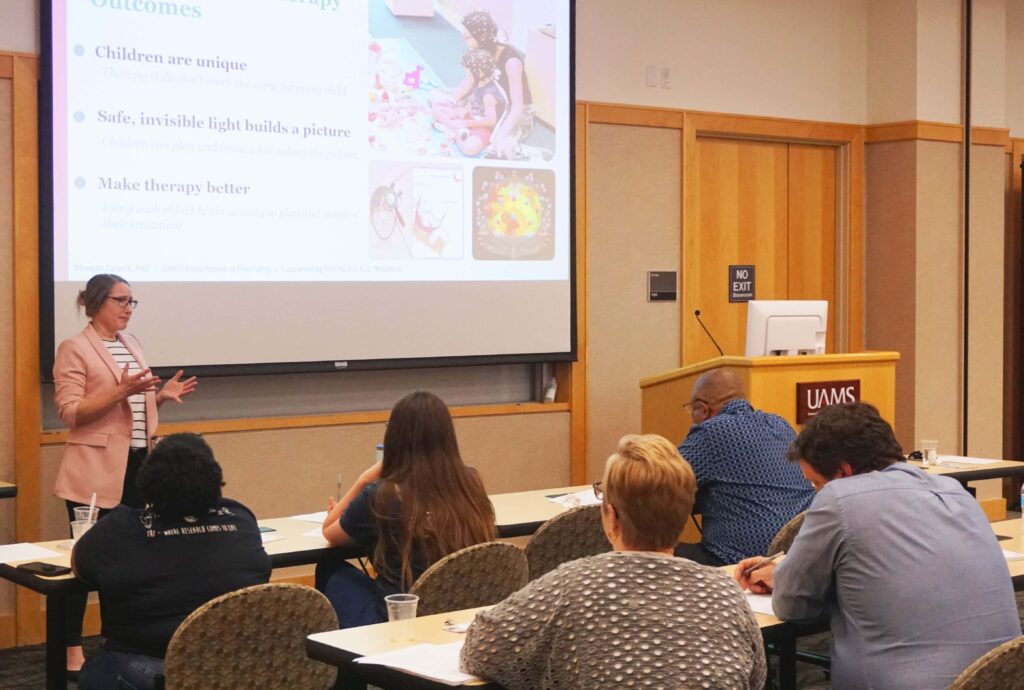
A woman stands in front of an audience with a screen behind her delivering a talk.
Maegan Calvert, Ph.D., talks to community members about her research as part of the Translational Research Institute’s TRIumph public speaking program.

Many people fear public speaking and rightly so. You’re on stage, out there in the spotlight, facing an audience filled with unknown faces and trying to connect through a story, while not misspeaking, boring the room to sleep, or freezing.

For researchers talking to a lay audience, the challenge is magnified. The dread of public speaking — an uneasy proposition feared by an estimated three-quarters of people — is coupled with trying to explain often complex science.

The University of Arkansas for Medical Sciences (UAMS) Translational Research Institute’s TRIumph public speaking program makes this challenge easier for researchers by equipping them with the tools to communicate research clearly, confidently, and in ways that connect with the communities they serve.

Launched in 2024 and led by Julien Mirivel, Ph.D., professor of applied communication at the University of Arkansas at Little Rock, the program bridges the gap between conducting research and communicating it effectively.

“It’s one thing to develop expertise and conduct research; it’s another set of skills to share your findings effectively and positively,” he said. “Our goals are to increase participants’ public speaking skills when sharing their research with the community, to improve participants’ communication competency, and to create a community-building experience.”

The program was started after Laura James, M.D., director of the Translational Research Institute, contacted Mirivel and tasked him with improving researchers’ and scientists’ ability to share their research with the larger community.

The program consists of three main sessions, beginning with the macro-structure of how to organize and present research in a clear, compelling way. The second emphasizes delivery, particularly the role of storytelling in making information memorable and engaging. The program includes online courses where researchers review information, submit draft videos, and receive feedback. Individual coaching is available as needed, creating a supportive environment for growth and refinement.

The third session is a live presentation with no notes and just one presentation slide to community members, which five UAMS researchers delivered April 2 through eight- to 10-minute talks.

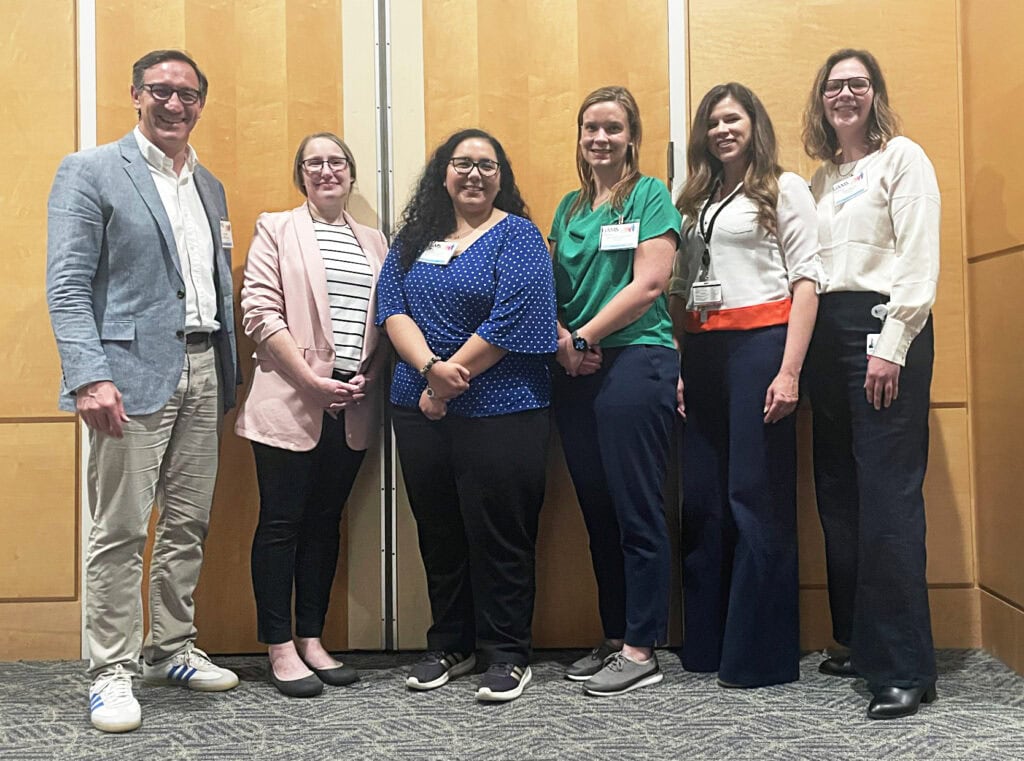
A man stands on the left with five women standing in a row going to the right.
Led by UALR professor Julien Mirivel, Ph.D. (far left), the spring 2026 TRIumph program speakers included (from left) Maegan Calvert, Ph.D.; Alexa Escapita, Ph.D.; Meghan Breckling, Pharm.D.; Carol Morris, Ph.D.; and Meagan Kingren, Ph.D.

For participant Meghan Breckling, Pharm.D., an assistant professor of pharmacy practice and psychiatry, the program reinforced the importance of storytelling as a communication tool.

“Effective storytelling is a powerful way to capture an audience’s attention and convey the importance of my research,” said Breckling, whose research is focused on assisting pharmacists in leading overdose education, especially in small towns and rural areas. “Practicing how to present research to diverse audiences helps broaden its reach and impact. Because the success of my research depends on community members’ understanding and engagement, it is essential to describe findings in clear, accessible ways that resonate with those most affected.”

That emphasis on connection was echoed by Maegan Calvert, Ph.D., an assistant professor of psychiatry and clinical psychologist. Her research uses neuroimaging to better understand human behavior, predict treatment outcomes, and develop interventions.

“If the community doesn’t understand what you are saying, they can’t connect with you, and we miss the opportunity to engage in a shared moment,” she said. “We do our science to benefit the community, but if we can’t communicate with the community in a way that they can understand, there is no way that the community can fully benefit or contribute to our work.”

Framing research so it connects

For Alexa Escapita, Ph.D., a postdoctoral fellow in the College of Medicine studying infant brain development, primarily focused on children of diabetic mothers, a quote from Maya Angelou shared during the program encapsulated TRIumph.

Angelou is noted for saying, “I’ve learned that people will forget what you said, people will forget what you did, but people will never forget how you made them feel.” Escapita said the quote — and TRIumph — made her realize her science is more accessible through simpler language and framing her research in ways that connect with audiences.

“I learned the importance of telling a story to connect with the audience and community members,” she said. “I believe that the research I do is valuable, and if I can share that with the community, then we can potentially improve the lives of children with a high risk of developmental delays. We can do this by educating mothers about what the milestones are that their children need to meet at certain ages and what they can do if their child is not meeting these milestones.”

Similarly, Carol Morris, Ph.D., a postdoctoral researcher in the College of Medicine focused on developing treatments for ischemic stroke, found value in the program’s emphasis on building relationships with audiences.

“I’ve always been a proponent for good science communication, but the TRIumph training emphasizes building a relationship with the audience to help facilitate understanding of the message,” she said. “This was helpful advice when speaking with community members. We also get the opportunity to have a conversation with them, where we learn new things from them as well. It’s a vital exchange for both parties.”

A common theme among all the participants was that communicating research effectively is as important as the research itself. Recognizing that advancing science is not only about discovery, but also about connection is the power of TRIumph, Mirivel said.

“So many researchers and scientists have exceptional research, findings, and do exciting work,” he said. “Yet many of them struggle to share their work effectively with the larger community.

“Medical researchers need to communicate with a larger audience to show the value of science, its impact on practice, and to shape public trust and support. We know that greater understanding of science is positively associated with higher trust in scientists.”

The Translational Research Institute is supported by the National Institutes of Health (NIH) National Center for Advancing Translational Sciences (NCATS), Clinical and Translational Science Awards (CTSA) Program UM1 TR004909, K12 TR004924, and T32 TR004918.

Filed Under: Front, News, Newsroom

Introducing REDCap Connect

Dear REDCap user,

REDCap systems are being consolidated into four environments to improve performance and better support research needs. To help users navigate the new structure and find the right instance for their project, the REDCap Connect website is also being launched on April 27. The site will include training resources, a user forum, guidance for submitting requests for support, and updates about all four REDCap instances, which are:

UAMS Campuses REDCap Instances:

  • Tier 1 REDCap: For researchers and staff independently managing research, quality improvement, and operational projects (formerly AR-CRIS REDCap)
  • Tier 2 REDCap: For projects requiring development support, Epic integration, or 21 CFR Part 11 compliance. Use this instance for projects involving direct Epic data transfer, electronic consent, or FDA-regulated research (formerly CIRC REDCap)

Arkansas Children’s Campus REDCap Instances:

  • Tier 1 REDCap: For researchers and staff independently managing research, quality improvement, and operational projects (formerly Arkansas Children’s REDCap)
  • Tier 2 REDCap: For projects requiring development support, Epic integration, or 21 CFR Part 11 compliance. Use this instance for projects involving direct Epic data transfer, electronic consent, or FDA-regulated research (new instance)

In parallel, we are asking REDCap users to review their existing REDCap projects. Projects that have been inactive for more than 12 months will be archived on Oct. 15, 2026. To keep your project active:

  • Log in and perform any activity (e.g., export data), OR
  • Contact your REDCap administrator redcap@uams.edu / redcap@archildrens.org or Melody Greer mlgreer@uams.edu

Archived projects can be reinstated anytime if needed. No new projects will be added to the BASE/UAMS DOP instance as of April 27.

If you have any questions about REDCap Connect or archiving, please contact your REDCap administrator.

Thank you,

The REDCap Governance Committee

Filed Under: Front, News, Newsroom

Must-Read NIH Public Access Policy Update

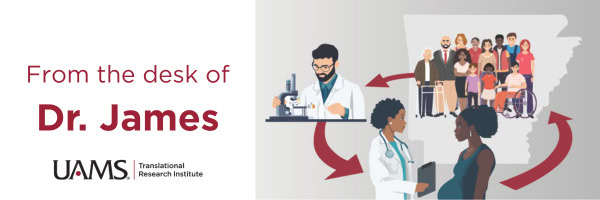
Graphic shows person looking at microscope, people talking and group of people standing over outline of state of Arkansas and says: From the desk of Dr. James.

April 15, 2026

Dear colleagues,

I am making a personal appeal to every researcher in our community to pay close attention to NIH’s new Public Access Policy that went into effect July 1, 2025. This is especially critical for principal investigators and first authors.

The stakes for the Translational Research Institute (TRI) are incredibly high. If even one paper that cites the TRI NIH grants is out of compliance, the NIH views the entire institute as non-compliant. This isn’t just a minor administrative hurdle – it can slow or even stop our grant renewal for the next year. We need everyone’s full cooperation to protect our collective funding and research mission.

A Major Paradigm Shift

In the past, TRI encouraged citing the Clinical and Translational Science Awards (CTSA) Program grant as broadly as possible – even for small-scale consultations or routine use of services like REDCap – because those citations were our primary way of measuring institutional impact for the NIH.

That mindset must now change. Because the consequences of citing the grant without strictly following the above NIH Public Access Policy are so severe, we must be much more judicious. We are moving to a two-tiered approach: a simple “acknowledgment” for general support (e.g., REDCap, biostatistics, informatics,, and/or community engagement consultations, and others), and a formal “grant citation” including the grant number only for work directly funded by the award. (Examples of direct funding would be K12 awards, T32 awards, or pilot grant awards.)

The New Citation Standard

To ensure we remain in compliance and retain our funding, we are asking you to adopt a new mindset regarding how you credit the institute:

  • Cite the grant number ONLY IF the award provided direct funding for the research being reported. By using the grant number (UM1 TR004909, K12 TR004924, and T32 TR004918), you are confirming that you will ensure the publication follows the NIH policy. This includes ensuring the paper is assigned a PubMed Central ID (PMCID) – which is different from a PMID – and is available immediately upon publication with no embargo.
  • Acknowledge TRI if you used our resources, such as REDCap, biostatistics, informatics, or the Community Engagement Core, but did not receive direct funding. Acknowledgement without using the grant number allows us to track our impact without triggering the same NIH Public Access Policy requirements.

Your Responsibility as the Author and Contract Holder

Compliance is the responsibility of the author because you hold the contract with the journal. If your chosen journal does not automatically deposit the article for immediate availability, you must take the lead in manually depositing the manuscript via the NIHMS system.

You are not navigating this alone. Our team is ready to help you verify compliance pathways before you submit and monitor the deposit process until it is complete. If you have questions about whether to cite or how to ensure immediate availability, contact Mtonya Hunter (HunterLewisMtonya@uams.edu)for direct assistance.

Please review our updated Cite TRI page. By being diligent now, you are ensuring that TRI can continue to support your work and the work of your colleagues for years to come.

Thank you for your partnership.

Laura P. James, M.D.
Director, Translational Research Institute
Associate Vice Chancellor for Clinical and Translational Research
University of Arkansas for Medical Sciences


Special thanks to our colleagues at the C. Kenneth and Dianne Wright Center for Clinical and Translational Research CTSA for their collaboration in developing this guidance for our hub.

Filed Under: Front, News, Newsroom

The Team Behind the Trials

Photo shows three people in an exam room with one preparing a needle for injection and another holding a clipboard.
The Clinical Trials Innovation Unit (CTIU) at UAMS helps clinical trials run smoother.

Good clinical trial research should be easy to start, run efficiently, and deliver health care impacts for patients.

At the Clinical Trials Innovation Unit (CTIU), part of the Translational Research Institute at the University of Arkansas for Medical Sciences (UAMS), these ideas shape the team’s work.

The unit is a comprehensive support system designed to help investigators navigate the complicated world of human-based research, said Al Keyes, director of clinical trials within the CTIU. The unit supports both investigator-initiated and industry-sponsored studies and focuses on improving study quality while streamlining start-up timelines.

“CTIU consists of our study coordinator team, regulatory team, start-up, and finance team (front and back end),” Keyes said. “In a nutshell, our study coordinators provide a resource to clinical investigators looking to delve into a research study who require assistance with data collection, entry, recruitment, consenting, and more.”

The start-up team collaborates with sponsors and investigators to determine feasibility and coordinate site qualification and initiation visits. The regulatory team ensures documentation is complete and works with institutional review boards and legal teams, so protocols meet all requirements. Meanwhile, finance staff ensure budgets properly support study needs and that research charges are billed correctly so participants are not mistakenly charged.

Together, these teams create a structure that allows investigators to focus on the science while CTIU manages the infrastructure.

The people behind the work

That structure supports research across a wide range of specialties, including neurology, cardiology, diabetes, pediatrics, behavioral health, pulmonary care, and trauma medicine. But for the people doing the work on the ground, the impact is most visible in the relationships they build with both researchers and patients.

For clinical research nurse Rory McCoy, the CTIU represents both a professional turning point and a chance to help make research real.

McCoy came to UAMS in 2016 as a cast technician, later becoming a nurse after graduating from nursing school in 2020. He worked on the orthopaedic, plastics, and ENT post-operative floor, often serving as charge nurse while managing his own patients. Eventually, the demands of bedside care led to a desire to shift his work focus.

Encouraged by his wife, who worked in research, he applied for a coordinator role.

“My position is research coordinator,” McCoy said. “I have the privilege to be the primary coordinator on several important studies. Coordinators are the bridge that makes the dream of research a reality.

“Through logistics, we gather the raw data from participants that is needed to advance medical knowledge. We connect principal investigators, sponsors, regulatory teams, and administration with human beings.”

For McCoy, the appeal of CTIU is twofold: the intellectual challenge and the ability to balance work with family life (he and his wife Hannah have two boys).

“I’ve always been a big science nerd,” he said. “This position offered me a more traditional work schedule with flexibility for my family while still being on the cutting edge of medical science.”

He compares coordinating studies to solving puzzles.

“In research, we put together the many pieces so that the dream of research can be realized,” he said. “At the CTIU, we’re puzzle masters.”

That same mix of coordination, patient interaction, and continuous learning is what keeps clinical research nurse manager Gail Runnells engaged in the work.

A woman nurse wearing a mask shows an info card to a male patient wearing a mask.
Clinical research nurse manager Gail Runnells has worked within the CTIU since 2017.

Runnells joined CTIU in 2017 after completing nursing school, bringing with her earlier experience working on cancer epidemiology studies at UAMS. Once licensed, she was able to move more directly into clinical research, where she now supports investigators by preparing study visits, communicating requirements, and conducting assessments.

Her work can include everything from collecting vital signs and ECGs to processing samples and coordinating imaging or specialty exams across departments.

“I like the wide variety of different studies that we work on,” Runnells said. “There is always something new coming in and always something new to learn. I also like working with the different doctors from different specialties.”

She encourages investigators new to research to rely on CTIU’s expertise.

“Research has different requirements than clinical care,” she said. “Don’t be afraid to learn from and lean on the coordinators. They are here to help and guide.”

The patients living better lives

For clinical research nurse Gwendolyn Cobbs, the meaning of the work crystallized in a single patient encounter.

Cobbs joined the Translational Research Institute four years ago after working in a different UAMS department and becoming familiar with the research staff. Early in her time with CTIU, she saw a patient who had received an implant for severe, chronic back pain.

“She had back pain since her teens,” Cobbs recalled. “There were so many things she couldn’t do. She couldn’t sleep under covers, couldn’t eat with a fork, couldn’t get her nails done.”

After treatment through a study, the change was dramatic.

“She told me she had been cooking, reading — everything,” Cobbs said. “I saw that her nails were painted. I was just amazed. I knew then that this was where I was supposed to be.”

Cobbs says the job offers the best balance of nursing care and coordination work.

“I get to see patients and their well-being at vulnerable moments, but I’m not running all the time,” she said. “It’s a good mixture of patient care and administrative work.”

Using a strong infrastructure of skilled coordinators to enable meaningful patient outcomes is exactly what CTIU was built to provide, Keyes said.

By serving as a liaison among researchers, institutions, sponsors, and campus partners, the unit reduces barriers, improves communication, and helps studies move forward faster.

And for the people working inside it, the mission is clear: when research runs smoothly, discoveries reach patients sooner. That’s the real measure of success.

Investigators interested in working with CTIU can request services through the TRI ServiceNow portal.

Filed Under: Front, News, Newsroom

UAMS Researcher Strives to Address Obesity in East Arkansas

Tiffany Miles is a woman with glasses and dark hair and wearing a blue jacket.
Tiffany Miles, Ph.D., led a nine-month project in Marvell and Elaine designed to determine health barriers and facilitate discussions around a community-led obesity intervention.

Tiffany Miles, Ph.D., a researcher with the UAMS Translational Research Institute, wants to understand barriers to addressing obesity and food insecurities in two east Arkansas communities — Marvell and Elaine.

Miles, who’s also an instructor in the UAMS College of Medicine Department of Pediatrics Division of Nutrition, led a nine-month project in Marvell and Elaine designed to determine health barriers and facilitate discussions around a community-led obesity intervention. The study was funded by a $25,000 pilot award from the Translational Research Institute.

Miles’ study “Community Developed and Implemented Obesity Interventions in Marvell, Arkansas,” launched in March and concluded in November. It explored the communities’ perception of nutrition, obesity, food insecurity, maternal nutrition as well as whether residents of Marvell and Elaine were aware of the area’s obesity rates, and how they wanted to solve the issues. Additionally, the researchers wanted the public’s outlook on past interventions brought into, or developed by, the community.  

“The project focused on what worked, what didn’t work, if something did work, why wasn’t it sustained, what the community members would like to see moving forward and how they’d like to maintain the project, once the research is complete,” Miles said. “I wanted the residents to discuss evidence-based interventions and programs and how to adapt it to their community.

“By fostering trust, partnership and shared leadership between researchers and residents, the project examined the health disparities in a region that’s disproportionately affected by food insecurity and metabolic disease.”

To execute this community-based participatory research project, Miles partnered with Marvell’s Boys, Girls, Adults Community Development Center and held five focus group sessions. Each group had 20 to 25 participants, primarily consisting of Marvell or Elaine residents who were between 18 and 39 years old.

Information gathered from the focus groups helped the researchers better understand community perceptions of obesity, maternal health and nutrition. The candid, in-person interactions with the study’s participants were vital to the team.

“When people came to the first focus group, I could tell they wondered who we were and why we’re there,” Miles said. “Some of them even asked me straight-up, what I wanted with them. Community members told us that they’re tired of people coming to their town and telling them that they’re obese. That’s not a positive conversation they want to have, especially if the researcher is not from their community. They wanted people to hear them and understand their reasons for why they can’t maintain a healthy lifestyle.”

Participants also referenced that people not understanding what malnutrition was, along with the Delta region being food insecure, factored into the high rates of obesity.

“We often discussed how food insecurity can lead to obesity,” Miles said. “We also discussed how it’s not about eating less, it’s about not eating the proper amounts of certain foods, that can lead to malnutrition.”    

Empowering people to tackle obesity                 

The project also included a grand finale community gathering, “Seeds for the Harvest.” During the event, findings from the focus group discussions were disseminated, and a breakout session was facilitated on how to best modify and sustain evidence-based strategies took place. 

Attendees also gave their feedback on the study, the potential implementation of a nutrition education class, and the creation of a partnership with the Marvell-Elaine School District EAST program in which students develop a technology to help address a community need.

“It’s a blessing to be able to work with Dr. Tiffany Miles,” said Beatrice Shelby, executive director of the community center. “Her project gave our center, and the residents of both Marvell and Elaine, one more opportunity to build community competency by empowering people to help themselves.”   

Miles said that Marvell is similar to communities surrounding Baton Rouge, Louisiana, where she grew up. That’s one of the reasons why she enjoyed leading the program.    

“Any research that I do, I must have a connection to my personal why,” she said. “This project connected with my personal why.

“During our final event, the people cared about everything we did. They were attentive. That reminded me of how vital this study and event is for the people of Marvell and Elaine. Coming together as a community was important to them. Research aside, I was so glad that we could meet a need for these communities.”

Filed Under: Front, News, Newsroom

Translational Research Institute LogoTranslational Research InstituteTranslational Research Institute
Mailing Address: 4301 West Markham Street, Little Rock, AR 72205
Phone: (501) 686-7000
  • Facebook
  • X
  • Instagram
  • YouTube
  • LinkedIn
  • Pinterest
  • Disclaimer
  • Terms of Use
  • Privacy Statement
  • Legal Notices

© 2026 University of Arkansas for Medical Sciences