
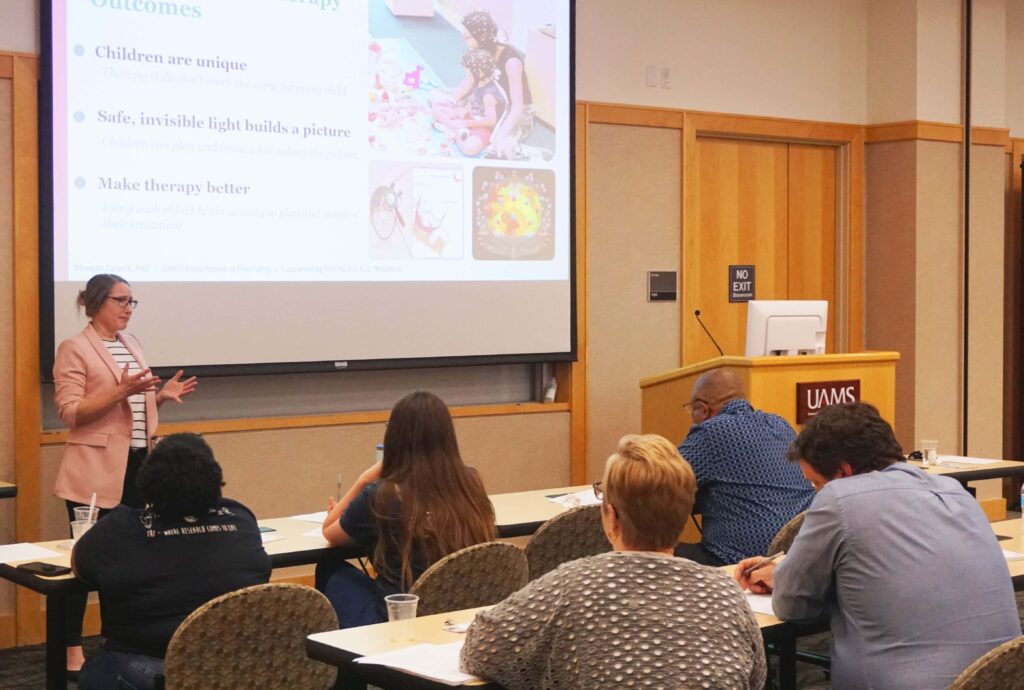
Many people fear public speaking and rightly so. You’re on stage, out there in the spotlight, facing an audience filled with unknown faces and trying to connect through a story, while not misspeaking, boring the room to sleep, or freezing.
For researchers talking to a lay audience, the challenge is magnified. The dread of public speaking — an uneasy proposition feared by an estimated three-quarters of people — is coupled with trying to explain often complex science.
The University of Arkansas for Medical Sciences (UAMS) Translational Research Institute’s TRIumph public speaking program makes this challenge easier for researchers by equipping them with the tools to communicate research clearly, confidently, and in ways that connect with the communities they serve.
Launched in 2024 and led by Julien Mirivel, Ph.D., professor of applied communication at the University of Arkansas at Little Rock, the program bridges the gap between conducting research and communicating it effectively.
“It’s one thing to develop expertise and conduct research; it’s another set of skills to share your findings effectively and positively,” he said. “Our goals are to increase participants’ public speaking skills when sharing their research with the community, to improve participants’ communication competency, and to create a community-building experience.”
The program was started after Laura James, M.D., director of the Translational Research Institute, contacted Mirivel and tasked him with improving researchers’ and scientists’ ability to share their research with the larger community.
The program consists of three main sessions, beginning with the macro-structure of how to organize and present research in a clear, compelling way. The second emphasizes delivery, particularly the role of storytelling in making information memorable and engaging. The program includes online courses where researchers review information, submit draft videos, and receive feedback. Individual coaching is available as needed, creating a supportive environment for growth and refinement.
The third session is a live presentation with no notes and just one presentation slide to community members, which five UAMS researchers delivered April 2 through eight- to 10-minute talks.
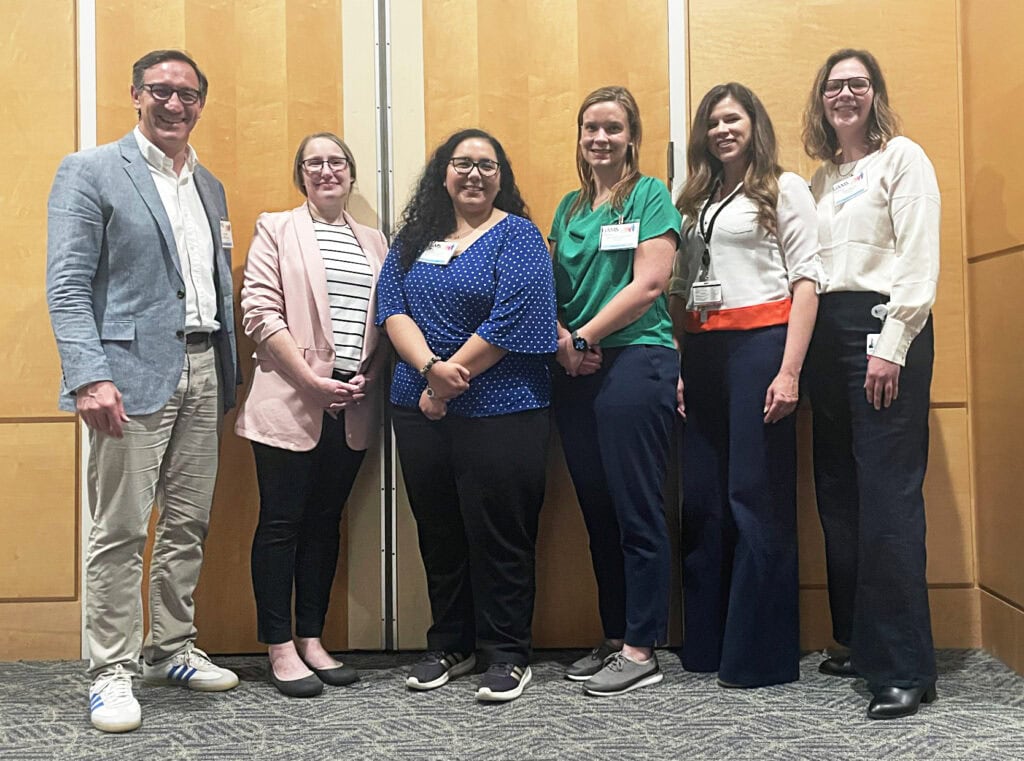
For participant Meghan Breckling, Pharm.D., an assistant professor of pharmacy practice and psychiatry, the program reinforced the importance of storytelling as a communication tool.
“Effective storytelling is a powerful way to capture an audience’s attention and convey the importance of my research,” said Breckling, whose research is focused on assisting pharmacists in leading overdose education, especially in small towns and rural areas. “Practicing how to present research to various audiences helps broaden its reach and impact. Because the success of my research depends on community members’ understanding and engagement, it is essential to describe findings in clear, accessible ways that resonate with those most affected.”
That emphasis on connection was echoed by Maegan Calvert, Ph.D., an assistant professor of psychiatry and clinical psychologist. Her research uses neuroimaging to better understand human behavior, predict treatment outcomes, and develop interventions.
“If the community doesn’t understand what you are saying, they can’t connect with you, and we miss the opportunity to engage in a shared moment,” she said. “We do our science to benefit the community, but if we can’t communicate with the community in a way that they can understand, there is no way that the community can fully benefit or contribute to our work.”
Framing research so it connects
For Alexa Escapita, Ph.D., a postdoctoral fellow in the College of Medicine studying infant brain development, primarily focused on children of diabetic mothers, a quote from Maya Angelou shared during the program encapsulated TRIumph.
Angelou is noted for saying, “I’ve learned that people will forget what you said, people will forget what you did, but people will never forget how you made them feel.” Escapita said the quote — and TRIumph — made her realize her science is more accessible through simpler language and framing her research in ways that connect with audiences.
“I learned the importance of telling a story to connect with the audience and community members,” she said. “I believe that the research I do is valuable, and if I can share that with the community, then we can potentially improve the lives of children with a high risk of developmental delays. We can do this by educating mothers about what the milestones are that their children need to meet at certain ages and what they can do if their child is not meeting these milestones.”
Similarly, Carol Morris, Ph.D., a postdoctoral researcher in the College of Medicine focused on developing treatments for ischemic stroke, found value in the program’s emphasis on building relationships with audiences.
“I’ve always been a proponent for good science communication, but the TRIumph training emphasizes building a relationship with the audience to help facilitate understanding of the message,” she said. “This was helpful advice when speaking with community members. We also get the opportunity to have a conversation with them, where we learn new things from them as well. It’s a vital exchange for both parties.”
A common theme among all the participants was that communicating research effectively is as important as the research itself. Recognizing that advancing science is not only about discovery, but also about connection is the power of TRIumph, Mirivel said.
“So many researchers and scientists have exceptional research, findings, and do exciting work,” he said. “Yet many of them struggle to share their work effectively with the larger community.
“Medical researchers need to communicate with a larger audience to show the value of science, its impact on practice, and to shape public trust and support. We know that greater understanding of science is positively associated with higher trust in scientists.”
The Translational Research Institute is supported by the National Institutes of Health (NIH) National Center for Advancing Translational Sciences (NCATS), Clinical and Translational Science Awards (CTSA) Program UM1 TR004909, K12 TR004924, and T32 TR004918.