
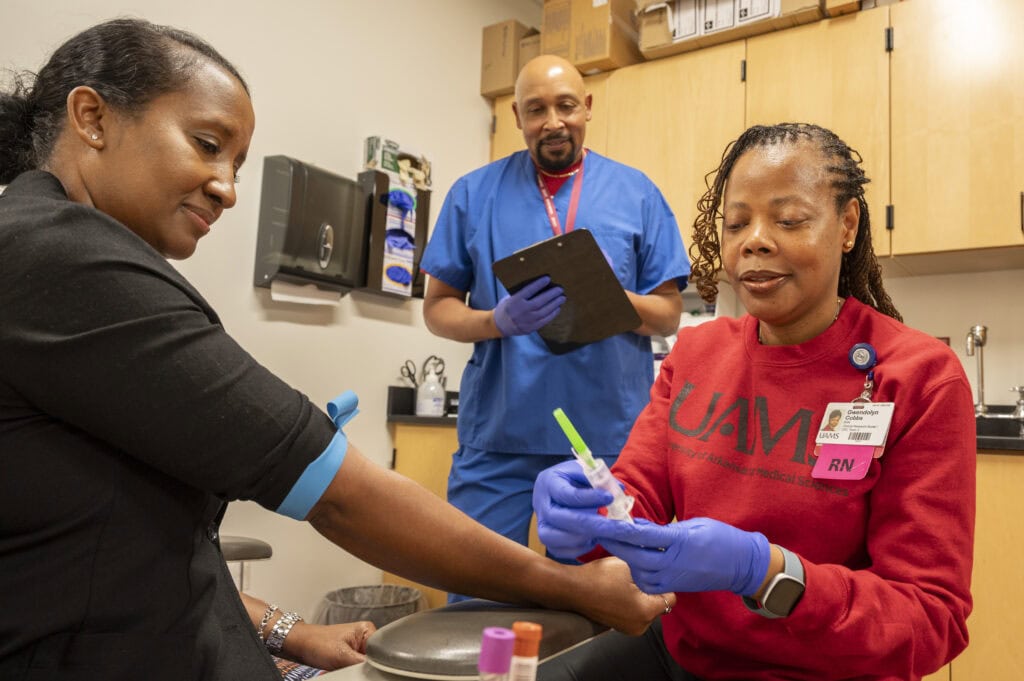
Good clinical trial research should be easy to start, run efficiently, and deliver health care impacts for patients.
At the Clinical Trials Innovation Unit (CTIU), part of the Translational Research Institute at the University of Arkansas for Medical Sciences (UAMS), these ideas shape the team’s work.
The unit is a comprehensive support system designed to help investigators navigate the complicated world of human-based research, said Al Keyes, director of clinical trials within the CTIU. The unit supports both investigator-initiated and industry-sponsored studies and focuses on improving study quality while streamlining start-up timelines.
“CTIU consists of our study coordinator team, regulatory team, start-up, and finance team (front and back end),” Keyes said. “In a nutshell, our study coordinators provide a resource to clinical investigators looking to delve into a research study who require assistance with data collection, entry, recruitment, consenting, and more.”
The start-up team collaborates with sponsors and investigators to determine feasibility and coordinate site qualification and initiation visits. The regulatory team ensures documentation is complete and works with institutional review boards and legal teams, so protocols meet all requirements. Meanwhile, finance staff ensure budgets properly support study needs and that research charges are billed correctly so participants are not mistakenly charged.
Together, these teams create a structure that allows investigators to focus on the science while CTIU manages the infrastructure.
The people behind the work
That structure supports research across a wide range of specialties, including neurology, cardiology, diabetes, pediatrics, behavioral health, pulmonary care, and trauma medicine. But for the people doing the work on the ground, the impact is most visible in the relationships they build with both researchers and patients.
For clinical research nurse Rory McCoy, the CTIU represents both a professional turning point and a chance to help make research real.
McCoy came to UAMS in 2016 as a cast technician, later becoming a nurse after graduating from nursing school in 2020. He worked on the orthopaedic, plastics, and ENT post-operative floor, often serving as charge nurse while managing his own patients. Eventually, the demands of bedside care led to a desire to shift his work focus.
Encouraged by his wife, who worked in research, he applied for a coordinator role.
“My position is research coordinator,” McCoy said. “I have the privilege to be the primary coordinator on several important studies. Coordinators are the bridge that makes the dream of research a reality.
“Through logistics, we gather the raw data from participants that is needed to advance medical knowledge. We connect principal investigators, sponsors, regulatory teams, and administration with human beings.”
For McCoy, the appeal of CTIU is twofold: the intellectual challenge and the ability to balance work with family life (he and his wife Hannah have two boys).
“I’ve always been a big science nerd,” he said. “This position offered me a more traditional work schedule with flexibility for my family while still being on the cutting edge of medical science.”
He compares coordinating studies to solving puzzles.
“In research, we put together the many pieces so that the dream of research can be realized,” he said. “At the CTIU, we’re puzzle masters.”
That same mix of coordination, patient interaction, and continuous learning is what keeps clinical research nurse manager Gail Runnells engaged in the work.
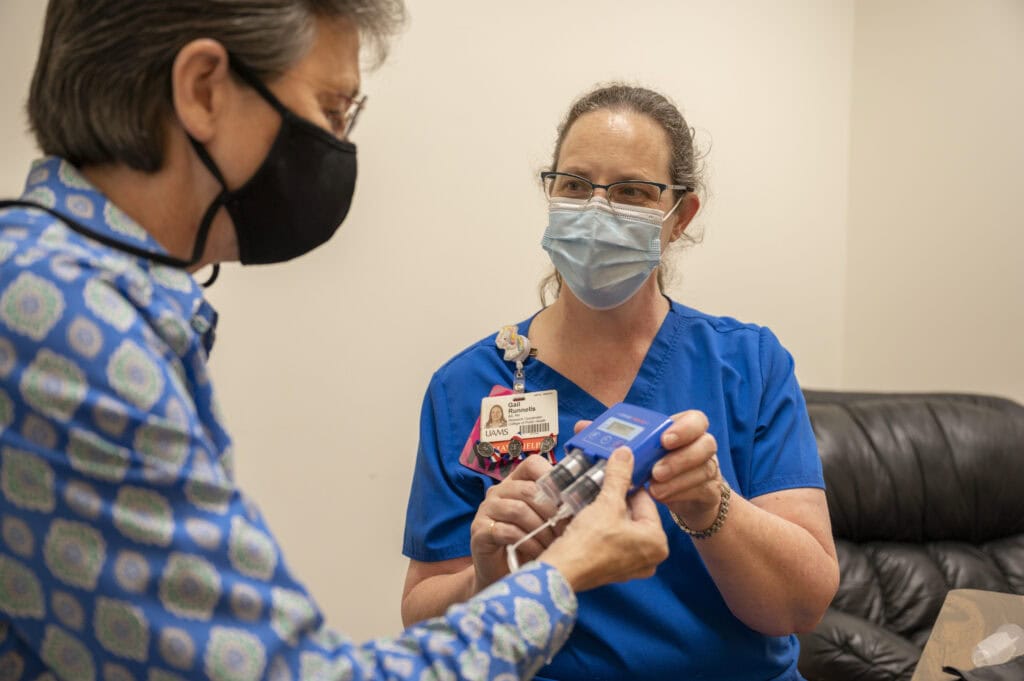
Runnells joined CTIU in 2017 after completing nursing school, bringing with her earlier experience working on cancer epidemiology studies at UAMS. Once licensed, she was able to move more directly into clinical research, where she now supports investigators by preparing study visits, communicating requirements, and conducting assessments.
Her work can include everything from collecting vital signs and ECGs to processing samples and coordinating imaging or specialty exams across departments.
“I like the wide variety of different studies that we work on,” Runnells said. “There is always something new coming in and always something new to learn. I also like working with the different doctors from different specialties.”
She encourages investigators new to research to rely on CTIU’s expertise.
“Research has different requirements than clinical care,” she said. “Don’t be afraid to learn from and lean on the coordinators. They are here to help and guide.”
The patients living better lives
For clinical research nurse Gwendolyn Cobbs, the meaning of the work crystallized in a single patient encounter.
Cobbs joined the Translational Research Institute four years ago after working in a different UAMS department and becoming familiar with the research staff. Early in her time with CTIU, she saw a patient who had received an implant for severe, chronic back pain.
“She had back pain since her teens,” Cobbs recalled. “There were so many things she couldn’t do. She couldn’t sleep under covers, couldn’t eat with a fork, couldn’t get her nails done.”
After treatment through a study, the change was dramatic.
“She told me she had been cooking, reading — everything,” Cobbs said. “I saw that her nails were painted. I was just amazed. I knew then that this was where I was supposed to be.”
Cobbs says the job offers the best balance of nursing care and coordination work.
“I get to see patients and their well-being at vulnerable moments, but I’m not running all the time,” she said. “It’s a good mixture of patient care and administrative work.”
Using a strong infrastructure of skilled coordinators to enable meaningful patient outcomes is exactly what CTIU was built to provide, Keyes said.
By serving as a liaison among researchers, institutions, sponsors, and campus partners, the unit reduces barriers, improves communication, and helps studies move forward faster.
And for the people working inside it, the mission is clear: when research runs smoothly, discoveries reach patients sooner. That’s the real measure of success.
Investigators interested in working with CTIU can request services through the TRI ServiceNow portal.