• Skip to primary navigation
  • Skip to main content
  • Skip to primary navigation
  • Skip to main content
Choose which site to search.
University of Arkansas for Medical Sciences Logo University of Arkansas for Medical Sciences
Translational Research Institute
  • UAMS Health
  • Jobs
  • Giving
  • About TRI
    • What We Offer
    • Leadership & Governance
    • Staff
    • Cite TRI
    • What is Translational Research?
    • Contact TRI
  • Funding Opportunities
    • Grants
      • Pilot Award Program
      • Consortium of Rural States (CORES) Multi-Institutional Pilot Award Program
      • Team Science Voucher Program
      • Winthrop P. Rockefeller Cancer Institute Rural Research Award Program
    • Scholarships
      • K12 Mentored Research Career Development Scholar Awards Program
      • HSIE (T32) Training Program
      • Implementation Science Scholar Program
      • (STARs) Program – Strategies for Training and Advancing Researchers
      • SMART Program [Master’s in Clinical and Translational Sciences (MS-CTS)]
    • Community
      • Community Based Participatory Research (CBPR) Scholars Program
      • Community Partners Educated as Arkansas Research Leaders (CPEARL) Program
    • Awardee Responsibilities
  • Services & Resources
    • Services
      • Biostatistics, Epidemiology and Research Design (BERD) Consultation
      • Clinical Data Repository (AR-CDR)
      • Comprehensive Informatics Resource Core (CIRC)
      • Mock Study Sections
      • Research Participant Recruitment
      • Research Support: Clinical Trials Innovation Unit (CTIU)
      • Implementation Science Program
      • Research Ethics Consultation
    • Resources
      • ARresearch Registry
      • Center for Health Literacy
      • Data Safety Monitoring
      • Grant Writing & Dissemination
      • UAMS Profiles
      • UAMS Rural Research Network
      • Other Resources
      • COVID-19 Research Guidelines
      • Community Partner Research Training
  • Career Development & Scholarships
    • Scholarship Opportunities
      • K12 Mentored Research Career Development Scholar Awards Program
      • HSIE (T32) Training Program
      • Data Science Scholars Program
      • Implementation Science Scholar Program
      • SMART Program
      • Translational Research Innovations and Partners (TRIP) Program
    • Training & Educational Opportunities
      • innOVATION Seminar Series
      • Path 2 K Program
      • Translational Workforce Development
      • Graduate Certificate in Implementation Science
      • SMART Program [Master’s in Clinical and Translational Sciences (MS-CTS)]
      • Good Clinical Practice Training
    • Didactic Training
  • Community
    • Community Engagement Leadership
    • Community Advisory Board
    • Community Engagement Partners
      • Community Partner Celebration
      • Faith-Academic Initiatives for Transforming Health (FAITH) Network
    • Community Engagement Services
      • Consultations and Technical Assistance
      • Community Review Boards
      • Community Partner Research Training
      • Equipment Library
    • Programs and Funding
      • Community Partners Educated as Arkansas Research Leaders (CPEARL) Program
      • Community Based Participatory Research (CBPR) Scholars Program
      • Community Scientist Academy
    • Toolkits
      • CSA Online Toolkit
      • CPEARL Toolkit
  • Events
    • Research Day
    • Clinical Trials Learning Collaborative
  • Newsroom
  1. University of Arkansas for Medical Sciences
  2. Translational Research Institute
  3. Anna Radominska-Pandya

Anna Radominska-Pandya

UAMS Synthetic ‘Marijuana’ Researcher Presents Findings at National Meeting

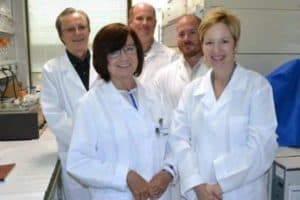
Anna Radominska-Pandya, Ph.D., (left front) with UAMS synthetic “marijuana” research team members, including Laura James, M.D., (right), and (back, l-r) Principal Investigator Paul Prather, Ph.D., Jeff Moran, Ph.D., and William Fantegrossi, Ph.D.

LITTLE ROCK — Some people who use so-called synthetic marijuana, known by names such as K2 and Spice, may be unable to metabolize the drug, leading them to experience its most harmful effects, a UAMS researcher said at the recent national Experimental Biology 2017 meeting in Chicago.

Anna Radominska-Pandya, Ph.D., part of a UAMS research team examining how the body processes the man-made cannabinoids, presented the team’s findings on the harmful effects of synthetic marijuana at the American Society for Pharmacology and Experimental Therapeutics annual meeting, which was held during Experimental Biology, a meeting that draws thousands.

Synthetic “marijuana” is a growing group of man-made cannabinoids marketed as alternatives to marijuana. Although the man-made drugs activate the same receptors in the brain as natural marijuana, they are known to have volatile effects that can lead to severe injury and death.

Radominska-Pandya is a professor in the UAMS College of Medicine Departments of Biochemistry and Molecular Biology and Medicine. Her work could identify genetic risk factors that make some people susceptible to the synthetic cannabinoids’ most harmful consequences, potentially leading to antidotes that counteract the worst effects.

Radominska-Pandya and her colleagues have found that some people are unable to metabolize and excrete synthetic cannabinoids. They now hypothesize that a person’s genetic makeup could produce the metabolism defects that cause the most harmful effects from the drug. Future genetics tests could potentially identify those people.

“It is important to understand the underlying causes and toxicity of synthetic cannabinoids so that effective treatments and antidotes can be developed,” Radominska-Pandya said.

UAMS has been a national leader of synthetic cannabinoid research since the UAMS Translational Research Institute funded the team’s work in 2011 with a $100,000 pilot award. In 2016, the team, led by Paul Prather, Ph.D., a professor in the Department of Pharmacology and Toxicology, received a five-year, $2.7 million National Institute of Drug Abuse grant that builds on the work of the pilot study.

Synthetic cannabinoids come in more than 150 chemical forms and the list is growing. As new synthetic cannabinoids appear on the market, the UAMS research team will study their properties and how the body’s metabolism may contribute to their harmful effects.

Experimental Biology is an annual meeting comprised of more than 14,000 scientists and exhibitors from six host societies and multiple guest societies. With a mission to share the newest scientific concepts and research findings shaping clinical advances, the meeting offers an unparalleled opportunity for exchange among scientists from across the United States and the world who represent dozens of scientific areas, from laboratory to translational to clinical research.

Filed Under: Front, News Tagged With: Anna Radominska-Pandya, Experimental Biology, genetics, k2, spice, synthetic marijuana, Translational Research Institute, UAMS

Translational Research Institute LogoTranslational Research InstituteTranslational Research Institute
Mailing Address: 4301 West Markham Street, Little Rock, AR 72205
Phone: (501) 686-7000
  • Facebook
  • X
  • Instagram
  • YouTube
  • LinkedIn
  • Pinterest
  • Disclaimer
  • Terms of Use
  • Privacy Statement
  • Legal Notices

© 2025 University of Arkansas for Medical Sciences