
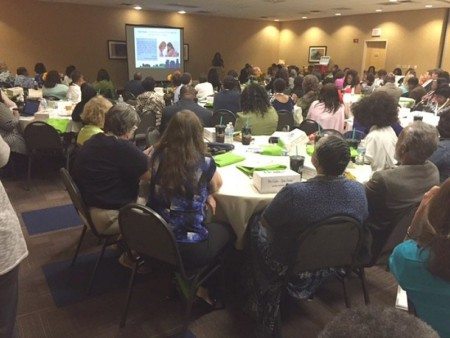
Nearly 200 Arkansas faith leaders, health ministries, educators, researchers and health care providers recently gathered in Little Rock to make connections and share ideas that will help reduce health challenges in Arkansas.
The second annual Community-Campus Partnership Conference to Address Health Challenges was hosted by the University of Arkansas for Medical Sciences (UAMS) at the Comfort Inn & Suites Presidential in Little Rock. The day included discussion of existing efforts to address health challenges and ongoing needs.
“Overall, we felt it was a huge success,” said Keneshia Bryant-Moore, Ph.D., FNP, APRN, who oversaw the event. “We were able to engage a portion of the faith community we had not reached before and provide them with some of the basic knowledge in health challenges, community-campus partnerships and research.”
UAMS, through the Fay W. Boozman College of Public Health and Translational Research Institute, has a track record of health research partnerships with communities in the Delta, particularly through its African-American churches. Bryant-Moore is also a Translational Research Institute KL2 Scholar alumnus.
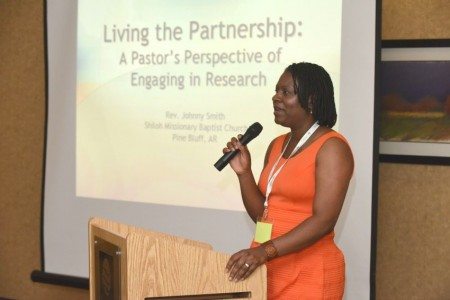
“Our goal was to make the initial connection with some and to connect current partners with each other,” said Bryant-Moore, associate professor of health behavior and health education in the College of Public Health. “We plan to follow up with all of the attendees throughout the year leading up to the next conference in April 2017.”
The Patient Protection and Affordable Care Act was cited as an important for improving health care access in Arkansas. Rural Arkansas has 64.5 primary care physicians per 100,000 people compared to 139 physicians per 100,000 people in urban Arkansas.
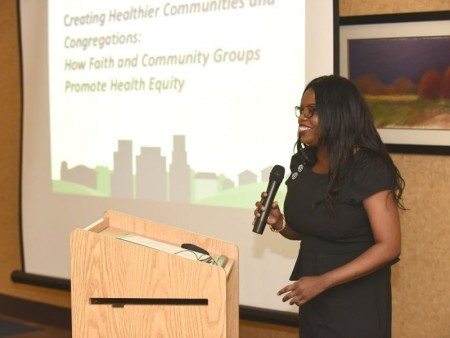
The event’s keynote speaker was Acacia Bamberg Salatti, acting director of the Center for Faith-Based and Neighborhood Partnerships, which is part of the U.S. Department of Health and Human Services. Other speakers included Micheal Knox, M.S., M.P.H., director of the Arkansas Minority Health Commission. The afternoon breakout sessions introduced attendees to faith-based community health clinics; strategies for reaching and mobilizing local congregations; understanding the role of faith-based organizations in research; and the role of the faith community in addressing homelessness, incarceration and community re-entry, and violence.
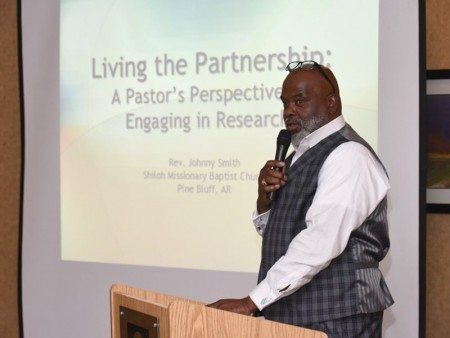
The Congregational Health Network was presented in the afternoon by Armika Berkley, M.P.H., program manager for the Congregational Health Network in partnership with Methodist Le Bonheur Healthcare; and Pastor Bobby G. Baker, D.Min., M.Div., director of Faith and Community Partnerships at Methodist Healthcare. The conference was partially funded through a Patient-Centered Outcomes Research Institute (PCORI) Eugene Washington PCORI Engagement Award (EAIN 2975). Additional funding was provided by a Health Resources and Services Administration Nursing Workforce Diversity Grant, which funds the Growing Our Own in the Delta (GOOD) program, and the UAMS Translational Research Institute. The conference was a collaboration with the Arkansas Foundation for Medical Care (AFMC), the Arkansas Minority Health Commission (AMHC), and Baptist Health Physician Partners.