• Skip to primary navigation
  • Skip to main content
  • Skip to primary navigation
  • Skip to main content
Choose which site to search.
University of Arkansas for Medical Sciences Logo University of Arkansas for Medical Sciences
Translational Research Institute
  • UAMS Health
  • Jobs
  • Giving
  • About TRI
    • What We Offer
    • Leadership & Governance
    • Staff
    • Citing Translational Research Institute CTSA Support
    • What is Translational Research?
    • Contact TRI
  • Funding Opportunities
    • Grants
      • Pilot Award Program
      • Consortium of Rural States (CORES) Multi-Institutional Pilot Award Program
      • Team Science Voucher Program
      • Winthrop P. Rockefeller Cancer Institute Rural Research Award Program
    • Scholarships
      • K12 Mentored Research Career Development Scholar Awards Program
      • Health Sciences Innovation and Entrepreneurship Postdoctoral Training Program
      • Implementation Science Scholar Program
      • (STARs) Program – Strategies for Training and Advancing Researchers
      • SMART Program [Master’s in Clinical and Translational Sciences (MS-CTS)]
    • Community
      • Community Based Participatory Research (CBPR) Scholars Program
      • Community Partners Educated as Arkansas Research Leaders (CPEARL) Program
    • Awardee Responsibilities
  • Services & Resources
    • Services
      • Biostatistics, Epidemiology and Research Design (BERD) Consultation
      • Clinical Data Repository (AR-CDR)
      • Comprehensive Informatics Resource Core
      • Mock Study Sections
      • Research Participant Recruitment
      • Research Support: Clinical Trials Innovation Unit (CTIU)
      • Implementation Science Program
      • Research Ethics Consultation
    • Resources
      • ARresearch Registry
      • Center for Health Literacy
      • Data Safety Monitoring
      • Grant Writing & Dissemination
      • UAMS Profiles
      • UAMS Rural Research Network
      • Other Resources
      • COVID-19 Research Guidelines
      • Community Partner Research Training
  • Career Development & Scholarships
    • Scholarship Opportunities
      • K12 Mentored Research Career Development Scholar Awards Program
      • Health Sciences Innovation and Entrepreneurship Postdoctoral Training Program
      • Data Science Scholars Program
      • Implementation Science Scholar Program
      • SMART Program
      • Translational Research Innovations and Partners (TRIP) Program
    • Training & Educational Opportunities
      • innOVATION Seminar Series
      • Path 2 K Program
      • Translational Workforce Development
      • Graduate Certificate in Implementation Science
      • SMART Program [Master’s in Clinical and Translational Sciences (MS-CTS)]
      • Good Clinical Practice Training
    • Didactic Training
  • Community
    • Community Engagement Leadership
    • Community Advisory Board
    • Community Engagement Partners
      • Community Partner Celebration
      • Faith-Academic Initiatives for Transforming Health (FAITH) Network
    • Community Engagement Services
      • Consultations and Technical Assistance
      • Community Review Boards
      • Community Partner Research Training
      • Equipment Library
    • Programs and Funding
      • Community Partners Educated as Arkansas Research Leaders (CPEARL) Program
      • Community Based Participatory Research (CBPR) Scholars Program
      • Community Scientist Academy
    • Toolkits
      • CSA Online Toolkit
      • CPEARL Toolkit
  • Events
    • Research Day
    • Clinical Trials Learning Collaborative
  • Newsroom
  1. University of Arkansas for Medical Sciences
  2. Translational Research Institute
  3. News
  4. Page 12

News

Researchers, Community Organizations Invited to Apply for CBPR Scholars Program

Image of text at top of information flyer stating: New Free Partnered Research Training PRogram with Pilot Funding Opportunities; Community-Based Participatory Research (CBPR) Scholars Program Begins March 2023; TRI is looking for researchers and community organizations interested in partnering, training and working on a research project.

TRI’s Community Engagement Program is seeking researchers and community organizations interested in partnering, training and working on a funded research project.

The Community-Based Participatory Research (CBPR) Scholars Program will provide successful applicants up to $25,000 or up to $50,000 in pilot funding. Applications are due Feb. 1, 2023, and the program begins in March 2023.

If interested, please email the TRI Community Engagement team at triceteam@uams.edu, or call/text 501-291-7301.

More information is available here.

View the flyer.

Filed Under: Front, News, Newsroom

TRI Study of the Month

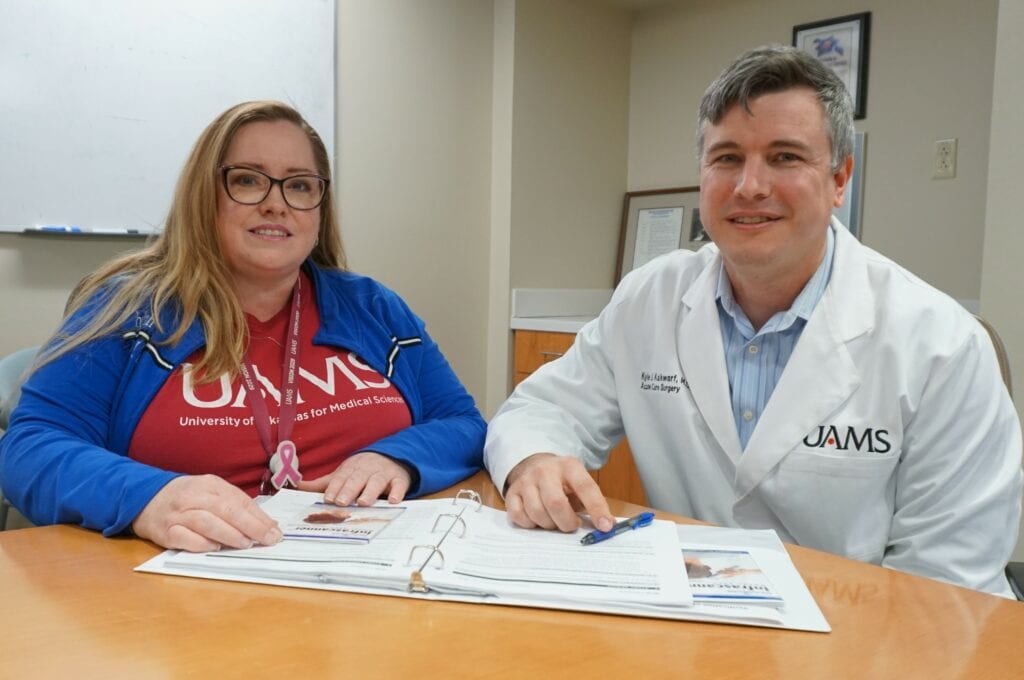
Kyle Kalkwarf, M.D., is assisted on the trial by TRI’s Shellah Rogers, B.S.N., RN, CMSRN, the study’s lead clinical research coordinator.
Kyle Kalkwarf, M.D., is assisted on the trial by TRI’s Shellah Rogers, B.S.N., RN, CMSRN, the study’s lead clinical research coordinator.  

UAMS Principal Investigator: Kyle Kalkwarf, M.D., assistant professor, College of Medicine Department of Surgery, Division of Trauma and Acute Care Surgery

Summary: This multi-site clinical trial involving hospitalized traumatic brain injury patients will test the effectiveness of a non-invasive device (Infrascanner) for detecting the growth of intracranial hematomas.

Significance: The study of this FDA-approved device, which uses near-infrared light to detect bleeding, may lead to earlier diagnosis and improved treatments for traumatic brain injury patients, especially in areas with limited resources, such as rural America or on military deployments

TRI Services: Medicare coverage analysis, study budget development, regulatory and nurse/clinical coordinator support, administration of Clinical Trial Management System, and post-award financial management

Sponsor: University of Alabama at Birmingham

Funding: U.S. Department of Defense

Filed Under: Front, News, Newsroom

The TRIbune Is Here

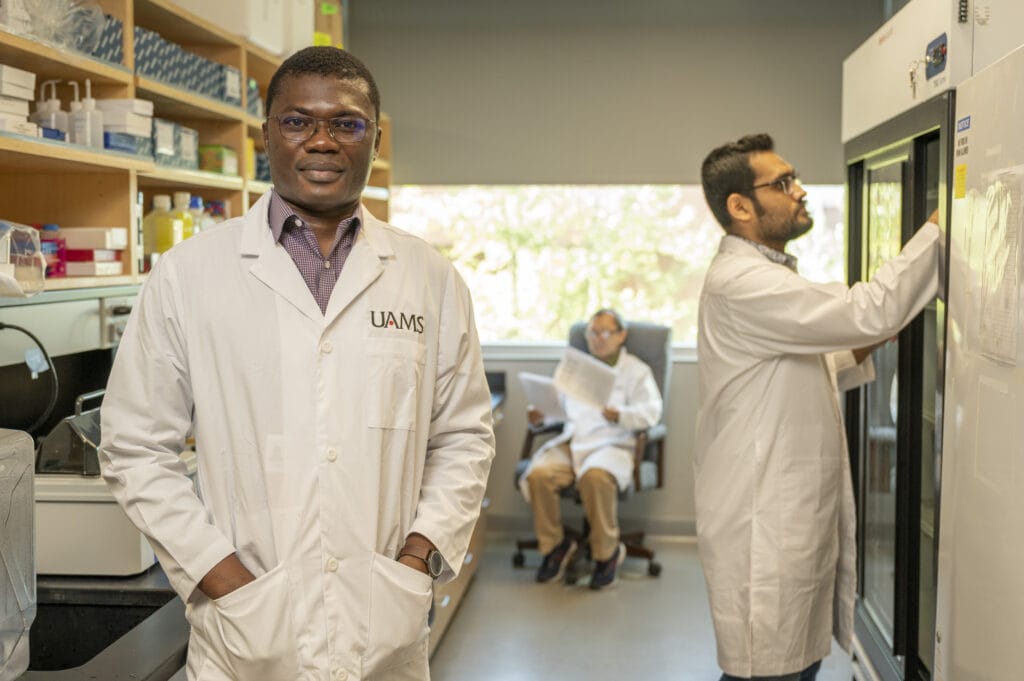
STARs participant Bolni “Marius” Nagalo, Ph.D., here in his lab at the UAMS Winthrop P. Rockefeller Cancer Institute, said the grant-writing program was a “fantastic” experience. Photo by Evan Lewis

In this issue of The TRIbune, we feature the achievements of researchers who participated in our Strategies for Training and Advancing Researchers (STARs) program in fall 2021. Participants described the program as “invaluable” and “fantastic” and have since secured career development awards, supplemental grants and internal funding. In addition:

We highlight Britni Ayers, Ph.D., a former TRI KL2 scholar, who received a $420,750 NIH grant for her research involving pregnant Marshallese women.

We introduce the four community groups selected to TRI’s Community Partners Educated as Arkansas Research Leaders (CPEARL) Program.

And our TRI Study of the Month features Kyle Kalkwarf, M.D., a TRI Implementation Science Scholars Program awardee, for his leadership on a clinical trial involving traumatic brain injury patients.

Read The TRIbune.

Filed Under: Front, News, Newsroom

TRI’s Tracy Thurman Named Clinical Billing Compliance Champion for 2022

TRI's Tracy Thurman (right) received the UAMS Compliance Champion Award from Amy Jones, senior director of UAMS Clinical Billing Compliance.
TRI’s Tracy Thurman (right) received the UAMS Compliance Champion Award from Amy Jones, senior director of UAMS Clinical Billing Compliance.

The UAMS Office of Institutional Compliance recognizes Corporate Compliance and Ethics Week each year during the first week of November. 

This year, Tracy Thurman, B.S., CCRP, clinical research finance manager for the UAMS Translational Research Institute (TRI), is UAMS’ Clinical Billing Compliance Champion. She was selected for going above and beyond in her adherence to compliance and maintaining positive, supportive relationships with compliance office employees and other members of Team UAMS.

Below is the narrative submitted with her nomination:

“Tracy Thurman is the Clinical Research Finance Manager in TRI. Tracy and the TRI team provide vital services for clinical research areas, such as Medicare Coverage Analysis, building budgets, negotiating budgets with sponsors, and reviewing billing charges for clinical research studies out of TRI.

Tracy has an invaluable depth of knowledge in her field and always strives to help ensure that billing for clinical research studies is set up to ensure compliance. Tracy and her fellow team members work with many areas on campus such as the UAMS Billing Offices, the Value Analysis Office and the UAMS Compliance Office.

Tracy is well respected by her peers. She is always kind, professional and respectful. She is one of the many employees in TRI who help to foster compliance in clinical research that allows UAMS to continue to offer ground-breaking clinical research opportunities for our community. UAMS is very fortunate to have Tracy on TEAM UAMS!”

As part of this awareness, recognition, and reinforcement campaign, each division within Compliance selected Team UAMS members who demonstrate outstanding support to UAMS compliance programs.

Read more here about other 2022 Compliance Champions.

Filed Under: Front, News, Newsroom

The October TRIbune Is Here!

In this issue of The TRIbune, we feature an exciting new software program that will simplify TRI grant application processes for researchers, reviewers and our staff. The Apply software program will be available in spring 2023 for six TRI funding opportunities. The program will provide a tool that not only streamlines processes but also ensures that TRI’s funding programs are equitable, fair and transparent.

TRI’s Paul Duguid, MPH, and Carolyn Greene, Ph.D., are leading TRI’s acquisition of the Apply software.

We also highlight our latest cohort of Strategies for Training and Advancing Researchers (STARs) program recipients and the recent national award for Jennifer Vincenzo, Ph.D., which stems from her work as a KL2 Mentored Research Career Development Program scholar.  

Our Study of the Month features Erika Petersen, M.D., a professor of neurosurgery, and her collaborations with Ranu Jung, Ph.D., at the University of Arkansas, Fayetteville Institute for Integrative & Innovative Research (I3R), and UAMS orthopaedic surgeons John Bracey Jr., M.D., and Mark Tait, M.D.

Read The TRIbune.

Filed Under: Front, News, Newsroom

Five UAMS Researchers Receive TRI Pilot Awards

New TRI pilot awardees, clockwise from top left: Stanley Ellis, Ed.D., Susan Emmett, M.D., Megan Smith, Pharm.D., Lindsey Wolf, M.D., and Michael Thomsen, Ph.D.

The UAMS Translational Research Institute has named five UAMS researchers who will receive pilot grants of up to $50,000 each for studies that impact rural health.

The one-year awards went to projects led by researchers in the College of Medicine, College of Pharmacy and Fay W. Boozman College of Public Health. They are: 

Stanley K. Ellis, Ed.D., M.S., associate professor, College of Medicine Department of Obstetrics and Gynecology; director of Education, Institute for Digital Health & Innovation.

Project: School-Based Tele-counseling Feasibility Pilot

Susan Emmett, M.D., MPH, associate professor, College of Medicine Department of Otolaryngology-Head and Neck Surgery, and director of the Center for Hearing Health Equity

Project: Achieving Hearing Health Equity for Rural Children: Optimization of a Novel Mobile Health Tympanometer for Community-Based Hearing Screening

Megan Smith, Pharm.D., BCACP, assistant professor, College of Pharmacy Department of Pharmacy Practice
Project: Evaluation of the Integration of Community Health Workers (CHW) into Rural Community Pharmacies

Michael Thomsen, Ph.D., professor, Governor Sidney S. McMath Chair in Obesity Prevention, director of the Center for the Study of Obesity, Fay W. Boozman College of Public Health

Project: Understanding Rural Disparities in Severe Obesity through the Arkansas Childhood Body Mass Index Panel

Lindsey Wolf, M.D., assistant professor, College of Medicine Department of Surgery, Division of Pediatric Surgery

Project: A Pilot Program to Evaluate the Feasibility of Telemedicine Pediatric Surgical Consultations in Referring Emergency Departments

Filed Under: Front, News, Newsroom

TRI Study of the Month

Sukanthi Kovvuru, M.D., consults with TRI’s Simone Walls, MBA, MPH, CHES, CRS, regulatory specialist for the HEALY ALS Platform Trial.

UAMS Principal Investigator: Sukanthi Kovvuru, M.D., assistant professor, College of Medicine Department of Neurology

Summary: The HEALY ALS Platform Trial is a multi-center, multi-regimen clinical trial evaluating the safety and efficacy of multiple investigational products for the treatment of Amyotrophic Lateral Sclerosis (ALS). UAMS will begin with Regimen E – SLS-005 Trehalose and a matching placebo.

Significance: Researchers hope that the trial can identify a safe drug that will slow ALS’ rate of progression and/or improve ALS symptoms.

TRI Services: Medicare coverage analysis, study budget development, regulatory management, clinical/nurse coordinator and finance support.

Sponsor/Clinical Coordinating Center: Merit Cudkowicz, M.D., Director, Sean M. Healey & AMG Center for ALS at Massachusetts General Hospital

Filed Under: News, Newsroom

TRI Employees Raise Funds, Serve Meals at Our House

Residents of Our House recently enjoyed a lunch and dinner courtesy of employees at the UAMS Translational Research Institute (TRI).

TRI volunteers at lunch were: (left side, front to back) Ladiedra Donahue, Ty Stacey (lead), Lasha Fite, Paul Duguid (lead); (right, front to back) Vallon Williams, Simone Walls, David Avery and Chaz England.

With staff donations totaling almost $900, the TRI Employee Council was able to prepare homemade meals for 30 residents at lunch and 75 residents at dinner. Lunch included oven-baked barbecue chicken sandwiches, baked beans, coleslaw and Rice Krispie treats. The dinner menu was lasagna, fresh salad, garlic bread and homemade fresh baked cookies.

TRI’s Crystal Walter (front), Crystal Sparks and Paul Duguid prepare trays for the evening meal.

Our House’s mission is to empower homeless or near-homeless families and individuals to succeed in the workforce, school, and life through hard work, wise decision-making and active participation in the community.

TRI volunteers provided about 30 meals to Our House residents at lunch and about 75 were served at dinner.
TRI volunteers provided about 30 meals to Our House residents at lunch, and about 75 were served at dinner.

“We are super thankful for organizations like the UAMS Translational Research Institute who come out and help their community in such a big way by serving meals for the residents at Our House,” said Caroline Robbins, Our House development director. “Preparing meals and gathering around a meal table include a lot of components of what building a community around yourself looks like, and we value partners who are willing to take the time to do that with our clients every single month.”

Paul Duguid, MPH, leads the TRI Employee Council, which organized the community service project.

“I’m happy to work where the staff are committed to teamwork and service to our community,” said Duguid, assistant director of Funding Programs. “My TRI colleagues consistently rally around events to give back to those in the community, both on and off campus, and I’m incredibly proud of working shoulder to shoulder to prepare and serve meals at Our House with them.”

TRI volunteers were: Paul Duguid (lead), Ty Stacey (lead), David Avery, Lasha Fite, Chaz England, LaDiedra Donahue, Laura James, M.D., Robin Liston, Crystal Sparks, Simone Walls, Crystal Walter, and Vallon Williams.

Filed Under: Employee Spotlight, News, Newsroom

KL2 Meeting Sparks Junior Investigators’ Collaboration, Three Publications

Maryam Garza, Ph.D., and Tremaine Williams, Ed.D., share a laugh during a recent meeting.

A routine monthly meeting, a comment and a question were the genesis for three publications this year by two TRI KL2 Mentored Research Career Development Program scholars.

Maryam Garza, Ph.D., MPH, MMCi, and Tremaine Williams, Ed.D., who became KL2 scholars in 2021, are co-authors on papers in BMC Medical Research Methodology; Journal of Multimorbidity and Comorbidity; and Journal of the American Medical Informatics Association.

For Garza and Williams, assistant professors in the College of Medicine Department of Biomedical Informatics, their early success speaks to the testimonies they have heard about the power of collaboration and team science.

“As early career investigators and KL2 scholars, we’re trying to carry out our research, write papers and grants, and it’s a lot to get done by yourself,” Garza said. “So collaboration is really helpful to get you out of any holes and elevate the quality of the work. It is also much more enjoyable to not be alone in this work.”

Williams agreed. “When I’ve taken a project as far as I can, I know I can go to Maryam and she will have some questions, suggestions or substantial contributions to guide the direction of the work.”

The two realized the opportunity for collaboration during a regular monthly meeting of the KL2 scholars as Williams gave his status report. He heard Garza say, “Ooh, I didn’t realize how much our worlds intersect.”

Her comment prompted him to ask the group if anyone was interested in collaborating. “Maryam was the first person to say, ‘Yes, I would love to collaborate,’ so it went from there,” he said.

Both are working in the area of data quality, and their worlds intersect at how to streamline processes of getting that data from point A to point B.

Garza’s work is focused on overcoming data-related barriers that slow the search for cures and vaccines.

“Informatics has a critical role to play improving the data pipeline, which will translate to more efficient bench-to-bedside processes,” Garza said. “No one can run clinical trials and leverage the electronic health record if the data doesn’t exist.”

John Arthur, M.D., Ph.D.

Williams’ work has focused on expanding the informatics capacity of the electronic health record to support patients with two or more chronic conditions, referred to as multimorbidity patients.

“These multimorbidity patients are behind the curve because medical care has been traditionally siloed into addressing single chronic diseases, and the data we have is a byproduct of those treatments,” he said. “The informatics infrastructure is lagging. We don’t have, for example, clinical data repositories or places that could support very robust, global clinical and translational research for multimorbidity patients.”

He noted that Garza is working on an emerging data standard called HL7® FHIR® (Fast Healthcare Interoperability Resources 1 ), which defines how health care information can be transferred between information systems regardless of how those systems store it.

Elisabet Borsheim, Ph.D.

“Maryam is going to change the world with the work that she’s doing to enable the use of real world data in real time,” Williams said. “But we can’t apply much of Maryam’s work on the FHIR standards with multimorbidity patients because most health care systems don’t currently have the data infrastructure needed for the management and longitudinal tracking of the compounding of chronic diseases.”

TRI Associate Director John Arthur, M.D., Ph.D., co-director of the KL2 Program, praised Garza and Williams for their enthusiastic collaboration.

“They are setting a great example for their colleagues in the KL2 Program as well as our entire research community,” said Arthur, also chief of the Division of Nephrology in the Department of Internal Medicine. “I am excited by the strength of their work and happy that the KL2 Program became a conduit for their collaboration.”

Williams said the collaboration was enabled in large part because of the tone set by the KL2 Program leaders, Arthur, Elisabet Borsheim, Ph.D., and Carolyn Greene, Ph.D.

Carolyn Greene, Ph.D.

“The environment in the monthly KL2 meetings is very warm, very supportive,” Williams said.

Hoping to capitalize on their efforts, Garza and Williams recently submitted an R01 grant application to the National Institutes of Health. And beyond that, they are dreaming big.

“We are going to grow old together as collaborators,” Garza said, “and who knows, maybe we’ll win the Nobel Prize.” 

Filed Under: News, Newsroom

New Researchers Find Valuable Resources at Research Expo 2022

Veronica Smith, who directs the UAMS Rural Research Network, speaks with Ruiqi Cen, Ph.D., a postdoctoral fellow in the Fay W. Boozman College of Public. Health.
Veronica Smith, who directs the UAMS Rural Research Network, speaks with Ruiqi Cen, Ph.D., a postdoctoral fellow in the Fay W. Boozman College of Public. Health. (Image credit: Bryan Clifton)

Research Expo 2022 arrived at a great time for Lisa Jansen, Ph.D., and more than 100 other researchers wanting to learn about and leverage the numerous research resources available at the University of Arkansas for Medical Sciences (UAMS), Arkansas Children’s Research Institute (ACRI) and the Central Arkansas Veterans Healthcare System (CAVHS).

Lisa Jansen, Ph.D., poses with a selfie frame during the expo.

“I am a new researcher, so I came to the Expo today to learn about all the options and possibilities that are out there,” said Jansen, who joined UAMS in January as an assistant professor in the College of Health Professions Department of Dietetics and Nutrition. “I love being able to directly ask questions to the representatives of these services. It’s better than just clicking on a website, and they were great at helping me understand how their services can benefit my research.”

Sponsored by the UAMS Translational Research Institute and the Division of Research and Innovation, the Research Expo on Sept. 21 promoted at least 47 research services and resources. The late afternoon event included food, beverages and door prizes.

Translational Research Institute Director Laura James, M.D., told the crowd that the event has grown from its origins six years ago to include research resources from UAMS, ACRI and CAVHS.

Nadim Nicolas Ghanem, M.D., visits with Joe Schaffner of the Institute for Digital Health & Innovation.

“I’m thrilled with this turnout,” she said. “It’s great to see everybody here and feel the enthusiasm in this room tonight.”

Shuk-Mei Ho, Ph.D., vice chancellor for the Division of Research and Innovation, said she was also thrilled that so many colleagues participated, noting that UAMS’ faculty, staff and students are hungry for new knowledge and innovations that can improve human health. Successful research projects, she said, require the support of a large group of research administrators.

“They are the heroes behind the frontline. They work tirelessly behind the scenes helping researchers with protocols, submissions, compliance, regulatory affairs, fiscal management, contracts and tech transfer,” Ho said. “They are the bells and whistles of any new research endeavor. Research Expo 2022 was a great event allowing the ‘engines’ to meet the ‘bells and whistles.’”

Zhong Su, Ph.D., talks to Nancy Rusch, Ph.D., and Pam Kahler, representing TRI’s Health Sciences Innovation and Entrepreneurship Training Program for postdoctoral fellows.

Nadim Nicolas Ghanem, M.D., a first-year fellow in the UAMS/Arkansas Children’s Clinical Informatics Fellowship Program, is new to the United States, so having face-to-face conversations with people at the expo was especially valuable, he said.

“Seeing all the available resources for research was great for someone like me coming from abroad,” Ghanem said. “It was a great day to meet new people and to learn more about the different tools I can potentially use in research.”

Zhong Su, Ph.D., MBA, who joined UAMS from the University of Florida in 2021, said the expo was a great way to gain institutional knowledge that he needs as a researcher.

Sharon Sanders, Ph.D., MPH.

“It’s a really good opportunity for people to get all the different aspects of research-related information right away,” said Su, a professor in the College of Medicine Department of Radiation Oncology at the Winthrop P. Rockefeller Cancer Institute. “You can talk to the people directly, quickly, instead of having to dig on the website.”

Su, a medical physicist, said he was happy to learn about the many sources of support, including grant funding opportunities, which he plans to pursue as part of his work with Arkansas’ first Proton Center. Proton therapy is a state-of-the-art technology that serves as an alternative to conventional radiation therapy, using a precisely focused high-energy proton beam to target tumors, often in hard-to-reach areas, with minimum impact of surrounding healthy tissue.

Sharon Sanders, Ph.D., MPH, said the expo is helpful to her role as research program manager at the Center for Childhood Obesity Prevention based at ACRI.

“As a community engagement person, I’m always looking for an opportunity to network with different people,” Sanders said. “The resources represented here at the expo can be helpful for our researchers at the Center for Childhood Obesity Prevention. We want to make sure we have as many resources and tools available to them as possible to make them more successful.”

For example, she said the Translational Research Institute-supported Center for Health Literacy can be a good resource for researchers at her center.

“Like our community engagement program, the Center for Health Literacy emphasizes the importance of communication and making sure that researchers use plain language and avoid jargon,” Sanders said. “We will point our researchers to the Center for Health Literacy because that is a resource that will be very helpful to them.”

Jansen pointed to the Center for Implementation Research and Center for Health Literacy as examples of newly discovered beneficial resources.

“They can help me with clinical trials as I am setting them up to ensure that they go smoothly and the methodology is sound,” Jansen said.

Ghanem said he especially enjoyed talking with representatives of the Translational Research Institute-supported Arkansas Clinical Data Repository and from the Institute for Digital Health & Innovation and BioVentures.

“As a Clinical Informatics fellow, that was more of my domain,” he said. “We can analyze UAMS’ data repositories to find new patterns and hopefully help improve care. And as family physician, I enjoyed playing around with the point of care devices IDHI had to offer while discovering new opportunities to provide care in the digital era.”

“It was also great to connect with the Institutional Review Board representatives,” Ghanem said. “It’s always important to ensure that the process goes smoothly with the IRB. Everyone was really nice, and it was great to connect with them.”

Filed Under: Front, News, Newsroom

  • «Previous Page
  • Page 1
  • Interim pages omitted …
  • Page 10
  • Page 11
  • Page 12
  • Page 13
  • Page 14
  • Interim pages omitted …
  • Page 48
  • Next Page»
Translational Research Institute LogoTranslational Research InstituteTranslational Research Institute
Mailing Address: 4301 West Markham Street, Little Rock, AR 72205
Phone: (501) 686-7000
  • Facebook
  • X
  • Instagram
  • YouTube
  • LinkedIn
  • Pinterest
  • Disclaimer
  • Terms of Use
  • Privacy Statement
  • Legal Notices

© 2026 University of Arkansas for Medical Sciences