• Skip to primary navigation
  • Skip to main content
  • Skip to primary navigation
  • Skip to main content
Choose which site to search.
University of Arkansas for Medical Sciences Logo University of Arkansas for Medical Sciences
Translational Research Institute
  • UAMS Health
  • Jobs
  • Giving
  • About TRI
    • What We Offer
    • Leadership & Governance
    • Staff
    • Cite TRI
    • What is Translational Research?
    • Contact TRI
  • Funding Opportunities
    • Grants
      • Pilot Award Program
      • Consortium of Rural States (CORES) Multi-Institutional Pilot Award Program
      • Team Science Voucher Program
      • Winthrop P. Rockefeller Cancer Institute Rural Research Award Program
    • Scholarships
      • K12 Mentored Research Career Development Scholar Awards Program
      • Health Sciences Innovation and Entrepreneurship Postdoctoral Training Program
      • Implementation Science Scholar Program
      • (STARs) Program – Strategies for Training and Advancing Researchers
      • SMART Program [Master’s in Clinical and Translational Sciences (MS-CTS)]
    • Community
      • Community Based Participatory Research (CBPR) Scholars Program
      • Community Partners Educated as Arkansas Research Leaders (CPEARL) Program
    • Awardee Responsibilities
  • Services & Resources
    • Services
      • Biostatistics, Epidemiology and Research Design (BERD) Consultation
      • Clinical Data Repository (AR-CDR)
      • Comprehensive Informatics Resource Core
      • Mock Study Sections
      • Research Participant Recruitment
      • Research Support: Clinical Trials Innovation Unit (CTIU)
      • Implementation Science Program
      • Research Ethics Consultation
    • Resources
      • ARresearch Registry
      • Center for Health Literacy
      • Data Safety Monitoring
      • Grant Writing & Dissemination
      • UAMS Profiles
      • UAMS Rural Research Network
      • Other Resources
      • COVID-19 Research Guidelines
      • Community Partner Research Training
  • Career Development & Scholarships
    • Scholarship Opportunities
      • K12 Mentored Research Career Development Scholar Awards Program
      • Health Sciences Innovation and Entrepreneurship Postdoctoral Training Program
      • Data Science Scholars Program
      • Implementation Science Scholar Program
      • SMART Program
      • Translational Research Innovations and Partners (TRIP) Program
    • Training & Educational Opportunities
      • innOVATION Seminar Series
      • Path 2 K Program
      • Translational Workforce Development
      • Graduate Certificate in Implementation Science
      • SMART Program [Master’s in Clinical and Translational Sciences (MS-CTS)]
      • Good Clinical Practice Training
    • Didactic Training
  • Community
    • Community Engagement Leadership
    • Community Advisory Board
    • Community Engagement Partners
      • Community Partner Celebration
      • Faith-Academic Initiatives for Transforming Health (FAITH) Network
    • Community Engagement Services
      • Consultations and Technical Assistance
      • Community Review Boards
      • Community Partner Research Training
      • Equipment Library
    • Programs and Funding
      • Community Partners Educated as Arkansas Research Leaders (CPEARL) Program
      • Community Based Participatory Research (CBPR) Scholars Program
      • Community Scientist Academy
    • Toolkits
      • CSA Online Toolkit
      • CPEARL Toolkit
  • Events
    • Research Day
    • Clinical Trials Learning Collaborative
  • Newsroom
  1. University of Arkansas for Medical Sciences
  2. Translational Research Institute
  3. Author: uamsonline
  4. Page 2

uamsonline

The TRIbune Is Here!

The March-April TRIbune highlights an important CTSA collaborative with 66 UAMS faculty taking part. The External Reviewer Exchange Consortium involves nine institutions and enables an efficient network for sharing the workload of pilot grant application reviews.

It is one of the first formalized reviewer exchanges with an online dashboard for streamlining the process.

This issue of the TRIbune also highlights funding awards to researchers as part of new TRI initiatives. These include our Data Scholars, Team Science Vouchers, and Health Sciences and Entrepreneurship (HSIE) Scholars.

And check out the list of publications that received TRI funding or other TRI support.

Read The TRIbune.

Filed Under: Front, News, Newsroom

$765,789 Grant to Focus on Advanced Analytics to Improve Health Outcomes

A five-year, $765,789 grant to the University of Arkansas for Medical Sciences ((UAMS) will support teaching graduate students advanced analytics to address health outcomes.

The grant, from the National Institute on Minority Health and Health Disparities (NIMHD), establishes the T32 Pre-doctoral Research Training Program.

Mick Tilford, Ph.D., professor and chair of the Department of Health Policy and Management in the UAMS College of Public Health, led the grant application with support from the UAMS Translational Research Institute.

He and Jonathan Bona, Ph.D., will co-direct the T32 program, which will select two graduate students per year. Bona is an assistant professor in the UAMS College of Medicine Department of Biomedical Informatics.

Tilford believes that developing the skills needed to analyze large sets of data by computer will lead to a better understanding of the complex relationships that determine health outcomes.

With multidisciplinary, team-based science as part of the T32 training, Tilford said the program will produce a new generation of researchers to address health outcomes.

“This is the only NIMHD T32 research training program in the state,” he said. “It will serve as a model for improving disparate population health outcomes in the state, region and nation.”

The T32 training will include collaborations with the Translational Research Institute, Regional Campuses and Institute for Digital Health & Innovation at UAMS, and the Institute for Advanced Data Analytics at the University of Arkansas, Fayetteville.

The Translational Research Institute is supported by a Clinical and Translational Science Award (CTSA) from the National Center for Advancing Translational Sciences of the National Institutes of Health, grant UL1 TR003107.

Filed Under: Front, News, Newsroom

TRI Names Four Entrepreneurship Scholars

The UAMS Translational Research Institute Health Sciences Innovation and Entrepreneurship (HSIE) Postdoctoral

Training Program has named four postdoctoral scholars for its class of 2022. The scholars, selected in a competitive application process, will begin two years of mentored entrepreneurship training July 1.

The HSIE Postdoctoral Scholars – all from the UAMS College of Medicine – their mentors and project plans are:

Emilie Darrigues, Ph.D., will be mentored by Analiz Rodriguez, M.D., Ph.D., in the Department of Neurosurgery. Her research project will focus on improving circulating-tumor DNA detection in glioblastoma liquid biopsies and devising therapeutic nanoparticles as a strategy to specifically target glioblastoma.

[twocolumn col1=”%0A%3Cstrong%3EShana%20Owens%2C%20Ph.D.%20Candidate%2C%3C%2Fstrong%3E%20will%20be%20mentored%20by%20%3Ca%20href%3D%22https%3A%2F%2Fuams-triprofiles.uams.edu%2Fprofiles%2Fprofile%2F127647%22%3ECraig%20Forrest%3C%2Fa%3E%2C%20Ph.D.%2C%20in%20the%20Department%20of%20Microbiology%20and%20Immunology.%C2%A0%20She%20plans%20to%20develop%20an%20improved%20gammaherpesvirus%20(GHV)%20vaccine.%0A” col2=”%5Bcaption%20id%3D%22attachment_10166%22%20align%3D%22alignright%22%20width%3D%22150%22%5D%3Cimg%20class%3D%22wp-image-10166%20size-mug-shot%22%20src%3D%22https%3A%2F%2Ftri.uams.edu%2Fwp-content%2Fuploads%2Fsites%2F116%2F2020%2F03%2FShana-Owens-crop-150×250.jpg%22%20alt%3D%22Shana%20Owens%22%20width%3D%22150%22%20height%3D%22250%22%20%2F%3E%20Shana%20Owens%5B%2Fcaption%5D%0A” ratio=”twothirds-third” /]

[twocolumn col1=”%0A%0A%3Cstrong%3EJohn%20Sherrill%2C%20M.P.H.%2C%20Ph.D.%20Candidate%2C%3C%2Fstrong%3E%20will%20be%20mentored%20by%20%3Ca%20href%3D%22https%3A%2F%2Fuams-triprofiles.uams.edu%2Fprofiles%2Fprofile%2F1588652%22%3EDavid%20Bumpass%3C%2Fa%3E%2C%20M.D.%20in%20the%20Department%20of%20Orthopaedic%20Surgery.%20He%20proposes%20to%20design%20a%20customized%203D%20printed%20stabilizer%20for%20orthopaedic%20applications.” col2=”%5Bcaption%20id%3D%22attachment_10167%22%20align%3D%22alignright%22%20width%3D%22150%22%5D%3Cimg%20class%3D%22wp-image-10167%20size-mug-shot%22%20src%3D%22https%3A%2F%2Ftri.uams.edu%2Fwp-content%2Fuploads%2Fsites%2F116%2F2020%2F03%2FJohn_Sherrill-crop-150×250.jpg%22%20alt%3D%22John%20Sherrill%22%20width%3D%22150%22%20height%3D%22250%22%20%2F%3E%20John%20Sherrill%5B%2Fcaption%5D” ratio=”twothirds-third” /]

[twocolumn col1=”%3Cstrong%3E%3Ca%20href%3D%22https%3A%2F%2Fuams-triprofiles.uams.edu%2Fprofiles%2Fprofile%2F5219509%22%3EZachary%20Waldrip%3C%2Fa%3E%2C%20Ph.D.%2C%3C%2Fstrong%3E%20will%20be%20mentored%20by%20%3Ca%20href%3D%22https%3A%2F%2Fuams-triprofiles.uams.edu%2Fprofiles%2Fprofile%2F2445868%22%3EMarie%20Burdine%3C%2Fa%3E%2C%20Ph.D.%2C%20in%20the%20Department%20of%20Surgery%2C%20Division%20of%20Surgical%20Research%2C%20at%20Arkansas%20Children%E2%80%99s%20Research%20Institute.%20He%20will%20continue%20research%20focused%20on%20targeting%20specific%20kinases%20to%20improve%20transplant%20immunotherapy.” col2=”%5Bcaption%20id%3D%22attachment_10168%22%20align%3D%22alignright%22%20width%3D%22150%22%5D%3Cimg%20class%3D%22wp-image-10168%20size-mug-shot%22%20src%3D%22https%3A%2F%2Ftri.uams.edu%2Fwp-content%2Fuploads%2Fsites%2F116%2F2020%2F03%2FZachary-Waldrip-crop-150×250.jpg%22%20alt%3D%22Zachary%20Waldrip%22%20width%3D%22150%22%20height%3D%22250%22%20%2F%3E%20Zachary%20Waldrip%2C%20Ph.D.%5B%2Fcaption%5D%0A” ratio=”twothirds-third” /]

The program, which includes stipends up to $55,000 per year, is designed to help promising scientists more quickly move their discoveries into everyday practice by teaching them commercialization and team science skills. It is supported by the NRSA Training Core (TL1) component of the UAMS Clinical and Translational Science Award, grant TL1 TR003109.

“Our program goal is to accelerate biomedical discoveries to improve health,” said Nancy Rusch, Ph.D., who directs the program for the UAMS Translational Research Institute. “I am very enthusiastic about this group of scholars. They all have exceptional talent and they are pursuing projects that can make a real impact on health outcomes.”

The HSIE Postdoctoral Training Program provides support annually for eight postdoctoral fellows (four in each year of the two-year program). The program is a partnership between the UAMS Translational Research Institute and the Entrepreneurship Graduate Program in the Sam M. Walton College of Business at the University of Arkansas, Fayetteville. In addition to Rusch, professor and chair of the Department of Pharmacology and Toxicology; the program’s leadership team includes Kevin Sexton, M.D., assistant professor of the Department of Surgery, and Nancy Gray, Ph.D., president of BioVentures and professor in the Department of Pharmacology and Toxicology. Pamela Kahler is program manager.

The first group of HSIE Scholars named in July 2019 are: Melody Greer, Ph.D. (mentor, Fred Prior, Ph.D.), Samir Jenkins, Ph.D. (mentor, Robert Griffin, Ph.D.), Ashta Malhotra, Ph.D. (mentors, Amanda Stolarz, Pharm.D., Ph.D.; and Jawahar Mehta, M.D., Ph.D.), and Aaron Storey, Ph.D. (mentor, Rick Edmondson, Ph.D.).

Filed Under: Front, News, Newsroom

TRI Announces Inaugural Class of Data Scholars

The Translational Research Institute (TRI) has selected three Data Scholars for its inaugural 2020-21 class.

TRI’s Data Scholars Program supports UAMS faculty in learning and applying the principles and methods of data analytics and data sciences to inform clinical practice and policy. Scholars will pursue formal course work in addition to mentoring during their data-driven research project.

The scholars and their project titles are:

Nishank Jain, M.D., M.P.H., Assistant Professor, College of Medicine, “Predictors of Bleeding in Patients on Chronic Dialysis on P2Y12 inhibitors (PREDICT BLEED study)”

Margarete Kulik, Ph.D., M.Sc., M.A., Assistant Professor, College of Public Health, “Using (Arkansas) All-Payer Claims Data to examine utilization and prescription patterns of tobacco cessation treatments among Medicaid enrollees in Arkansas”

Yasir Rahmatallah, Ph.D., Assistant Professor, College of Medicine, “Temporal trajectory analysis promotes data-driven knowledge extraction and identifies critical intervention points to disrupt disease progression pathways”

“We had a diverse, competitive pool of 10 applicants, and I am very excited about the three who were chosen,” said Brad Martin, Pharm.D., Ph.D., a professor in the UAMS College of Pharmacy who led the launch of the program for TRI.

A study section (group) of seven UAMS faculty reviewers selected the scholars.

The data scholars will receive 20% salary support and reimbursement for tuition and fees up to $5,000 per year starting July 1, 2020. They will also receive close mentoring from UAMS TRI faculty and staff in developing their research projects using existing UAMS data resources such as the UAMS Arkansas Clinical Data Repository (AR-CDR), LifeLink, Arkansas All-Payer Claims Database, Healthcare Cost and Utilization Project or Veterans Administration data.

The program is supported by the UAMS Translational Research Institute and its Clinical and Translational Science Award, grant TL1 TR003109.

Filed Under: Front, News, Newsroom

Diet, Cancer Radiation Finding Earns Best Paper for TRI KL2 Scholar

UAMS Translational Research Institute (TRI) KL2 Scholar Isabelle Racine Miousse, Ph.D., is the lead author on a publication selected as the best research paper in the March issue of the American Journal of Physiology – Gastrointestinal and Liver Physiology.

The selection was announced by the American Physiological Society APSselect.

Miousse is an assistant professor in the Department of Biochemistry and Molecular Biology in the UAMS College of Medicine. The title of her paper is “Methionine dietary supplementation potentiates ionizing radiation-induced gastrointestinal syndrome.” Its co-authors are Laura E. Ewing, M.S., Charles M. Skinner, B.S., Rupak Pathak, Ph.D., Sarita Garg, Ph.D., Kristy R. Kutanzi, Ph.D., Stepan Melnyk, Ph.D., Martin Hauer-Jensen, M.D., Ph.D., and Igor Koturbash, M.D., Ph.D., senior author.

The team found that in mice, high levels of the amino acid methionine in the diet increased the amount of damage to the gut caused by radiation. It suggests that a diet high in methionine (found in meat, fish and dairy), such as a typical Western diet, may worsen gastrointestinal side effects from radiation therapy. This, in turn, may prevent cancer patients from receiving the most effective doses of radiation therapy.

The KL2 Mentored Research Career Development Award Program is supporting Miousse’s research in improving survival in patients with metastatic melanoma by exploiting cancer cells’ dependence on methionine. KL2 scholars receive two years of research support, including 75 percent salary support and $25,000 per year for research, tuition, travel and education materials in support of the scholar’s career development plan.

Filed Under: Front, News, Newsroom

TRI Offers CBPR Scholars Program with Pilot Funding Opportunities

The Translational Research Institute (TRI) is looking for researchers interested in partnering with community organizations and attending a Community Based Participatory Research Training Program.

CBPR is a collaborative approach to research that equitably involves all partners in the research process and recognizes the unique strengths that each brings.

Researchers who are interested but need help identifying a community partner will receive assistance from the TRI Community Engagement Team.

Interested researchers should fill out the brief Interest Form here: https://bit.ly/2T1fI0K.

The deadline for submitting the Interest Form is Monday, March 30. TRI will release a Request for Proposals on Wednesday, July 1.

The researchers/community partners selected as CBPR Scholars will be invited to apply for TRI pilot awards earmarked for the program. The CBPR Scholars Program will begin in January 2021.

View flyer.

Filed Under: Front, News, Newsroom

UAMS Researchers Have COVID-19’s ‘Fingerprint’

Coronavirus Disease 2019 (COVID-19) has the attention of biomedical researchers across the globe, including at UAMS.

Researchers at the UAMS Arkansas Center for Genomic Epidemiology & Medicine (ArC-GEM) are applying their comparative genomic analysis and sequencing prowess to the disease. The ArC-GEM team has also studied the Ebola virus, Zika virus, and the mumps outbreak in Northwest Arkansas.

Under the direction of David Ussery, Ph.D., ArC-GEM is known for its groundbreaking research, particularly with portable gene sequencing devices that can rapidly diagnose pathogenic diseases like COVID-19. Ussery also has a national profile, working with U.S. health leaders to address hurdles that prevent use of the portable devices in real-world settings.

Visanu Wanchai
Visanu Wanchai

With its sequencing expertise and computing power, the team has a unique ability to dig into coronavirus’ makeup. One of Ussery’s Ph.D. students, Visanu Wanchai, has been mining genomic sequences of coronaviruses from the National Center for Biotechnology Information (NCBI) and other sources. The sequence of coronavirus samples collected from all over the world are stored in databases, including NCBI, which is part of the U.S. National Library of Medicine, a branch of the National Institutes of Health.

Wanchai has created a dendrogram, which is akin to a family tree, for a wide-ranging set of 81 coronaviruses, including samples of COVID-19 from patients in the United States and other countries.

Wanchai downloaded more than 30,000 coronavirus genomes, checked them for genome quality, and sorted them into major groups, representing all of the major Coronavirus clades (groups that evolved from a common ancestor). He produced the dendrogram after “cleaning” the data, which meant discarding about two-thirds of incomplete or mislabeled genomes. He was able to create the dendrogram in just hours, using high-throughput computing made possible by UAMS’ 2017 investment in a $3.5 million super computer.

“Only a few years ago, it would have taken months to analyze this data,” said Ussery, who holds the Helen Adams & Arkansas Research Alliance Endowed Chair in Biomedical Informatics.

Shown in seven PowerPoint slides, the dendrogram includes the date and country where the viruses were collected, as well as its human and animal hosts. It also includes the viruses’ family, genus and subgenus. The work provides a context for the coronaviruses that will inform efforts to monitor the virus and help with rapid detection going forward.

Ussery also noted that Wanchai’s dendrogram shows COVID-19 almost certainly came from bats, confirming other scientists’ findings that debunk conspiracy theories about its origin. This image taken from the dendrogram shows that the closest relative to COVID-19’s human strain comes from bats. It also shows variations of the coronavirus that cause the common cold.

“We’re looking at the big picture here, not just COVID-19,” Ussery said. “The COVID-19 that we see in the United States and in South Korea and Italy – it’s all the same virus, and you can tell that from the genome sequence – its fingerprint.  There are only one or two nucleotides that have changed so far in the outbreak.”

In 2019, using hand-held genetic sequencing flow-cell devices, Ussery’s team was the first to demonstrate a new technique that allowed detection of six different human RNA viruses, mixed in the same sample, by directly sequencing the RNA viral genomes. It marked an important step toward rapid diagnosis of viruses in real-world settings, including rural areas. While a significant proof of principal, the early-stage research will need more development before health workers can take human tissue samples and use the devices to diagnose viruses.

“Currently, large amounts of virus are needed, but in principle, since this technology is based on single-molecule sequencing, only tiny amounts from a clinical sample might be enough to be detected,” Ussery said. “The portability and low cost makes this an exciting possibility for rural health settings.”

One of the primary roadblocks is a lack of quality and safety standards for using the devices in an actual outbreak. Ussery recently presented on the issue to the National Institute of Standards and Technology and the U.S. Food and Drug Administration. A summary of his presentation appears in a report in the February 2020 journal Biologicals.

“There is a need for being able to rapidly go from a sequence to the nearest neighbor in the sequence databases, and for being able to interpret what the organism is,” Ussery said. “There are many ways that this can go wrong, and it’s important to have a reliable, robust, ‘idiot-proof’ and simple method for quickly knowing what the virus is, and to be able to keep track and monitor outbreaks.”

Established just three years ago, UAMS ArC-GEM’s team has already published more than 100 articles on its work, Ussery said. Congress’ recent approval of more than $8 billion to address COVID-19, including $3 billion for research, is an opportunity for the ArC-GEM team, he said. Additional funding would allow the team to further its development of tools for monitoring and tracking pathogen outbreaks.

Filed Under: Front, News, Newsroom

Researchers Invited to fastPACE Course to Learn Basics of Biomedical Commercialization

Arkansas clinicians, researchers, and postdoctoral students are invited to attend a free course teaching the fundamentals of biomedical commercialization April 3 – May 1, 2020.

The fastPACE course is designed for the busy biomedical academician with an early-stage project. It blends in-person and online education to help faculty, researchers and clinicians learn the

Marie Burdine, Ph.D.

basics of biomedical commercialization and prepare a successful business case for funding and developing partnerships.

The deadline for registering is March 15. Applications may be submitted at: https://bioventures.uams.edu/fastpace/.

The course is offered by BioVentures and the UAMS Translational Research Institute. It was  developed by FastForward Medical Innovations at the University of Michigan.

As a project-based course, participants must enroll with at least one other team member but may enroll their entire team of collaborators, including students. The course features an expert interdisciplinary team from academia and industry. Project teams are divided into educational tracks and assigned a teaching team member to maximize their mentorship opportunities.

More than 70 project teams have graduated from fastPACE and used their experience to secure additional funding, find collaborators, submit publications and conduct additional research.

UAMS’ Marie Burdine, Ph.D., a graduate of the course, said it taught her the process for commercializing her research team’s idea.

Nancy Gray, Ph.D.
Nancy Gray, Ph.D.

“We didn’t know the channels to take, what the patent process was like or if this was even a good idea,” Burdine said. “We learned how to do market research and got great feedback on how to target more people to generate more revenue.”

“During our first two fastPACE courses, participants learned how to develop a successful business case to secure funding and attract collaborators,” said Nancy Gray, Ph.D., BioVentures director. “They also were able to determine the commercial viability of their innovation and use the course to expand their network of innovation partners. We’re looking forward to building on that success again in 2020.”

For more information, email Nancy Gray at nmgray@uams.edu or submit an application at https://bioventures.uams.edu/fastpace/.

Filed Under: Front, News, Newsroom

Mentors, New and Veteran, Find Value in TRI Workshop

Erin Mannen, Ph.D., has been a faculty member for just two years, and yet she is mentoring medical students, residents, postdoctoral fellows, a PhD student and a

Erin Mannen, Ph.D., said the mentor training was time well spent. (Mark Mathews photo)

summer engineering intern.

“I’m mentoring a lot of different folks,” she said. “And as a new faculty, I feel like I need a lot of mentoring for myself.”

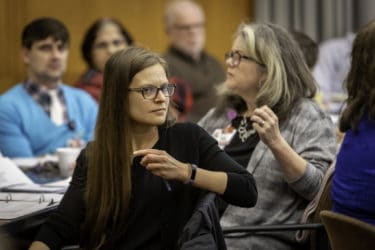
That led Mannen to join more than 30 UAMS faculty members from all five colleges for the TRI-sponsored Mentoring Matters training workshop in January.

It was time well spent, she said.

“The takeaway for me was that mentoring is a lot about just building relationships, and even though I’m a young faculty, I still have a lot to offer as a mentor to these different folks at different levels in their own schooling or career,” she said.

Tom Chung, Ph.D., said the course would be helpful to any mentor, regardless of experience.

“It’s a good way for mentors to review their own habits, so to speak,” he said. “It’s a good refreshment opportunity.”

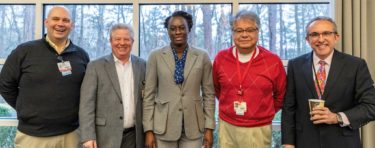
Beatrice Boateng, Ph.D., (center) TRI director of evaluation, led the evidence-based training. She was joined by (l-r), Kevin Sexton, M.D., Mick Tilford, Ph.D., Reza Hakkak, Ph.D., and Erick Messias, M.D., Ph.D. (Mark Mathews photo)
Beatrice Boateng, Ph.D., (center) TRI director of evaluation, led the evidence-based training. She was joined by (l-r), Kevin Sexton, M.D., Mick
Tilford, Ph.D., Reza Hakkak, Ph.D., and Erick Messias, M.D., Ph.D. (Mark Mathews photo)

Most of the participants were junior faculty with 1-5 years of mentoring experience, according to a report based on feedback from the participants.

Comments provided anonymously by participants included:

“The workshop was great and full of lots of great discussions. Please continue to give others this opportunity.”

“The most valuable take to me is the personal experience and knowledge shared by the senior faculty.”

Praise for Erick Messias, M.D., Ph.D., one of the mentor trainers: “His insight, experience and ability to deliver knowledge is amazing. It was a pleasure to listen and learn from him.”

The knowledge gained from the workshop also led participants to raise their self-assessed mentoring competency scores based on five mentoring skills: maintaining effective communication; aligning expectations; assessing understanding; fostering independence; and promoting professional development.

View the gallery of photos from this event.

Filed Under: Front, News, Newsroom

The TRIbune Is Here!

In the latest TRIbune newsletter, the UAMS Translational Research Institute (TRI) is excited to report about new possibilities for your research. In partnership with the Arkansas Children’s Research Institute (ACRI), TRI is offering free consultations for researchers who may be interested in expanding their studies to other research institutions. The opportunity is being made available through the Trial Innovation Network, which serves academic medical centers like UAMS that are supported by the national Clinical and Translational Science Awards (CTSA) Program.
The TRIbune also highlights our new Community Partners Educated as Arkansas Research Leaders (CPEARL) program, our Study of the Month featuring Sanjeeva Onteddu, M.D., and our recent, successful Mentoring Matters Workshop.

Read The TRIbune.

Filed Under: Front, News, Newsroom

  • «Previous Page
  • Page 1
  • Page 2
  • Page 3
  • Page 4
  • Interim pages omitted …
  • Page 30
  • Next Page»
Translational Research Institute LogoTranslational Research InstituteTranslational Research Institute
Mailing Address: 4301 West Markham Street, Little Rock, AR 72205
Phone: (501) 686-7000
  • Facebook
  • X
  • Instagram
  • YouTube
  • LinkedIn
  • Pinterest
  • Disclaimer
  • Terms of Use
  • Privacy Statement
  • Legal Notices

© 2026 University of Arkansas for Medical Sciences