• Skip to primary navigation
  • Skip to main content
  • Skip to primary navigation
  • Skip to main content
Choose which site to search.
University of Arkansas for Medical Sciences Logo University of Arkansas for Medical Sciences
Translational Research Institute
  • UAMS Health
  • Jobs
  • Giving
  • About TRI
    • What We Offer
    • Leadership & Governance
    • Staff
    • Cite TRI
    • What is Translational Research?
    • Contact TRI
  • Funding Opportunities
    • Grants
      • Pilot Award Program
      • Consortium of Rural States (CORES) Multi-Institutional Pilot Award Program
      • Team Science Voucher Program
      • Winthrop P. Rockefeller Cancer Institute Rural Research Award Program
    • Scholarships
      • K12 Mentored Research Career Development Scholar Awards Program
      • Health Sciences Innovation and Entrepreneurship Postdoctoral Training Program
      • Implementation Science Scholar Program
      • (STARs) Program – Strategies for Training and Advancing Researchers
      • SMART Program [Master’s in Clinical and Translational Sciences (MS-CTS)]
    • Community
      • Community Based Participatory Research (CBPR) Scholars Program
      • Community Partners Educated as Arkansas Research Leaders (CPEARL) Program
    • Awardee Responsibilities
  • Services & Resources
    • Services
      • Biostatistics, Epidemiology and Research Design (BERD) Consultation
      • Clinical Data Repository (AR-CDR)
      • Comprehensive Informatics Resource Core (CIRC)
      • Mock Study Sections
      • Research Participant Recruitment
      • Research Support: Clinical Trials Innovation Unit (CTIU)
      • Implementation Science Program
      • Research Ethics Consultation
    • Resources
      • ARresearch Registry
      • Center for Health Literacy
      • Data Safety Monitoring
      • Grant Writing & Dissemination
      • UAMS Profiles
      • UAMS Rural Research Network
      • Other Resources
      • COVID-19 Research Guidelines
      • Community Partner Research Training
  • Career Development & Scholarships
    • Scholarship Opportunities
      • K12 Mentored Research Career Development Scholar Awards Program
      • Health Sciences Innovation and Entrepreneurship Postdoctoral Training Program
      • Data Science Scholars Program
      • Implementation Science Scholar Program
      • SMART Program
      • Translational Research Innovations and Partners (TRIP) Program
    • Training & Educational Opportunities
      • innOVATION Seminar Series
      • Path 2 K Program
      • Translational Workforce Development
      • Graduate Certificate in Implementation Science
      • SMART Program [Master’s in Clinical and Translational Sciences (MS-CTS)]
      • Good Clinical Practice Training
    • Didactic Training
  • Community
    • Community Engagement Leadership
    • Community Advisory Board
    • Community Engagement Partners
      • Community Partner Celebration
      • Faith-Academic Initiatives for Transforming Health (FAITH) Network
    • Community Engagement Services
      • Consultations and Technical Assistance
      • Community Review Boards
      • Community Partner Research Training
      • Equipment Library
    • Programs and Funding
      • Community Partners Educated as Arkansas Research Leaders (CPEARL) Program
      • Community Based Participatory Research (CBPR) Scholars Program
      • Community Scientist Academy
    • Toolkits
      • CSA Online Toolkit
      • CPEARL Toolkit
  • Events
    • Research Day
    • Clinical Trials Learning Collaborative
  • Newsroom
  1. University of Arkansas for Medical Sciences
  2. Translational Research Institute
  3. Services and Resources
  4. TRI Services
  5. Research Support: Clinical Trials Innovation Unit (CTIU)
  6. Study Prep and Planning

Study Prep and Planning

The trial start-up process at an academic medical center like UAMS can be a complex process.  The Clinical Trials Innovation Unit (CTIU) can help investigators navigate the steps.  To support an efficient start-up process, the CTIU offers investigators a well organized team-based approach. This approach serves as a systematic means to coordinate the work of multiple experts simultaneously working on the same goal.  This team driven approach relies heavily on common work sharing tools, teamwork, communication, and accountability. 

The CTIU staff have expertise in feasibility analyses, protocol development management, Medicare coverage analyses, budget development and negotiations, regulatory management, study coordinator and nursing support.   The CTIU also works collaboratively with other groups on campus, such as attorneys for research contracts and institutional compliance offices as well as coordinates protocol submissions to central and local institutional review boards (IRBs).

Get Started

Meet with a CTIU Project Manager about beginning the trial start-up process.

Contact Us

Accessing Feasibility

Prior to starting an industry-sponsored study, the investigator and/or their department should evaluate the study on the basis of the research interests of the individual investigator and the perceived availability of research participants.  Another part of this evaluation should include the administrative feasibility of conducting each trial.

The (CTIU) recommends using the Feasibility and Study Planning Guide to assess these questions and all other applicable sections for study feasibility. 

Trial sponsors typically request their own feasibility questionnaires after a confidentially agreement is executed. These questionnaires help  sponsors decide on site selections and will include questions about the study team’s experience, potential participants, facilities, and study start-up timelines.  A CTIU Project Manager is available to help answer feasibility questionnaires from trial sponsors.

Pre-Study Visits (PSV)

After the CDA is signed and a feasible assessment is started a pre-study visit (PSV) also know as a qualification visit or site selection visit may be required by the sponsor.  A sponsor may use a pre-study visit to determine if a) the site is adequate, b) the investigator and research team are motivated, experienced, and capable of conducting the clinical trial, and c) if access to the patient population is adequate.  The principal investigator is required to attend at least a portion of this visit.    The sponsor may request a tour of research facilities and present the protocol for questions from the study team during this visit.

Site Initiation Visits (SIV)

Most sponsors will require a site initiation visit (SIV). The purpose of this visit is to prepare a research site and get them ready to conduct the study. This occurs prior to participant recruitment.  The principal investigator must attend this visit and it is strongly recommended that all of the research team also attend. During this visit the research team will receive training on the study protocol design. Responsibilities regarding study procedures, regulations and documentation of study activities are discussed to ensure agreement and understanding. The sponsor’s representative may answer any of the study team’s questions at this time.

CTIU’s Clinical Research Team offers support to help investigators schedule and prepare for these visits and will assist them throughout each visit.

The Trial Start-up Process Overview

The CTIU overall timeline goal is 90 days from the time all start-up documents are received to an executed contract.  The budget will be negotiated and agreed upon before the consent will be edited. Once the consent and budget are agreed upon, contract negotiation will begin.  Submission to the IRB can be in parallel to the contract negotiation. The CTIU can provide investigators access to the team members who expertly navigate the steps. 
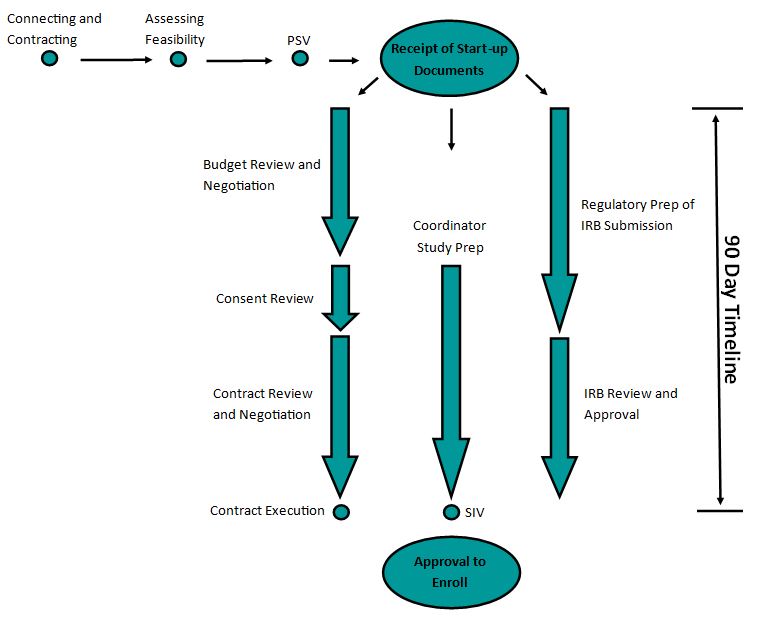
Flow chart of start-up process. 90-day timeline
Translational Research Institute LogoTranslational Research InstituteTranslational Research Institute
Mailing Address: 4301 West Markham Street, Little Rock, AR 72205
Phone: (501) 686-7000
  • Facebook
  • X
  • Instagram
  • YouTube
  • LinkedIn
  • Pinterest
  • Disclaimer
  • Terms of Use
  • Privacy Statement
  • Legal Notices

© 2026 University of Arkansas for Medical Sciences