• Skip to primary navigation
  • Skip to main content
  • Skip to primary navigation
  • Skip to main content
Choose which site to search.
University of Arkansas for Medical Sciences Logo University of Arkansas for Medical Sciences
Translational Research Institute
  • UAMS Health
  • Jobs
  • Giving
  • About TRI
    • What We Offer
    • Leadership & Governance
    • Staff
    • Cite TRI
    • What is Translational Research?
    • Contact TRI
  • Funding Opportunities
    • Grants
      • Pilot Award Program
      • Consortium of Rural States (CORES) Multi-Institutional Pilot Award Program
      • Team Science Voucher Program
      • Winthrop P. Rockefeller Cancer Institute Rural Research Award Program
    • Scholarships
      • K12 Mentored Research Career Development Scholar Awards Program
      • Health Sciences Innovation and Entrepreneurship Postdoctoral Training Program
      • Implementation Science Scholar Program
      • (STARs) Program – Strategies for Training and Advancing Researchers
      • SMART Program [Master’s in Clinical and Translational Sciences (MS-CTS)]
    • Community
      • Community Based Participatory Research (CBPR) Scholars Program
      • Community Partners Educated as Arkansas Research Leaders (CPEARL) Program
    • Awardee Responsibilities
  • Services & Resources
    • Services
      • Biostatistics, Epidemiology and Research Design (BERD) Consultation
      • Clinical Data Repository (AR-CDR)
      • Comprehensive Informatics Resource Core (CIRC)
      • Mock Study Sections
      • Research Participant Recruitment
      • Research Support: Clinical Trials Innovation Unit (CTIU)
      • Implementation Science Program
      • Research Ethics Consultation
    • Resources
      • ARresearch Registry
      • Center for Health Literacy
      • Data Safety Monitoring
      • Grant Writing & Dissemination
      • UAMS Profiles
      • UAMS Rural Research Network
      • Other Resources
      • COVID-19 Research Guidelines
      • Community Partner Research Training
  • Career Development & Scholarships
    • Scholarship Opportunities
      • K12 Mentored Research Career Development Scholar Awards Program
      • Health Sciences Innovation and Entrepreneurship Postdoctoral Training Program
      • Data Science Scholars Program
      • Implementation Science Scholar Program
      • SMART Program
      • Translational Research Innovations and Partners (TRIP) Program
    • Training & Educational Opportunities
      • innOVATION Seminar Series
      • Path 2 K Program
      • Translational Workforce Development
      • Graduate Certificate in Implementation Science
      • SMART Program [Master’s in Clinical and Translational Sciences (MS-CTS)]
      • Good Clinical Practice Training
    • Didactic Training
  • Community
    • Community Engagement Leadership
    • Community Advisory Board
    • Community Engagement Partners
      • Community Partner Celebration
      • Faith-Academic Initiatives for Transforming Health (FAITH) Network
    • Community Engagement Services
      • Consultations and Technical Assistance
      • Community Review Boards
      • Community Partner Research Training
      • Equipment Library
    • Programs and Funding
      • Community Partners Educated as Arkansas Research Leaders (CPEARL) Program
      • Community Based Participatory Research (CBPR) Scholars Program
      • Community Scientist Academy
    • Toolkits
      • CSA Online Toolkit
      • CPEARL Toolkit
  • Events
    • Research Day
    • Clinical Trials Learning Collaborative
  • Newsroom
  1. University of Arkansas for Medical Sciences
  2. Translational Research Institute
  3. Novel Study Addresses Patient-Provider Conflict

Novel Study Addresses Patient-Provider Conflict

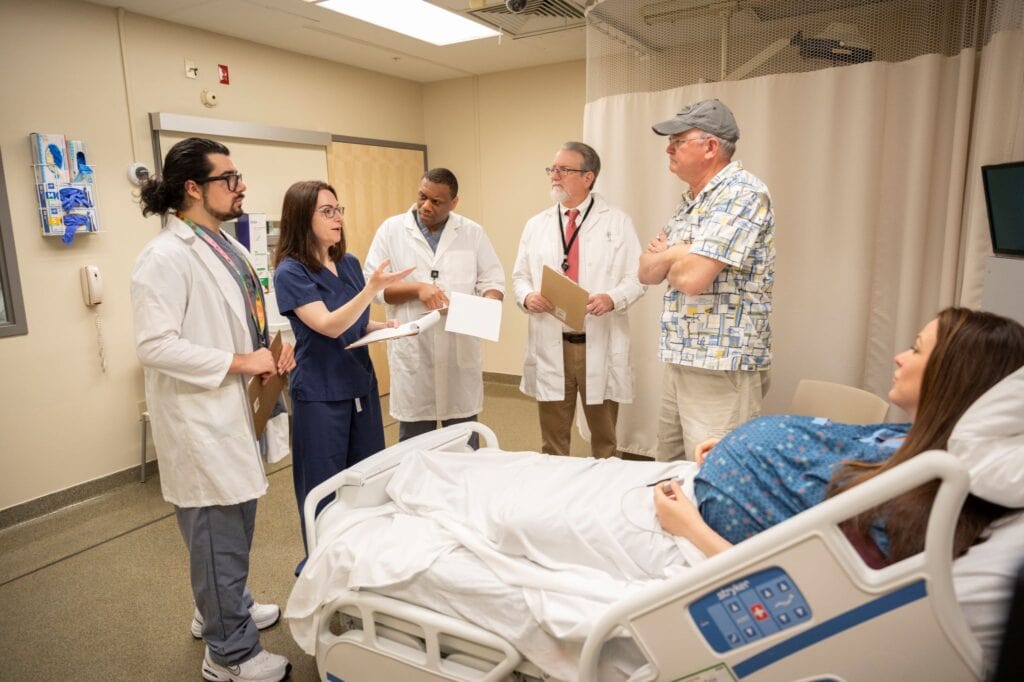
As part of the CORES study with the University of New Mexico and University of Utah, Karen Dickinson, directed a video at the UAMS Simulation Center involving patient prejudice.  (Photo by Evan Lewis)
As part of the CORES study with the University of New Mexico and University of Utah, Karen Dickinson, M.D., directed a video at the UAMS Simulation Center. (Photo by Evan Lewis)

In a project involving three rural CTSA institutions, UAMS’ Karen Dickinson, M.D., is co-leading a novel effort using simulated scenarios to help health care teams manage disruptive patient encounters with providers.

Dickinson, a surgeon and interprofessional simulation education expert, is working with co-principal investigators Michael Andreae, M.D., Ph.D., professor of anesthesiology at the University of Utah, and Anita Fernander, Ph.D., executive diversity officer and professor at the University of New Mexico.

Their work was funded in 2023 by a one-year Consortium of Rural States (CORES) pilot, with each institution receiving $25,000.

“Nothing like this collaborative project has been done before in this area,” said Dickinson, director of Interprofessional Education Simulation and Clinical Skills Training at UAMS. “It’s challenging to provide this education because these are sensitive issues, but it’s important and ultimately benefits both providers and patients.”

The simulated scenarios, based on real-life experiences, feature patient behaviors that create difficult communication challenges for providers. The incidents have been created as part of a multi-step process in which a comprehensive simulation-based educational program is being created to equip health care teams with the tools to manage such situations.

In addition to helping clinical teams manage challenging patient interactions, the project addresses how these situations create a barrier to translational science, negatively impacting the stability of the clinical research workforce.

The CORES pilot is providing the resources to develop and record simulated scenarios. Health care providers who have experienced these challenges will watch the videos, and experts in cognitive task analysis will follow up with structured interviews to gain participants’ perspectives and glean details from their personal experiences. The results will inform development of a simulation-based education program.  

“This work is needed because it’s a common experience, and it can be very detrimental on multiple levels, most importantly to the patient-provider relationship,” Dickinson said. “We chose simulation as an active learning strategy to support and equip all members of the team to deal with this situation.”

The collaboration was inspired by the 2022 American College of Education Accredited Educational Institute (ACSAEI) initiative to collaborate with the ASA Simulation Education Network (SEN) at the annual Surgical Simulation Summit meetings to foster interprofessional simulation education. The meeting generated connections between UAMS and the University of Utah, which led to the collaboration with the University of New Mexico.

“Conversations were already happening as a result of the ACSAEI and ASA SEN meetings, then we learned about the CORES pilot opportunity, and we knew it could really help get this project off the ground,” Dickinson said.

Other UAMS co-investigators on the project are Faiza Khan, M.D., an associate professor, and Rania Elkhateb, M.D., an instructor, both in the Department of Anesthesiology.

She is excited to be working with experts in other fields and seeing how the multi-institutional effort benefits the project.

“We’re all bringing complementary knowledge so that we can do together what we could never do individually,” she said. “Without the CORES grant, there’s no way we could have done this as effectively as we are.”

Posted by David Robinson on July 1, 2024

Filed Under: News

Translational Research Institute LogoTranslational Research InstituteTranslational Research Institute
Mailing Address: 4301 West Markham Street, Little Rock, AR 72205
Phone: (501) 686-7000
  • Facebook
  • X
  • Instagram
  • YouTube
  • LinkedIn
  • Pinterest
  • Disclaimer
  • Terms of Use
  • Privacy Statement
  • Legal Notices

© 2026 University of Arkansas for Medical Sciences